
Skip to content
The Encyclopedia of Horology

Marine chronometer · Central second marine chronometer

Paul Ditisheim Central Second Marine Chronometer

Partially verified

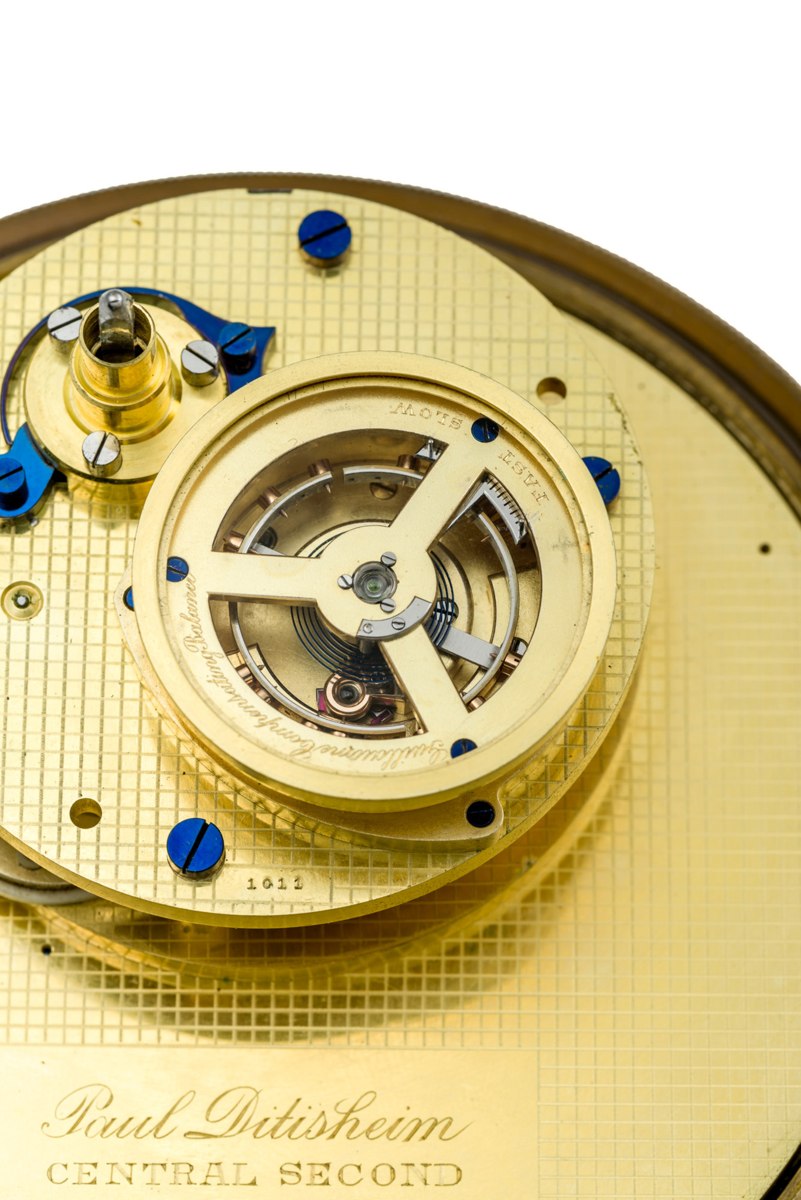
This Paul Ditisheim central-seconds marine chronometer is numbered 1 011 on both case and movement, and is dated by the auction house to circa 1920–1925. Built under seven Swiss patents, the 27-ligne movement features hatched gilded brass plates secured by blued steel screws. A raised glazed sub-assembly encloses the lever escapement, flat blued steel hairspring, and Guillaume compensating balance, complete with regulation indices. The source reports that the piece incorporates a mahogany and brass case, a 52-hour power reserve indicator, and dead-seconds electrical contacts, with indirect hand adjustment operated through a milled wheel on the bowl.

Top plate view of Paul Ditisheim central-second marine chronometer movement no. 1 011 showing the hatched gilded finish and glazed Guillaume balance assembly.
Top plate view of Paul Ditisheim central-second marine chronometer movement no. 1 011 showing the hatched gilded finish and glazed Guillaume balance assembly. — Antiquorum. Rights pending — permission not yet requested. Original source

Catalogue identity

Source
catalog.antiquorum.swiss
Category
Marine chronometer · Central second marine chronometer
Maker / attribution
Paul Ditisheim
Reference
Not recorded
Catalogue / lot identifier
356
Source-reported date
Circa 1920-1925
Country
Switzerland
Source-reported serial
1 011

Source-reported attribution and specifications are not independent authentication. A listing does not establish present ownership, current display, availability or permission to reproduce.

Object description

Identity and Stamped Markings

Identified as a Paul Ditisheim central second marine chronometer, this movement is recorded under case number 1 011 and movement number 1 011, dating approximately to circa 1920–1925 according to auction house cataloguing.

Direct observation of the movement plate shows the number '1 011' stamped into the gilded upper plate edge. The lower segment of the plate is engraved in script reading 'Paul Ditisheim' above 'CENTRAL SECOND'.

Evidence for this section
  • “Case N. 1 011, Movement N. 1 011”
  • “Movement number '1 011' stamped into the gilded upper plate edge.”
  • “Engraving on the lower plate segment reading 'Paul Ditisheim' in script above 'CENTRAL SECOND'.”

Plate Decoration and Glazed Sub-Assembly

The 27-ligne movement features circular gilded brass plates finished with a fine crosshatched grid pattern. According to the source description, the plates are secured by four pillars with blued steel screws to the top plate.

A raised circular glazed platform houses the balance and escapement assembly secured to the top plate. Engraved markings visible on this circular platform include 'Guillaume Compensating Balance' alongside 'SLOW' and 'FAST' regulation indices.

Evidence for this section
  • “Caliber 27''' with hatched circular gilded brass plates, secured with four pillars with blued steel screws to the top plate”
  • “Circular gilded brass plate finished with a fine crosshatched grid pattern.”
  • “Glazed circular platform housing the balance, engraved 'Guillaume Compensating Balance' alongside 'SLOW' and 'FAST' index markings.”

Reported Exterior and Unseen Features

According to cataloguer descriptions, the chronometer measures 18 x 18 x 20 cm and is housed in mahogany and brass, incorporating keyless winding, a 52-hour power reserve indicator sector at 12 o'clock, and dead-seconds electrical contacts. Indirect hand adjustment via a milled wheel on the outside of the bowl is also reported.

The source further describes the dial as engraved with Grand Prix insignia for Paris in 1900 and Berne in 1914, along with inscriptions noting service to the British Government and United States Navy. Because the primary available photo illustrates only the top plate of the movement, the exterior casing, dial face, gimbal mounting, and electrical contact hardware are not visually verified here.

Evidence for this section
  • “Dimensions 18x 18 x 20 cm.”
  • “Mahogany and brass, keyless-winding, marine Chronometer with 52-hour power reserve (sector at 12 o'clock) and dead seconds electrical contacts.”
  • “Main-plate dial engraved with Grand Prix insignia for Paris in 1900 and Berne in 1914 and the following mentions "Maker to the BritishGovernment, Holder of the Kew and TeddingtonRecords"”

Open research questions

  • What specific patent numbers are documented in the patent copies accompanying lot 356?
  • Does the physical dial and mahogany bowl assembly bear serial markings matching movement number 1 011?
  • What terminal layout and contact configuration are utilized for the reported dead-seconds electrical contacts?

Source evidence

Recorded claims and source quotations for Paul Ditisheim Central Second Marine Chronometer
FieldSource-reported valueSource quotation
Movement Number1 011“Movement N. 1 011”
Case Number1 011“Case N. 1 011”
Caliber Size27'''“Caliber 27''' with hatched circular gilded brass plates”
Balance TypeGuillaume balance“Guillaume balance, flat blued steel hairspring”
Power Reserve52 hours“marine Chronometer with 52-hour power reserve”
Dimensions18 x 18 x 20 cm“Dimensions 18x 18 x 20 cm.”
Reported Included AccessoriesCopies of the Swiss invention patents“Accessories Copies of the Swiss invention patents”
Pillar Count4 pillars“secured with four pillars with blued steel screws to the top plate”

Visible details

  • Circular gilded brass plate finished with a fine crosshatched grid pattern.
  • Glazed circular platform housing the balance, engraved 'Guillaume Compensating Balance' alongside 'SLOW' and 'FAST' index markings.
  • Engraving on the lower plate segment reading 'Paul Ditisheim' in script above 'CENTRAL SECOND'.
  • Movement number '1 011' stamped into the gilded upper plate edge.
  • Blued steel screws securing balance sub-assembly components and movement plate pillars.

Research qualifications

  • The wooden mahogany box, gimbal mount, and front dial face are described in the source text but not shown in this photograph.
  • Reported electrical contact operation and patent documentation cannot be verified from the image alone.

Photograph identity and source facts were screened before import; rights clearance remains pending.