
Skip to content
The Encyclopedia of Horology

Pocket watch · Keyless pocket chronometer

Patek, Philippe & Cie. Hunting Cased Keyless Pocket Chronometer No. 47372

Partially verified

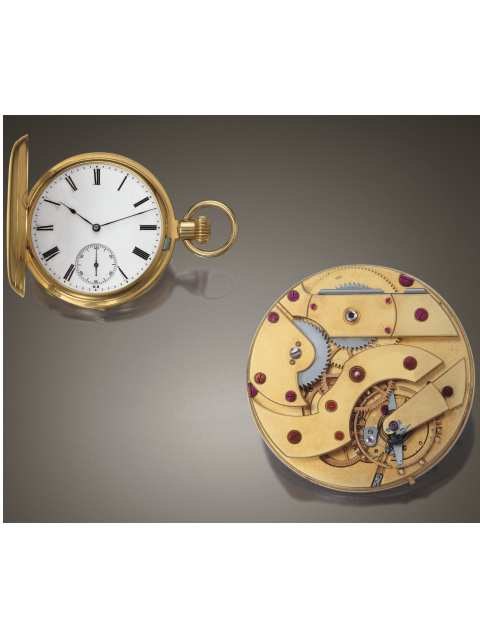
This Patek, Philippe & Cie. pocket chronometer, bearing serial number 47372, was manufactured in 1872. Produced for A. Barbero & Co. in Rome, the watch was sold to General Zinovief on September 27, 1873. The object features a four-body, 18K gold "bassine et filets" hunting case measuring 55 mm in diameter, complete with a hinged cuvette. The white enamel dial is marked with Roman numerals and an outer minute track, accompanied by blued steel spade hands. The movement is a 45.4 mm frosted gilt brass caliber utilizing a going barrel and a gold train. It is distinguished by an Earnshaw-type spring detent chronometer escapement, which includes a gold escape wheel and a specialized passing spring, paired with a cut bimetallic compensation balance and a freesprung blued steel spherical balance spring. This watch is identified as one of only two known Patek Philippe timepieces featuring this specific spherical spring configuration.

Front view of the hunting case and the frosted gilt movement.
Front view of the hunting case and the frosted gilt movement. — Antiquorum. Rights pending — permission not yet requested. Original source

Catalogue identity

Source
catalog.antiquorum.swiss
Category
Pocket watch · Keyless pocket chronometer
Maker / attribution
Patek, Philippe & Cie.
Reference
Not recorded
Catalogue / lot identifier
115
Source-reported date
1872
Source-reported place
Switzerland
Source-reported serial
47372

Source-reported attribution and specifications are not independent authentication. A listing does not establish present ownership, current display, availability or permission to reproduce.

Object description

Case and Dial

The watch is housed in a four-body, 18K gold hunting case styled as "bassine et filets." The exterior of the case is polished, and it features a hinged gold cuvette protecting the movement.

The white enamel dial presents a traditional layout with Roman numerals for the hours and an outer minute ring. The time is indicated by a set of blued steel spade-style hands. The overall condition of these components is listed as grade 3 by the auction house.

Evidence for this section
  • “C. Four-body, "bassine et filets", polished, gold, hinged cuvette.”
  • “D. White enamel, Roman numerals, outer minute ring. Blued steel "spade" hands.”

Movement and Escapement

The caliber measures 45.4 mm and is constructed from frosted gilt brass. It operates with a going barrel and a gold wheel train. A defining technical feature is the Earnshaw-type spring detent chronometer escapement, which incorporates a gold escape wheel and a specific passing spring that extends over the locking jewel.

Regulation is achieved through a cut bimetallic compensation balance, fitted with gold timing and compensation screws. The balance is controlled by a freesprung blued steel spherical balance spring. The source notes that this configuration is exceptionally rare, with only two such Patek Philippe watches currently known.

Evidence for this section
  • “Earnshaw type spring detent chronometer escapement with gold escape wheel and unusual gold passing spring coming from outside to inside over the locking jewel”
  • “cut bimetallic compensation balance with gold timing and compensation screws controlled by freesprung blued steel spherical balance spring”
  • “Spring detent watches by Patek Philippe are very rare, and only two are known with spherical balance springs.”

History and Documentation

Records indicate the watch was produced for A. Barbero & Co. of Rome and was subsequently sold to General Zinovief in September 1873. The timepiece is documented as being accompanied by its original 'Bulletin de Marche de l'Observatoire de Genève' and an official certificate.

The watch is referenced in horological literature, specifically within the publication "Patek Philippe wristwatches" by Martin Huber and Alan Banbery (1998 Edition). The auction house notes that the movement utilizes an ebauche that was strictly reserved for the highest grade of watches produced by the firm.

Evidence for this section
  • “sold to General Zinovief on September 27, 1873.”
  • “accompanied by a 'Bulletin de Marche de l'Observatoire de Genève' and a certificate.”
  • “A similar chronometer is published in "Patek Philippe wristwatches" by Martin Huber and Alan Banbery, 1998 Edition, pp. 170 and 172.”

Open research questions

  • What is the specific archival context of the 'Bulletin de Marche' for this serial number?
  • Are there further technical differences between this piece and the other known example of a Patek Philippe watch with a spherical balance spring?

Source evidence

Recorded claims and source quotations for Patek, Philippe & Cie. Hunting Cased Keyless Pocket Chronometer No. 47372
FieldSource-reported valueSource quotation
MakerPatek, Philippe & Cie.“Patek, Philippe & Cie., Genève”
Serial Number47372“No. 47372”
Date of manufacture1872“made in 1872”
Case material18K gold“18K gold, hunting cased”
Dial typeWhite enamel“White enamel, Roman numerals”
Movement diameter45.4 mm“45.4 mm, frosted gilt brass”
Escapement typeEarnshaw type spring detent“Earnshaw type spring detent chronometer escapement”
ProvenanceA. Barbero & Co., General Zinovief“made in 1872 for A. Barbero & Co., Rome, sold to General Zinovief on September 27, 1873”

Visible details

  • Frosted gilt brass plate movement
  • Earnshaw-type spring detent escapement
  • Spherical blued steel balance spring
  • Gold escape wheel with passing spring

Research qualifications

  • Condition grading is an internal auction assessment
  • Full operational state requires professional overhaul

Photograph identity and source facts were screened before import; rights clearance remains pending.