
Skip to content
The Encyclopedia of Horology

Marine chronometer · 2-day marine chronometer

Parkinson and Frodsham 2-day marine chronometer No. 1769

Partially verified

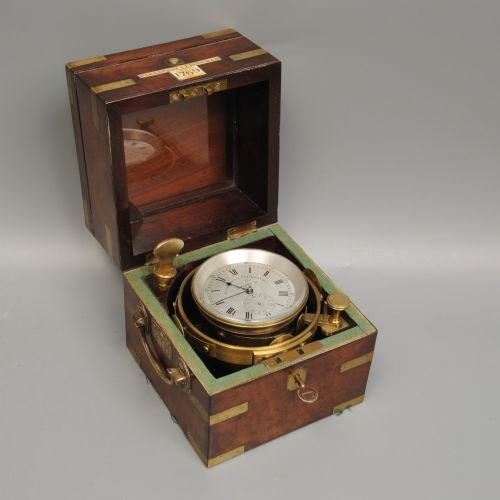
This early 19th-century two-day marine chronometer was made by Parkinson and Frodsham of London and is numbered 1769 on both its silvered dial and three-tier brass-bound mahogany box. The instrument features an 8 cm diameter dial and is gimbal-mounted within its transit case. According to the dealer description, the chain fusee movement includes cylindrical ring-turned pillars, an Earnshaw spring detent escapement, a bimetallic compensated balance with a diamond endpiece, a blued steel hairspring, and an internal sprung dust cover. The chronometer also retains its original tipsy winding key.

Elevated view of the Parkinson and Frodsham chronometer No. 1769 gimballed in its brass-bound mahogany box
Elevated view of the Parkinson and Frodsham chronometer No. 1769 gimballed in its brass-bound mahogany box — Hansord Antiques. Rights pending — permission not yet requested. Original source

Catalogue identity

Source
www.sellingantiques.co.uk
Category
Marine chronometer · 2-day marine chronometer
Maker / attribution
Parkinson and Frodsham
Reference
Not recorded
Catalogue / lot identifier
SA1132958
Source-reported date
circa 1820
Country
United Kingdom
Source-reported serial
1769

Source-reported attribution and specifications are not independent authentication. A listing does not establish present ownership, current display, availability or permission to reproduce.

Object description

Casing and Mounting

The instrument is housed within a three-tier mahogany box reinforced with brass corner brackets. Visible exterior fittings include side brass drop handles and a front keyhole shown with a key inserted. Inside, the box is lined with green felt and encloses a brass gimbal assembly supporting the chronometer bowl.

Numbered identification is present on the housing: a rectangular plaque inscribed with the number 1769 is mounted along the upper rim of the box's middle tier, matching the serial number stated to be on both the box and the dial.

Evidence for this section
  • “Numbered on the brass bound mahogany 3 tier box, and the dial 1769.”
  • “Chronometer bowl is mounted on brass gimbals within a green felt-lined three-tier wooden box.”
  • “The box features brass corner brackets, a front keyhole with a key inserted, and brass drop handles on the sides.”
  • “A rectangular plaque inscribed with number 1769 is mounted along the upper rim of the mid-tier of the box.”

Dial Presentation

The chronometer features a silvered dial measuring 8 cm in diameter. Visible dial details include Roman numeral hour markers, blued steel hands, and a subsidiary seconds dial.

The dealer listing describes the silvered dial as signed by Parkinson and Frodsham, London, and records the serial number 1769 directly on the dial face.

Evidence for this section
  • “Dial is 8cm diameter”
  • “The silvered dial displays Roman numerals, blued steel hands, and a subsidiary seconds dial.”
  • “Beautifully signed on the movement and the silvered dial, and with a sprung dust cover.”
  • “Numbered on the brass bound mahogany 3 tier box, and the dial 1769.”

Reported Movement and Accessories

The movement is stated by the dealer to have a 2-day running duration and to be signed by Parkinson and Frodsham, London. Described internal components include a chain fusee, cylindrical ring-turned pillars, an Earnshaw spring detent escapement, a bimetallic compensated balance with a diamond endpiece, a blued steel hairspring, and an internal sprung dust cover. Because the movement remains unexposed in the provided open-box photograph, these technical details rely entirely on the dealer's description.

The listing also notes that the chronometer retains an original tipsy winding key. Hansord Antiques dates the instrument to the 19th century, specifically circa 1820.

Evidence for this section
  • “An early 19th century 2 day marine chronometer by Parkinson and Frodsham, London.”
  • “The signed chain fusee movement has cylindrical ring-turned pillars and bi-metallic compensated balance with diamond endpiece, blued steel hairspring, Earnshaw spring detent escapement and an internal springed dust cover.”
  • “The chronometer retains its charming original tipsey winding key.”
  • “Circa 1820”
  • “Hansord Antiques has dated this piece to the 19th Century.”

Open research questions

  • What specific text and layout are engraved on the movement backplate beneath the dust cover?
  • Can surviving Parkinson & Frodsham production records corroborate the circa 1820 dating for serial number 1769?
  • What markings or physical characteristics substantiate the dealer's attribution of the tipsy key as original to this instrument?

Source evidence

Recorded claims and source quotations for Parkinson and Frodsham 2-day marine chronometer No. 1769
FieldSource-reported valueSource quotation
Movement Duration2 day“An early 19th century 2 day marine chronometer by Parkinson and Frodsham, London.”
Serial Number1769“Numbered on the brass bound mahogany 3 tier box, and the dial 1769.”
Dial Diameter8 cm“Dial is 8cm diameter”
EscapementEarnshaw spring detent“Earnshaw spring detent escapement”
DimensionsHeight 17cm, Width 15cm, Depth 15cm“Height 17cm (6.69") Width 15cm (5.91") Depth 15cm (5.91")”
Maker LocationLondon“An early 19th century 2 day marine chronometer by Parkinson and Frodsham, London.”
Dealer Internal SKUSKU00001371“Dealers Internal Ref SKU00001371”
Box DimensionsHeight 17cm, Width 15cm, Depth 15cm“Height 17cm (6.69") Width 15cm (5.91") Depth 15cm (5.91")”

Visible details

  • Chronometer bowl is mounted on brass gimbals within a green felt-lined three-tier wooden box.
  • The box features brass corner brackets, a front keyhole with a key inserted, and brass drop handles on the sides.
  • A rectangular plaque inscribed with number 1769 is mounted along the upper rim of the mid-tier of the box.
  • The silvered dial displays Roman numerals, blued steel hands, and a subsidiary seconds dial.

Research qualifications

  • Internal movement features including the chain fusee, Earnshaw detent escapement, and balance are not visible in the open-box photograph and rely entirely on the dealer's report.
  • The dealer declares the period as 19th century and specifically dates it to circa 1820.

Photograph identity and source facts were screened before import; rights clearance remains pending.

Terms in this record

Glossary explanations for terms named in this object’s record.