
Skip to content
The Encyclopedia of Horology

Tool · Arabic-inscribed astrolabe, North Africa

North African Astrolabe

Partially verified

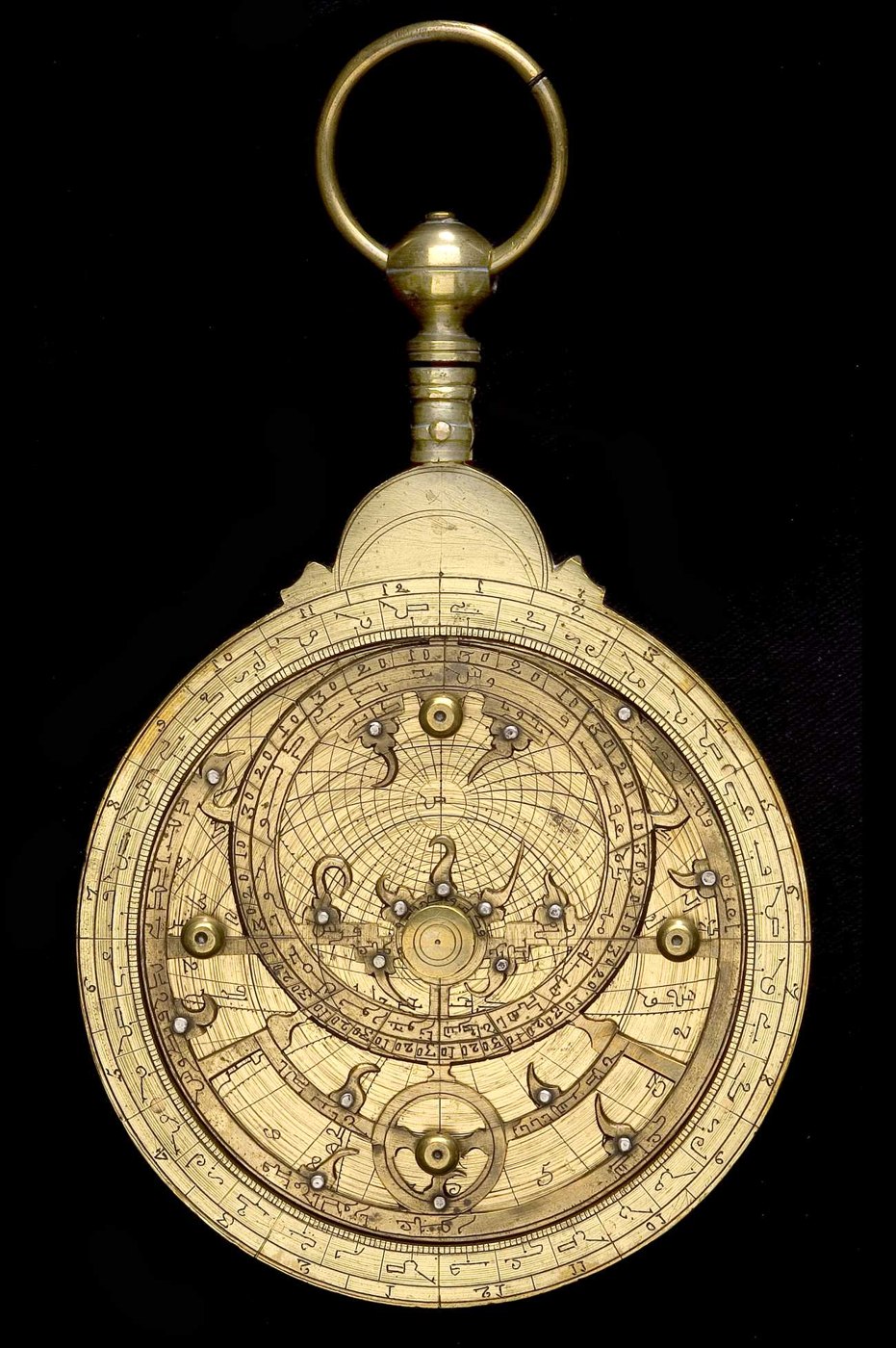
This brass astrolabe is dated to the late 19th century and attributed to North African origin. It features a simple throne with an integrated base, a round-section ring, and a rotating pin-type shackle. Notably, the base of each star pointer is embellished with a silver stud, and the underside of the rete bears the stamped word 'PATENT', suggesting it was cut from previously repurposed European brass. The instrument includes three plates with latitudes from 21° to 35°, a double-ended alidade with decorative scroll-work, and a nut and bolt assembly. It was presented to the History of Science Museum by Lewis Evans in 1924.

Front view of the North African brass astrolabe showing the rete, star pointers with silver studs, and the central pivot.
Front view of the North African brass astrolabe showing the rete, star pointers with silver studs, and the central pivot. — History of Science Museum, University of Oxford. Rights pending — permission not yet requested. Original source

Catalogue identity

Source
www.mhs.ox.ac.uk
Category
Tool · Arabic-inscribed astrolabe, North Africa
Maker / attribution
Not established
Reference
Not recorded
Catalogue / lot identifier
1924-0/2018
Source-reported date
late 19th century
Source-reported place
North Africa
Source-reported serial
47714

Source-reported attribution and specifications are not independent authentication. A listing does not establish present ownership, current display, availability or permission to reproduce.

Object description

Construction and Design

The instrument is constructed primarily of brass and features a simple throne design characterized by a large single lobe flanked by two scrolls. The mater and limb are produced via a two-piece soldered and riveted process. The limb includes scales for equal hours and degrees of arc, while the womb exhibits circular decorative scratching.

The rete displays an indicator-line style and is equipped with four rotational knobs. Each of the 19 star pointers is fitted with a silver stud, which the documentation notes were applied after the engraving of the star names, as the studs partially obscure some lettering. The back of the instrument supports six distinct scales, including altitude, zodiacal signs, calendar, unequal hours, and a shadow square.

Evidence for this section
  • “The throne is of the simple type made of brass attached with integrated base made of brass and has a simple, round cross-section ring”
  • “The mater and limb are of two pieces, soldered and riveted construction.”
  • “The base of each star pointer is embellished with a silver stud. These studs cover over some of the letters, indicating that they were added to the rete after the words had been engraved.”

Inscriptions and Repurposed Material

The engraving on the rete employs a monumental Kufic script for the star and zodiacal names. Uniquely, the maker incorporated modern European numerals for the ecliptic markings. The rete itself bears the stamped word 'PATENT' on its reverse side.

The presence of this stamp is interpreted as evidence that the brass plate used for the rete was recycled from an earlier, unrelated object of European manufacture.

Evidence for this section
  • “The words are written in the clear, monumental Kufic script.”
  • “Above the names of the zodiacal signs, engraved along the ecliptic, the maker chose to use modern European numerals rather than Arabic numbers.”
  • “On the back of the rete, near the bottom, are stamped the letters 'PATENT' in a curve.”

Provenance and Acquisition

The astrolabe was part of the collection of Lewis Evans, who acquired the piece from the London dealer Percy Webster in 1916. Following his collecting activities, Evans presented the instrument to the History of Science Museum at the University of Oxford in 1924.

The object is catalogued under inventory number 47714 and carries the museum accession number 1924-0/2018. It has been documented as part of the museum's broader catalogue of western Islamic instruments.

Evidence for this section
  • “Evans bought it from Percy Webster, his main London dealer, in 1916.”
  • “Presented by Lewis Evans in 1924”
  • “Accession 1924-0/2018”

Open research questions

  • What specific type of European object provided the brass for the rete stamped 'PATENT'?
  • Do the silver studs added to the star pointers serve a functional purpose beyond decorative embellishment?

Source evidence

Recorded claims and source quotations for North African Astrolabe
FieldSource-reported valueSource quotation
Inventory Number47714“Inventory no. 47714”
Datelate 19th century“Date late 19th century”
PlaceNorth Africa“Place North Africa”
MaterialBrass“Material Brass”
Star count19“There are 19 stars on the rete marked with dagger pointers.”
Accession1924-0/2018“Accession 1924-0/2018”
ProvenanceAcquired from Percy Webster in 1916“Evans bought it from Percy Webster, his main London dealer, in 1916.”

Visible details

  • Silver studs are present at the base of each star pointer on the rete.
  • The rete features four rotational knobs.
  • The word 'PATENT' is stamped on the back of the rete.
  • The alidade is double-ended with scroll-work near the pivot.

Research qualifications

  • The 'PATENT' mark is suggested to indicate reused material, though the specific original application is unknown.
  • The exact workshop or specific locale of manufacture within North Africa is not identified.

Photograph identity and source facts were screened before import; rights clearance remains pending.

Consulted source

Astrolabe, inventory 47714 (North Africa, late 19th century)

Reviewed 2026-10-26 · Record dc58b83150

Terms in this record

Glossary explanations for terms named in this object’s record.