
Skip to content
The Encyclopedia of Horology

Tool · Arabic-inscribed astrolabe, North Africa

Astrolabe by 'Abdullah ibn Sāsī

Partially verified

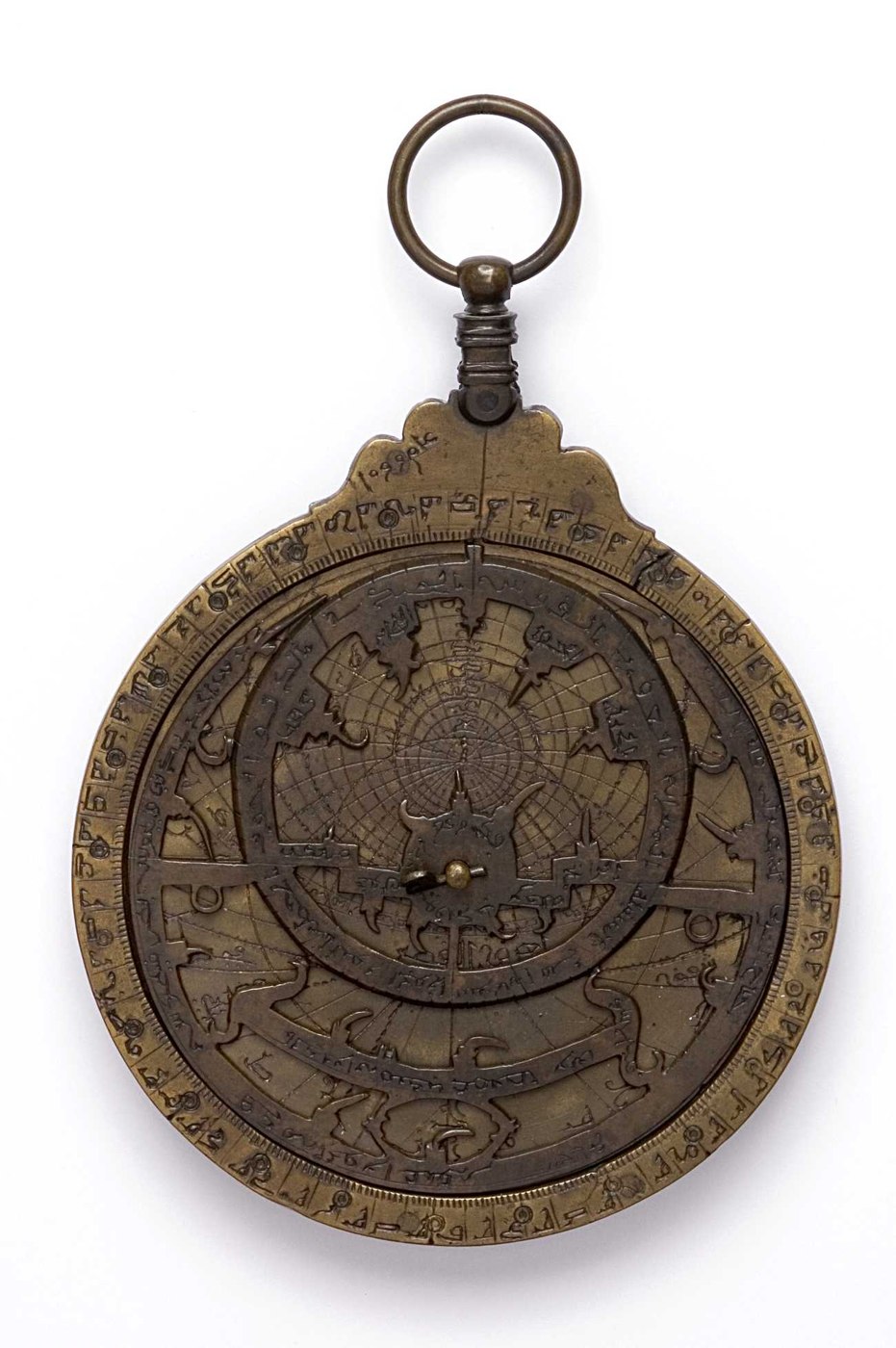
This planispheric astrolabe, crafted from brass in Morocco during 1687/8 (A.H. 1099), is signed by the maker 'Abdullah ibn Sāsī. The instrument features a simple, engraved throne with an integrated base, supporting an eye-bolt type shackle and a round cross-section ring. The rete is of the maghribi type with two knobs, though these are currently missing; it incorporates 25 star pointers in the shape of daggers and features a zodiac labeled in Arabic. The construction includes two plates covering latitudes from 32° to 35°. The alidade is double-ended and rigid, featuring decorative elements. The object is held in the History of Science Museum, Oxford, having been presented by Lewis Evans in 1924, who acquired it via the dealer Percy Webster. The instrument utilizes a pin and wedge mechanism for assembly.

Frontal view of the astrolabe showing the rete, throne, and ring.
Frontal view of the astrolabe showing the rete, throne, and ring. — History of Science Museum, University of Oxford. Rights pending — permission not yet requested. Original source

Catalogue identity

Source
www.mhs.ox.ac.uk
Category
Tool · Arabic-inscribed astrolabe, North Africa
Maker / attribution
'Abdullah ibn Sāsī
Reference
Not recorded
Catalogue / lot identifier
45220
Source-reported date
1687/8 (A.H. 1099)
Source-reported place
Morocco

Source-reported attribution and specifications are not independent authentication. A listing does not establish present ownership, current display, availability or permission to reproduce.

Object description

Construction and Design

The astrolabe is constructed primarily of brass and exhibits a traditional planispheric design consistent with the period of manufacture. The throne is of a simple engraved type, secured with an integrated base, and serves as the mounting point for an eye-bolt type shackle and a simple, circular ring. The rete displays a maghribi style with two distinct knob positions, which are absent in the current state of the instrument.

The rete features a zodiac scale and identifies 25 stars using dagger-shaped pointers. The assembly of the central components is maintained via a pin and wedge mechanism. The device includes two internal plates designed for specific latitudes ranging between 32°0' and 35°0'.

Evidence for this section
  • “The throne is of the simple, engraved type made of brass attached with integrated base”
  • “The rete is of the maghribi (two knobs) type. The two knobs are now missing.”
  • “The rete is attached using a pin & wedge.”

Signatures and Inscriptions

The instrument includes specific epigraphic details that identify both the period and the artisan. The front of the throne bears the date 1099 (A.H.), corresponding to 1687/8. The back of the throne incorporates the signature of the maker, 'Abdullah ibn Sāsī.

The rete is inscribed with the names of the zodiac signs in Arabic, corresponding to the twelve signs of the ecliptic. Each star pointer is marked in relation to the rete's geometric arrangement, facilitating astronomical observations according to the instrument's designated latitudes.

Evidence for this section
  • “The back of the throne bears the maker's inscription. The front of the throne bears the date 1099.”
  • “Maker ‘Abdullah ibn Sāsī”
  • “The zodiac on the rete is labelled: الحمل , الثور , الجوزا , السرطان , الاسد , السنبله , الميزان , العقرب , القوس , الجدي , الدلو , الحوت.”

Provenance and History

The astrolabe was incorporated into the History of Science Museum collection in Oxford following a gift from Lewis Evans in 1924. Its recorded history traces back to the early 20th century through the London antique trade.

Evans obtained the piece from Percy Webster in 1918. Records indicate that Webster had previously secured the object through a Paris-based dealer named Gélis. The item is cataloged under the inventory number 45220 and is associated with the accession number 1924-0/2020.

Evidence for this section
  • “Presented by Lewis Evans in 1924”
  • “Evans bought it from Percy Webster, his main London dealer, in 1918. Webster had bought it through the Paris dealer Gélis.”
  • “Accession 1924-0/2020”

Open research questions

  • What is the specific geographical focus of the latitudes 32°0' to 35°0' represented on the plates?
  • Are there extant examples of 'Abdullah ibn Sāsī's work in other collections for comparison?

Source evidence

Recorded claims and source quotations for Astrolabe by 'Abdullah ibn Sāsī
FieldSource-reported valueSource quotation
Maker'Abdullah ibn Sāsī“Maker ‘Abdullah ibn Sāsī”
Date1687/8 (A.H. 1099)“Date 1687/8 (A.H. 1099)”
Place of manufactureMorocco“Place Morocco”
MaterialBrass“Material Brass”
Inventory Number45220“Inventory no. 45220”
Star count25“There are 25 stars on the rete”
ProvenancePresented by Lewis Evans in 1924“Presented by Lewis Evans in 1924”
DealerPercy Webster“Evans bought it from Percy Webster, his main London dealer”

Visible details

  • The rete features star indicators shaped as daggers.
  • The throne bears an inscription and the date 1099.
  • The instrument includes a double-ended, decorative alidade.
  • The rete is designed with a Maghribi two-knob configuration, now missing the knobs.

Research qualifications

  • The two knobs of the rete are noted as missing.
  • The exact provenance prior to its acquisition by dealer Gélis remains undocumented in the source.

Photograph identity and source facts were screened before import; rights clearance remains pending.

Consulted source

Astrolabe, inventory 45220 (Morocco, 1687/8 (A.H. 1099))

Reviewed 2026-10-26 · Record c5a00f6802

Terms in this record

Glossary explanations for terms named in this object’s record.