
Skip to content
The Encyclopedia of Horology

Tool · Arabic-inscribed astrolabe, North Africa

Astrolabe, inventory 41122

Partially verified

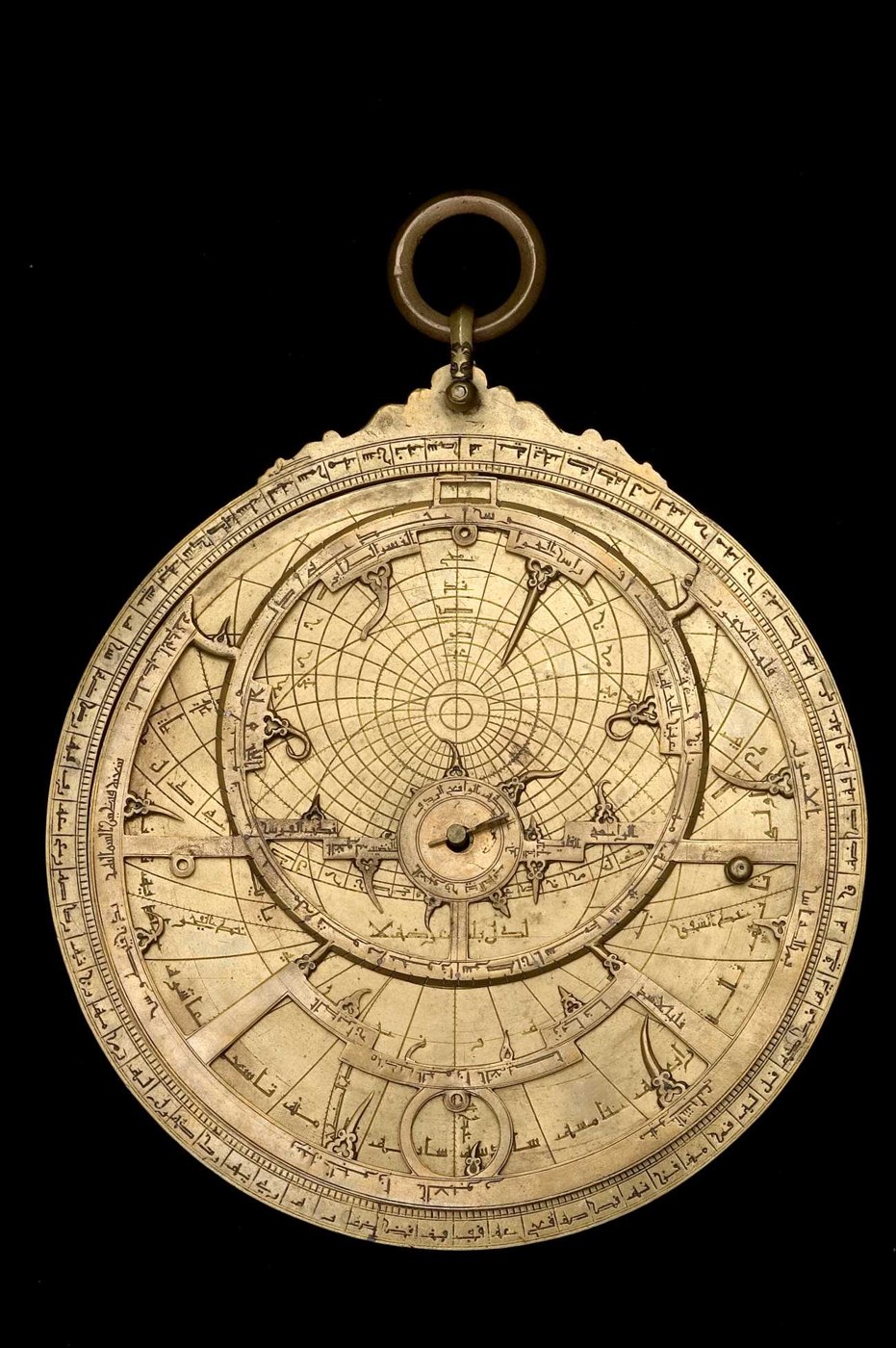
This 13th-century brass astrolabe (inventory 41122) is catalogued as originating from North Africa. The instrument features a five-lobed throne, an omega-type shackle with animal-head carving, and a simple ring with a square cross-section. The mater and limb are constructed from two riveted pieces, with a notch on the throne for tympan alignment. The back incorporates a universal projection based on the system developed by Ibn az-Zarqāllu, featuring sets of equatorial and ecliptic coordinates, though the declination scale is omitted. The instrument includes four plates for latitudes 31°0' to 47°0'. The object was bequeathed to the History of Science Museum by T. G. Barnett in 1935, having been acquired by him around 1925 from 'Ali Hikmet of Kirkuk.

Full front view of the astrolabe showing the rete, throne, and limb scales.
Full front view of the astrolabe showing the rete, throne, and limb scales. — History of Science Museum, University of Oxford. Rights pending — permission not yet requested. Original source

Catalogue identity

Source
www.mhs.ox.ac.uk
Category
Tool · Arabic-inscribed astrolabe, North Africa
Maker / attribution
Not established
Reference
Not recorded
Catalogue / lot identifier
41122
Source-reported date
13th century
Source-reported place
North Africa
Source-reported serial
41122

Source-reported attribution and specifications are not independent authentication. A listing does not establish present ownership, current display, availability or permission to reproduce.

Object description

Construction and Design

The astrolabe is manufactured from brass and follows a construction utilizing a five-lobed throne and an integrated base. The mater and limb are assembled from two riveted pieces, and the throne includes a notch to accept tympan tabs, which prevents rotation during use. The ring displays a simple, squared cross-section, and the shackle is of the omega type, with tabs shaped to resemble the heads of animals.

The instrument includes four distinct plates, each calibrated for latitudes ranging from 31°0' to 47°0'.

Evidence for this section
  • “The throne is of the five-lobed type made of brass attached with integrated base made of brass”
  • “There are 4 plates with latitudes ranging from 31°0' to 47°0'”
  • “The rete is attached using a pin & horse. Probably a replacement.”

Universal Projection and Astronomical Features

The rear of the instrument features an az-Zarqellu universal projection, which integrates both equatorial and ecliptic coordinate systems. The ecliptic is inclined downward to the right and bears the names of zodiacal signs in Kufic script. While the instrument includes a complete set of equatorial coordinates, it provides only an abbreviated set of ecliptic coordinates and omits a declination scale.

The rete is engraved with 29 stars, 28 of which are named. These are indicated by dagger-style pointers. The womb, located on the back of the device, contains six scales, including declination, zodiacal signs, a calendar, lunar mansions, and a shadow square. A scale on the limb contains 91 approximately equal divisions marked with characters, the specific function of which remains unverified.

Evidence for this section
  • “The back of this astrolabe bears an az-Zarqellu projection.”
  • “On this particular astrolabe, only an abbreviated set of ecliptic coordinates have been included.”
  • “The edge of the limb is divided into 91 approximately equal divisions, each marked with some characters.”

Provenance and History

The instrument was acquired by the History of Science Museum in 1935 as part of a bequest from T. G. Barnett, a jeweller and goldsmith based in Birmingham. The collection donated by Barnett was primarily composed of time-telling devices including watches, clocks, and sundials, with this astrolabe being the sole example in the assemblage.

Prior to its acquisition by Barnett around 1925, the astrolabe belonged to 'Ali Hikmet of Kirkuk, Iraq.

Evidence for this section
  • “It had previously belonged to ‘Ali Hikmet, of Kirkuk, Iraq, who had taught astronomy with its aid until his death in 1924.”

Open research questions

  • What is the specific utility of the 91-division inscription on the limb of the instrument?
  • Are there any physical traces or comparative studies that might confirm the date of the replacement pin and horse assembly?

Source evidence

Recorded claims and source quotations for Astrolabe, inventory 41122
FieldSource-reported valueSource quotation
Inventory number41122“Inventory no. 41122”
Date13th century“Date 13th century”
Place of originNorth Africa“Place North Africa”
MaterialBrass“Material Brass”
Number of plates4“There are 4 plates”
Rete star count29“The rete contains 29 stars.”
ProvenanceBequeathed by T. G. Barnett“Bequeathed by T. G. Barnett in 1935”
Universal projection sourceIbn az-Zarqāllu“The back of this instrument bears a universal projection based on that developed by Ibn az-Zarqāllu.”

Visible details

  • Five-lobed throne with simple, undecorated design.
  • Rete features dagger-style star pointers.
  • Omega-shaped shackle with carved animal-head terminals.
  • Rete attached with a pin and horse assembly.

Research qualifications

  • The rule and the pin and horse assembly are considered to be likely replacements.
  • The use of the scale or inscriptions along the edge of the limb is not immediately clear.

Photograph identity and source facts were screened before import; rights clearance remains pending.

Consulted source

Astrolabe, inventory 41122 (North Africa, 13th century)

Reviewed 2026-10-26 · Record 28ee715f9c

Terms in this record

Glossary explanations for terms named in this object’s record.