
Skip to content
The Encyclopedia of Horology

Tool · Scientific instrument

Muhammad ibn Ahmad al-Battuti Brass Astrolabe

Partially verified

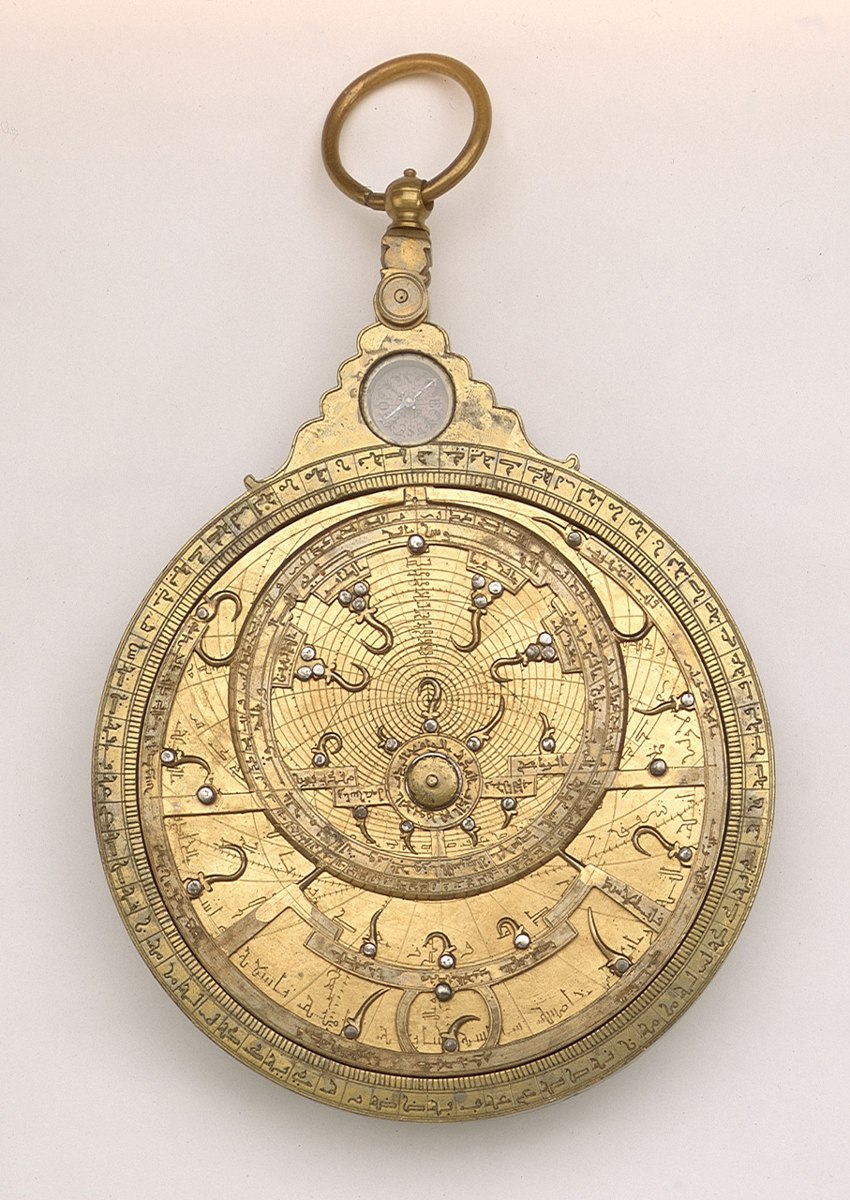
This brass astrolabe is recorded as made by Muhammad ibn Ahmad al-Battuti, dated to 1151 AH (1738–1739 CE). The source notes al-Battuti and Hasan ibn Ahmad as key representatives of the astrolabe-making tradition in the Islamic West. The instrument incorporates a throne design with compass influenced by Safavid Iranian models. A magnetic compass of French fabrication is set into the front of the throne. Supported by a vertical pivot with a hollow sphere and suspension ring, the instrument contains eight plates and a rete with 25 star pointers. The mater interior contains an engraved chronological table with Julian and Hijra perpetual calendars.

Front view of the assembled brass astrolabe showing the suspension ring, throne compass, engraved rim, and rete with silver pointers
Front view of the assembled brass astrolabe showing the suspension ring, throne compass, engraved rim, and rete with silver pointers — National Maritime Museum, Greenwich, London, Caird Collection. Rights pending — permission not yet requested. Original source

Catalogue identity

Source
www.rmg.co.uk
Category
Tool · Scientific instrument
Maker / attribution
Muhammad ibn Ahmad al-Battuti
Reference
AST0532
Catalogue / lot identifier
Source URL identifies the listing
Source-reported date
1738-1739
Country
Not established

Source-reported attribution and specifications are not independent authentication. A listing does not establish present ownership, current display, availability or permission to reproduce.

Object description

Attribution and Chronology

The instrument is identified by an Arabic inscription on the reverse of the throne naming Muhammad ibn Ahmad al-Battuti as the maker. The inscription provides a date of 1151 AH (1738–1739 CE).

Al-Battuti and Hasan ibn Ahmad (presumed to be his brother) are described as the final representatives of the astrolabe-making tradition in the Islamic West.

Evidence for this section
  • “On the throne's reverse is the Arabic inscription: 'Praise to God! Made by Muhammad ibn Ahmad al-Battuti - God is his friend and saviour - in the year 1151 of the Hijra of the Prophet'”
  • “The prolific Muhammad ibn Ahmad al-Battuti, together with Hasan ibn Ahmad (presumed to be his brother), were the last serious representatives of the distinguished tradition of astrolabe-making in the Islamic West.”
  • “Date made: 1738-1739”

Physical Configuration

The astrolabe is composed of brass, silver, and glass, with an overall diameter of 160 mm. It features a vertical pivot with a hollow sphere and a large suspension ring to allow rotation.

The instrument contains eight plates, six of which are engraved for latitudes between Mecca and the northern polar circle. The mater contains an engraved chronological table with perpetual calendars for the Julian and Hijra eras.

Evidence for this section
  • “Materials: Silver ; Glass Brass”
  • “Diameter: 160 mm”
  • “A vertical pivot with hollow sphere supports a large suspension ring”
  • “There are eight plates, six being engraved for a range of latitudes between Mecca and the northern polar circle.”
  • “In the mater, an elaborate chronological table is engraved, with perpetual calendars for the Julian and Hijra eras.”

Design and Components

The triangular throne features a magnetic compass of French fabrication on its front, which the source suggests is an appropriation of Safavid Iranian throne design. The brass rete features 25 star pointers.

The reverse of the instrument includes two altitude scales and eight concentric circular bands containing zodiacal and calendrical scales.

Evidence for this section
  • “The plain, triangular throne has a magnetic compass of French fabrication on the front.”
  • “one can nevertheless discern elements which are clearly appropriations from Safavid Iran, such as the throne design with compass.”
  • “The rete bears 25 star pointers.”
  • “On the back of the instrument are two altitude scales and eight concentric circular bands comprising zodiacal and calendrical scales.”

Open research questions

  • What is the content of the remaining two plates not described by the specific latitude range?
  • What specific indicators distinguish the compass as French in fabrication?

Source evidence

Recorded claims and source quotations for Muhammad ibn Ahmad al-Battuti Brass Astrolabe
FieldSource-reported valueSource quotation
MakerMuhammad ibn Ahmad al-Battuti“Made by Muhammad ibn Ahmad al-Battuti”
Object IDAST0532“ID: AST0532”
Date made1738-1739“Date made: 1738-1739”
Hijra Date1151 AH“in the year 1151 of the Hijra of the Prophet”
MaterialsSilver, Glass, Brass“Materials: Silver ; Glass Brass”
Star pointers25“The rete bears 25 star pointers.”
Plate countEight plates“There are eight plates, six being engraved for a range of latitudes between Mecca and the northern polar circle.”
Object IDAST0532“ID: AST0532”
Measurements32 x 260 x 160 mm“Overall: 32 x 260 x 160 mm”

Visible details

  • Integrated circular compass set into the upper throne below the pivot
  • Openwork brass rete adorned with circular silver-studded star pointers
  • Large rounded suspension ring attached to a vertical swivel mount
  • Engraved scale markings and Arabic calligraphy along the outer rim and plate faces

Research qualifications

  • Specific country of manufacture is not explicitly designated beyond general Islamic West attribution
  • The back of the astrolabe showing the two altitude scales and calendar bands is not depicted in Photo 0

Photograph identity and source facts were screened before import; rights clearance remains pending.

Consulted source

Astrolabe | Royal Museums Greenwich

Reviewed 2026-10-25 · Record f840044236

Terms in this record

Glossary explanations for terms named in this object’s record.