
Skip to content
The Encyclopedia of Horology

Tool · Scientific instrument

Persian Brass Astrolabe by Najm al-Din Muhammad

Partially verified

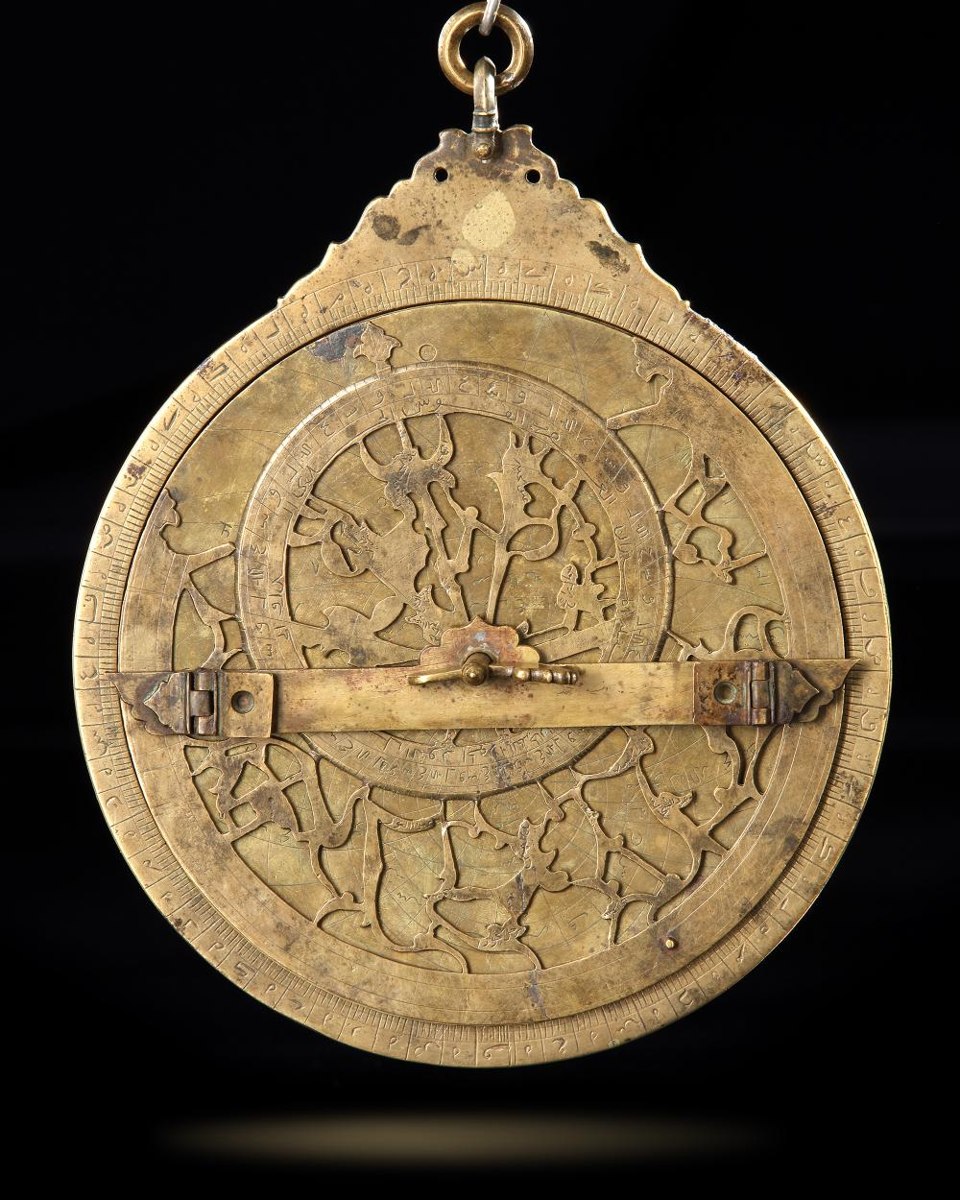
This brass astrolabe is catalogued as a 16th-century Persian instrument attributed to maker Najm al-Dīn Muḥammad Munajjim Ibn Imām ‘Alī ibn Bayazid ibn Sayyid Hasan ‘Ajam Seyyid Muhammad al-‘Abbāsī. The auction house reports a total length of 24.5 cm and a diameter of 18.8 cm. According to the description, the mater is engraved with a gazetteer composed of two sets of five concentric circle bands detailing localities, coordinates, hours of daylight, and direction to Mecca. Degree scales calibrated in 1-degree and 5-degree increments run along the rim with abjad numerals.

Front face of the brass astrolabe showing the suspension throne, rete, and horizontal rule
Front face of the brass astrolabe showing the suspension throne, rete, and horizontal rule — Oriental Art Auctions. Rights pending — permission not yet requested. Original source

Catalogue identity

Source
www.invaluable.com
Category
Tool · Scientific instrument
Maker / attribution
Najm al-Dīn Muḥammad Munajjim Ibn Imām ‘Alī ibn Bayazid ibn Sayyid Hasan ‘Ajam Seyyid Muhammad al-‘Abbāsī
Reference
Not recorded
Catalogue / lot identifier
214
Source-reported date
16th century
Country
Iran

Source-reported attribution and specifications are not independent authentication. A listing does not establish present ownership, current display, availability or permission to reproduce.

Object description

Physical Description

The instrument is a brass astrolabe featuring a cast mater, suspension throne, and a ring for suspension. It includes an openwork rete with star pointers and a zodiac ring, positioned over an engraved plate, with a horizontal rule secured by a central pin.

The raised outer rim of the mater contains dual degree scales inscribed with abjad characters.

Evidence for this section
  • “Cast brass mater with suspension throne, ring, and scalloped edges.”
  • “Openwork rete with star pointers and zodiac ring set over the engraved plate.”
  • “Straight horizontal bar secured with central pin across the diameter.”
  • “Dual degree scales inscribed on the raised outer rim featuring abjad characters.”

Gazetteer Details

The face of the mater is engraved with a gazetteer organized into two sets of five concentric circle bands. The layout provides for categories including Buldān (locality), Tūl (longitude), ‘Arḍ (latitude), Saat (maximum hours of daylight), and Inhiraf (direction to Mecca).

The segments dedicated to 'hours' and 'inhiraf' are recorded as empty in both sets of circles.

Evidence for this section
  • “The mater in engraved with a gazetteer. The gazetteer consists of two sets of 5 concentric circle bands.”
  • “The first row of the first circle band on top left to the center line reads: Buldān (Locality), Tūl ( Longitude), ‘Arḍ (Latitude), Saat ( Maximum Hours of Daylight for that Locality) and the Inhiraf ( The direction to Mekka,).”
  • “Interestingly the bands dedicated to “hours” and “inhiraf” are empty. This is also the case for the second set of concentric circles.”

Scale and Notation

The rim features dual degree scales running from 0° to 360° in increments of 1 and 5 degrees. The values are expressed using abjad numerals.

Only 100-degree increments are fully written in abjad. The 10-degree increments repeat from 0° to 90°, and for 5-degree increments, only the abjad letter 'ha' is used as a shorthand label.

Evidence for this section
  • “Along the rim there are two degree scale which run from 0° until 360° in increments of 1 and in 5 degrees.”
  • “Along the rim, only the values of the 100° increments are written in full abjad numerals.”
  • “Probably to save space, the ten degree increments run recurrently from [ 0° until 90°].”
  • “For the 5 degree increments only the abjad value “5” is used, thus 5, 85, 215 are all labeled as the abjad letter “ha”.”

Open research questions

  • What is the historical significance of the blank 'hours' and 'inhiraf' segments in this specific gazetteer layout?
  • How does the use of the abjad letter 'ha' for all 5-degree increments correlate with other known 16th-century Persian instruments?

Source evidence

Recorded claims and source quotations for Persian Brass Astrolabe by Najm al-Din Muhammad
FieldSource-reported valueSource quotation
MakerNajm al-Dīn Muḥammad Munajjim Ibn Imām ‘Alī ibn Bayazid ibn Sayyid Hasan ‘Ajam Seyyid Muhammad al-‘Abbāsī“Persian astrolabe made by Najm al-Dīn Muḥammad Munajjim Ibn Imām ‘Alī ibn Bayazid ibn Sayyid Hasan ‘Ajam Seyyid Muhammad al-‘Abbāsī.”
MaterialBrass“Brass, 16th century”
Date16th century“Brass, 16th century”
Length24.5 cm“Length: 24.5 cm.”
Diameter18.8 cm“Diameter: 18.8 cm.”
Attributed MakerNajm al-Dīn Muḥammad Munajjim Ibn Imām ‘Alī ibn Bayazid ibn Sayyid Hasan ‘Ajam Seyyid Muhammad al-‘Abbāsī“Persian astrolabe made by Najm al-Dīn Muḥammad Munajjim Ibn Imām ‘Alī ibn Bayazid ibn Sayyid Hasan ‘Ajam Seyyid Muhammad al-‘Abbāsī.”
DimensionsLength 24.5 cm, Diameter 18.8 cm“Length: 24.5 cm. Diameter: 18.8 cm.”

Visible details

  • Cast brass mater with suspension throne, ring, and scalloped edges.
  • Openwork rete with star pointers and zodiac ring set over the engraved plate.
  • Straight horizontal bar secured with central pin across the diameter.
  • Dual degree scales inscribed on the raised outer rim featuring abjad characters.

Research qualifications

  • Maker attribution and 16th-century date are stated by the auction catalogue and cannot be verified from the photograph alone.
  • The reverse of the mater and underlying plates are not shown in the single image.

Photograph identity and source facts were screened before import; rights clearance remains pending.

Terms in this record

Glossary explanations for terms named in this object’s record.