
Skip to content
The Encyclopedia of Horology

Tool · Scientific instrument

English Planispheric Astrolabe

Partially verified

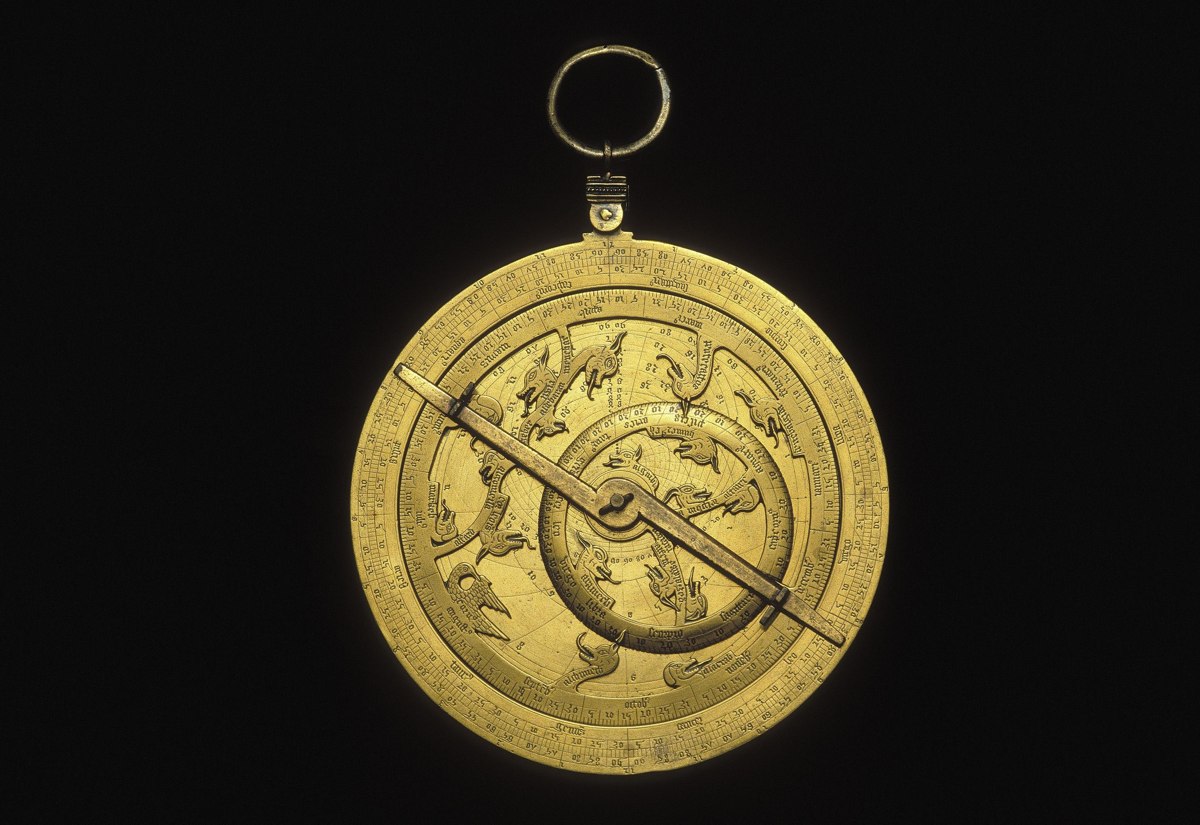
The National Museum of American History preserves this brass planispheric astrolabe, documented under catalog number MA.318198 and referred to in literature as CCA No. 2006. Source notes indicate it was manufactured in England, with dating estimated across 1350–1450 and 1400–1600, while John Davis proposes the second half of the fourteenth century. The instrument features an openwork rete showing northern sky stars with zoomorphic pointers shaped as animal tongues. Concentric brass circles define the Tropic of Capricorn and an eccentric zodiac ring. Beneath the rete, the plate scales are inscribed directly for 52 degrees latitude without separate interchangeable plates. Source notes report a later sundial scale on the reverse and a front-mounted sighting device used to calculate celestial positions and time of night.

Front view of the English brass planispheric astrolabe displaying the zoomorphic rete, latitude plate, and suspension ring.
Front view of the English brass planispheric astrolabe displaying the zoomorphic rete, latitude plate, and suspension ring. — National Museum of American History. Rights pending — permission not yet requested. Original source

Catalogue identity

Source
www.si.edu
Category
Tool · Scientific instrument
Maker / attribution
Not established
Reference
CCA No. 2006
Catalogue / lot identifier
Source URL identifies the listing
Source-reported date
1350-1450, 1400-1600 (second half of 14th century proposed by Davis)
Country
England

Source-reported attribution and specifications are not independent authentication. A listing does not establish present ownership, current display, availability or permission to reproduce.

Object description

Construction and Design

The instrument is a brass planispheric astrolabe of English origin. It lacks interchangeable plates, instead featuring scales inscribed directly for 52 degrees latitude.

The front includes an openwork rete acting as a star map of the northern sky. It is described as a 'zoomorphic' instrument, with star pointers shaped like animal tongues. The face also features the Tropic of Capricorn and an eccentric zodiac ring.

Evidence for this section
  • “The brass instrument was made in England”
  • “the scales below the rete are for a latitude of 52 degrees (there are no separate plates)”
  • “on this “zoomorphic” instrument they are in the shape of animal tongues”
  • “The outermost circle is the Tropic of Capricorn, and the circle that is off-center represents the zodiac”

Operational Features

The astrolabe includes a front-mounted sighting device and a pivoted rule used to measure stellar height, which allowed users to calculate the time of night and stellar positions.

The reverse of the object features a sundial scale. This scale is identified in the source as a later addition to the original instrument.

Evidence for this section
  • “Measuring the height of a star using the sighting device on the front, one could set the map to find the time of night and the position of other stars.”
  • “the sundial scale drawn on the back is of a later date.”

Chronological Documentation

The manufacturing date of the astrolabe is recorded with varying estimates in museum metadata, ranging from 1350–1450 and 1400–1600. The source notes the instrument may have been made before 1500.

Scholarly research by John Davis specifically dates the instrument to the second half of the fourteenth century.

Evidence for this section
  • “date made 1350-1450 1400-1600”
  • “The brass instrument was made in England, perhaps before 1500”
  • “Davis dates this instrument to the second half of the fourteenth century.”

Open research questions

  • What specific physical evidence on the reverse supports the determination that the sundial scale is of a later date than the primary instrument?
  • Does the fixed 52-degree latitude plate imply a specific geographic region of utility within medieval England?

Source evidence

Recorded claims and source quotations for English Planispheric Astrolabe
FieldSource-reported valueSource quotation
Museum Catalog NumberMA.318198“ID Number MA.318198”
MaterialBrass“brass (overall material)”
Overall Dimensions17.9 cm x 12.9 cm x 1.1 cm“overall: 17.9 cm x 12.9 cm x 1.1 cm; 7 1/16 in x 5 3/32 in x 7/16 in”
Latitude Scale52 degrees“the scales below the rete are for a latitude of 52 degrees (there are no separate plates)”
Country of ManufactureEngland“The brass instrument was made in England, perhaps before 1500”
Rete Design StyleZoomorphic“Pointers on the rete correspond to stars – on this “zoomorphic” instrument they are in the shape of animal tongues.”
Museum Catalog NumberMA.318198“ID Number MA.318198”
Dimensions17.9 cm x 12.9 cm x 1.1 cm“overall: 17.9 cm x 12.9 cm x 1.1 cm; 7 1/16 in x 5 3/32 in x 7/16 in”
MaterialBrass“brass (overall material)”

Visible details

  • Circular brass suspension ring attached via a small decorative bracket at the top rim.
  • Openwork rete with zoomorphic star pointers depicted as animal heads and protruding tongues.
  • Eccentric circular zodiac ring crossed by a pivoted straight brass sighting rule across the face.
  • Multi-ringed concentric degree and astronomical scales inscribed on the brass rim and plate.

Research qualifications

  • The reverse face containing the later sundial scale mentioned in the source is not shown in this photograph.
  • Dates of manufacture range in source documentation from 1350–1450, 1400–1600, and the second half of the fourteenth century.

Photograph identity and source facts were screened before import; rights clearance remains pending.

Consulted source

English Planispheric Astrolabe | Smithsonian Institution

Reviewed 2026-10-25 · Record df125c92d3

Terms in this record

Glossary explanations for terms named in this object’s record.