
Skip to content
The Encyclopedia of Horology

Tool · Scientific instrument

Safavid Brass Astrolabe Plate

Partially verified

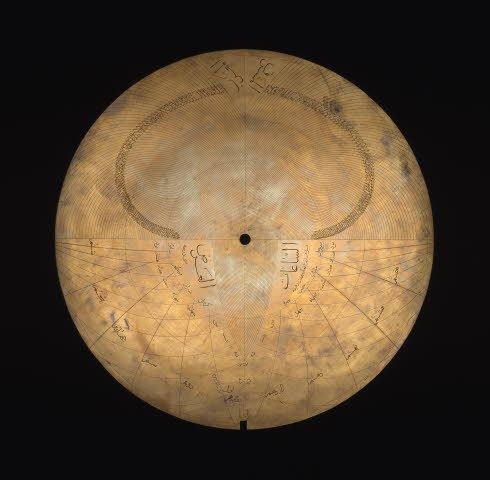
This circular engraved copper-alloy plate belongs to an astrolabe catalogued as museum number OA+.369 at the British Museum. The complete instrument was produced in Iran in 1712 (Sha'ban 1124) during the Safavid dynasty and was named in an inscription for Shah Sultan Husayn. According to the museum, the full astrolabe comprises seven latitude plates, a rete referencing sixty-three stars, and a mater inscribed with a gazetteer of 103 cities. The instrument entered the collection as a bequest from Sir Hans Sloane in 1753. Curator notes observe that its substantial dimensions suggest it was intended for conspicuous display rather than practical use.

Engraved plate from Safavid astrolabe OA+.369
Engraved plate from Safavid astrolabe OA+.369 — The Trustees of the British Museum. Rights pending — permission not yet requested. Original source

Catalogue identity

Source
islamicworld.britishmuseum.org
Category
Tool · Scientific instrument
Maker / attribution
Not established
Reference
OA+.369
Catalogue / lot identifier
Source URL identifies the listing
Source-reported date
1712 (Sha'ban 1124 (Sep-Oct 1712))
Country
Iran

Source-reported attribution and specifications are not independent authentication. A listing does not establish present ownership, current display, availability or permission to reproduce.

Object description

Object Identity and Provenance

This object is a circular plate originating from an astrolabe (museum number OA+.369) held in the British Museum. The instrument was produced in Iran during the Safavid dynasty, with a date recorded as 1712 (Sha'ban 1124).

The complete astrolabe was bequeathed to the museum by Sir Hans Sloane in 1753. Curator notes state that the substantial size and weight of the instrument suggest it was intended for conspicuous ostentation rather than use.

Evidence for this section
  • “Museum number: OA+.369”
  • “Culture/period: Safavid dynasty”
  • “Date: 1712 (Sha'ban 1124 (Sep-Oct 1712))”
  • “Bequeathed by: Sir Hans Sloane”
  • “The massive size and weight of this instrument show that it was more for conspicuous ostentation than use.”

Construction and Technical Features

The object is a circular engraved copper-alloy plate. It features a central circular piercing and a small rectangular locating notch at the bottom outer rim.

The surface displays engraving and silver inlay. Observations of the plate note the presence of fine projection arcs, concentric curves, and Arabic script. The metal surface shows patination, mottling, and circular machining or burnishing marks.

Evidence for this section
  • “Circular engraved copper-alloy disc with a central circular piercing.”
  • “A small rectangular locating notch is visible at the bottom outer rim.”
  • “made of brass, inlaid with silver, and engraved”
  • “Fine projection arcs, concentric curves, and engraved Arabic script occupy the face.”
  • “The metal surface shows slight mottling, patination, and circular machining or burnishing marks.”

Inscriptions and Royal Attribution

The astrolabe bears a calligraphic inscription in Arabic script. This inscription explicitly names the royal patron, Shah Sultan Husayn.

The text praises the patron and records the instrument's completion in Sha'ban 1124.

Evidence for this section
  • “Inscription details: inscription in Arabic script”
  • “Named in inscription: Shah Sultan Husayn”
  • “A calligraphic inscription at the top of the astrolabe praises the royal patron, Sultan Husayn.”

Open research questions

  • What specific geographic latitude does this individual plate represent?
  • Does the current museum housing or display arrangement acknowledge the separation of this plate from the mater and rete?

Source evidence

Recorded claims and source quotations for Safavid Brass Astrolabe Plate
FieldSource-reported valueSource quotation
Museum NumberOA+.369“Museum number: OA+.369”
Culture / PeriodSafavid dynasty“Culture/period: Safavid dynasty”
Date1712 (Sha'ban 1124 (Sep-Oct 1712))“Date: 1712 (Sha'ban 1124 (Sep-Oct 1712))”
Production PlaceMade in: Iran“Production place: Made in: Iran”
Materialscopper alloy, silver“Materials: copper alloy, silver”
Techniqueengraved, inlaid“Technique: engraved, inlaid”
Associated NameShah Sultan Husayn“Named in inscription: Shah Sultan Husayn”
AcquisitionBequeathed by Sir Hans Sloane, 1753“Bequeathed by: Sir Hans Sloane Acquisition date: 1753”
Full Instrument DimensionsHeight: 58.20 cm, Width: 14.00 cm, Depth: 3.40 cm“Height: 58.20 cm Width: 14.00 cm Depth: 3.40 cm”
Full Instrument ComponentsSeven latitude plates, a rete for sixty-three stars, and a mater with a 103-city gazetteer“with seven latitude plates. The rete is marked with pointers to sixty-three important stars and the mater is inscribed with a gazetteer of 103 cities”

Visible details

  • Circular engraved copper-alloy disc with a central circular piercing.
  • A small rectangular locating notch is visible at the bottom outer rim.
  • Fine projection arcs, concentric curves, and engraved Arabic script occupy the face.
  • The metal surface shows slight mottling, patination, and circular machining or burnishing marks.

Research qualifications

  • The image depicts a single latitude plate rather than the complete astrolabe assembly.
  • The maker of the instrument is not recorded in the source text.

Photograph identity and source facts were screened before import; rights clearance remains pending.

Consulted source

Astrolabe - The British Museum: Islamic Gallery

Reviewed 2026-10-25 · Record 0e98c16ac1

Terms in this record

Glossary explanations for terms named in this object’s record.