
Skip to content
The Encyclopedia of Horology

Tool · Scientific instrument

Middle Eastern planispheric astrolabe

Partially verified

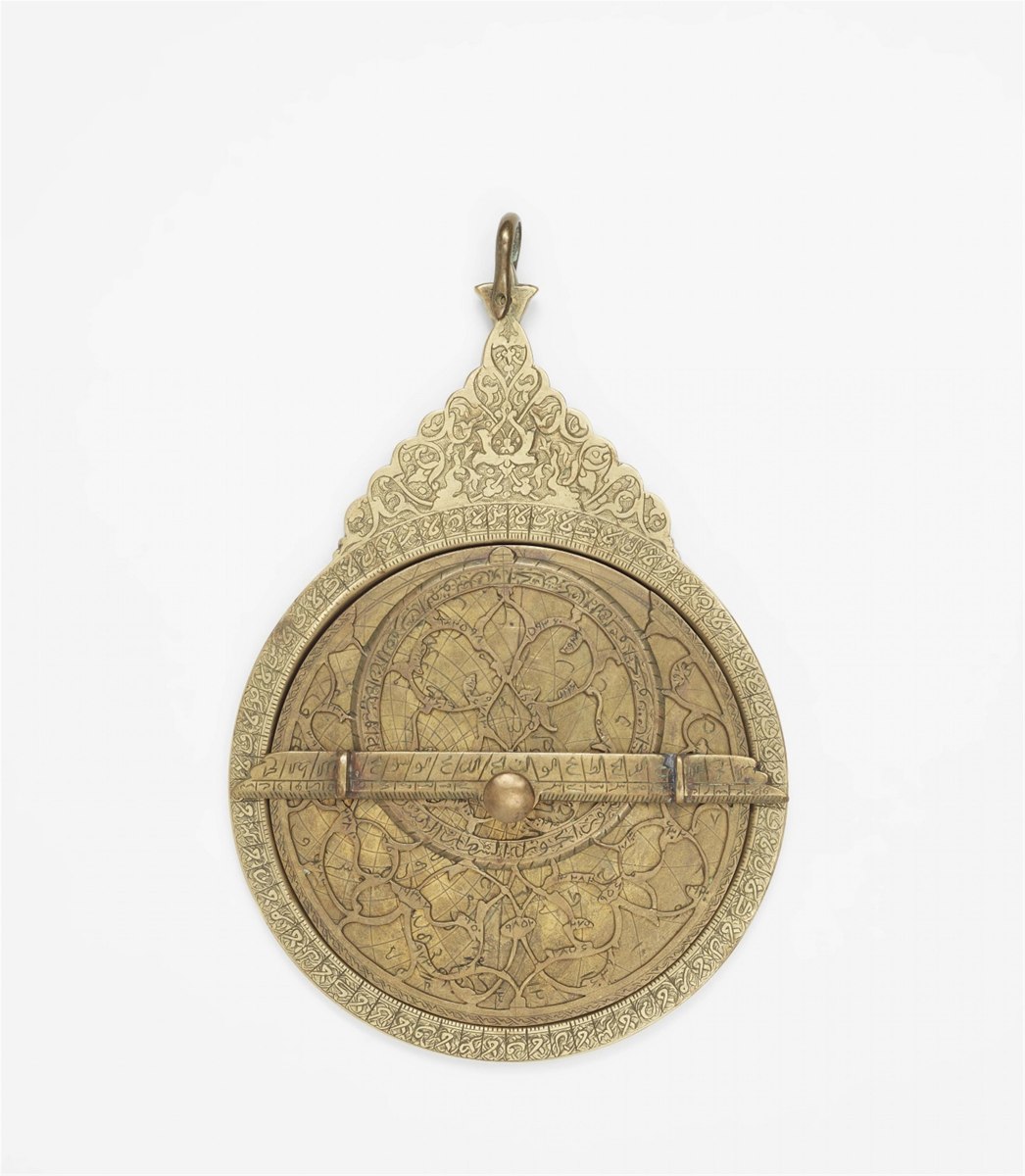
This unsigned engraved brass planispheric astrolabe is attributed to the Middle East between the 16th and 19th centuries. The instrument features a raised throne engraved with scrolling foliate motifs and an attached suspension shackle. Its inscriptions are rendered in naskh script, with the mater recording the names of major Islamic cities including Mecca, Medina, Sanaa, Cairo, Aleppo, and Baghdad. The pierced foliate rete is engraved with standard zodiacal designations. The auction house notes the astrolabe is accompanied by interchangeable tympani for astronomical observations while travelling.

Assembled front view of the brass planispheric astrolabe showing the throne, rete, and rule
Assembled front view of the brass planispheric astrolabe showing the throne, rete, and rule — Lempertz. Rights pending — permission not yet requested. Original source

Catalogue identity

Source
www.lempertz.com
Category
Tool · Scientific instrument
Maker / attribution
Not established
Reference
Not recorded
Catalogue / lot identifier
722
Source-reported date
16th - 19th C.
Country
Not established

Source-reported attribution and specifications are not independent authentication. A listing does not establish present ownership, current display, availability or permission to reproduce.

Object description

Physical Configuration

This unsigned instrument is crafted from brass and measures 17.6 cm in height by 12.3 cm in width, with a weight of 612 g. The construction includes a raised throne featuring scrolling foliate engravings, which supports a simple shackle attached to a hole.

The front face includes a pierced foliate rete featuring curvilinear pointers. A central rule or alidade is held in place by a rounded central pin.

Evidence for this section
  • “Engraved brass astrolabe”
  • “H 17.6, W 12.3 cm.”
  • “weight 612 g.”
  • “The throne is raised: the suspensory apparatus consists in a simple shackle attached to a hole.”
  • “pierced foliate rete”
  • “On the rete the zodiacal signs are inscribed with the standard names”

Inscriptions and Geographical Data

The instrument features text rendered in naskh, an Oriental cursive script. The mater contains a list of major Islamic cities, specifically identified as Mecca, Medina, Ṣanʿāʾ, Cairo, and Aleppo.

Standard zodiacal designations are engraved on the rete, including terms such as al-ḥūt for Pisces, al-thawr for Taurus, and al-sunbula for Virgo.

Evidence for this section
  • “the inscriptions are in naskh – an Oriental cursive script”
  • “On the mater (i.e. the body of the planispheric astrolabe) are inscribed the names of the major Islamic cities: Mecca, Medina, Ṣanʿāʾ, Cairo (Miṣr), Aleppo (Ḥalab), Baghdād etc.”
  • “On the rete the zodiacal signs are inscribed with the standard names (e.g. Pisces: al-ḥūt; Taurus: al-thawr; Virgo: al-sunbula).”

Dating and Auxiliary Components

The instrument is attributed to the Middle East, dated to the 16th through 19th centuries. It is unsigned.

The source documentation contains inconsistent data regarding the number of additional tympani: the header specifies four, while the body text identifies a set of three.

Evidence for this section
  • “Middle Eastern, 16th - 19th C.”
  • “Unsigned.”
  • “Engraved brass astrolabe with four additional tympani”
  • “There are also a set of three other tympani”

Open research questions

  • What is the actual count of tympani provided with the object?
  • Can technical analysis of the naskh script refine the broad 16th-19th century date range?

Source evidence

Recorded claims and source quotations for Middle Eastern planispheric astrolabe
FieldSource-reported valueSource quotation
MaterialBrass“Engraved brass astrolabe”
DimensionsH 17.6, W 12.3 cm“H 17.6, W 12.3 cm.”
Weight612 g“weight 612 g.”
Maker attributionUnsigned“Unsigned.”
ProvenanceFormer collection of an engineer for construction machinery active in Iran and Syria (1960s-1970s), later held in family ownership in Hamburg.“Family ownership, Hamburg. From the collection of an engineer for construction machinery, active in Iran and Syria in the 1960s and 1970s.”

Visible details

  • High-arched throne decorated with scrolling foliate engraving and an integral suspension loop
  • Openwork rete featuring curvilinear pointers and an eccentric zodiac circle
  • Central rule or alidade arm secured across the front face with a rounded central pin

Research qualifications

  • Broad dating range spanning the 16th to 19th centuries without specific year
  • Middle Eastern origin is regionally attributed rather than tied to a specific country of manufacture
  • Discrepancy in catalogue text describing four additional tympani in the header versus a set of three other tympani in the body

Photograph identity and source facts were screened before import; rights clearance remains pending.

Consulted source

A planispheric astrolabe (or universal astrolabe) - Lot 722

Reviewed 2026-10-25 · Record 0b5c6a9024

Terms in this record

Glossary explanations for terms named in this object’s record.