
Skip to content
The Encyclopedia of Horology

Component · Escapement model

Model of co-axial escapement

Partially verified

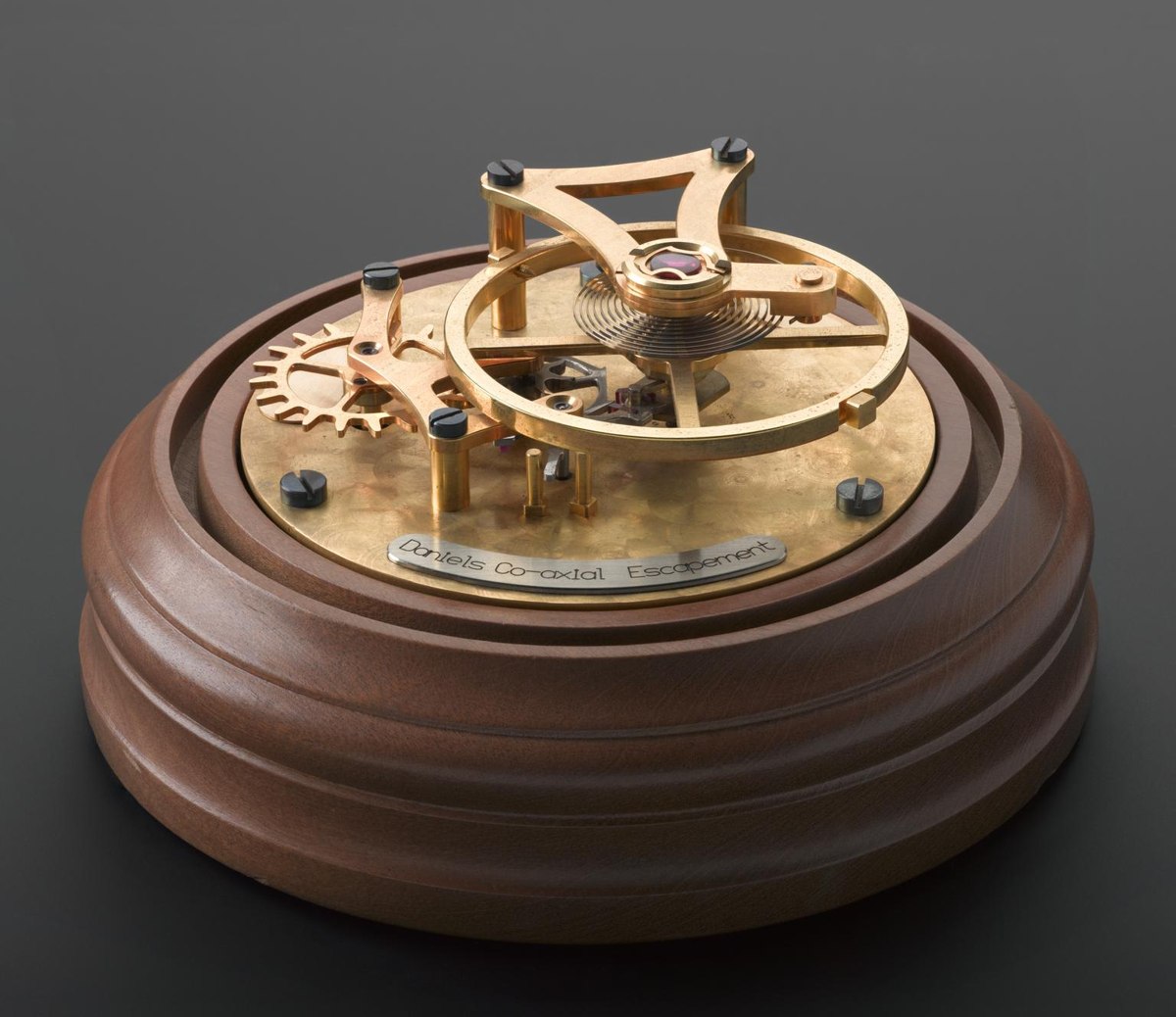
This horological demonstration model represents the co-axial escapement invented by Dr George Daniels CBE (1926–2011). According to the Science Museum Group, it was manufactured for Daniels by Omega in Switzerland in 1999. The device features an escapement assembly, large balance wheel, and balance spring supported on pillars and bridges over a circular metal plate with perlage decoration, all mounted on a stepped circular turned wooden base. An applied metal plaque at the front edge of the plate is engraved 'Daniels Co-axial Escapement'.

Demonstration model of the Daniels co-axial escapement made by Omega, mounted on a circular wooden plinth
Demonstration model of the Daniels co-axial escapement made by Omega, mounted on a circular wooden plinth — The Board of Trustees of the Science Museum. Rights pending — permission not yet requested. Original source

Catalogue identity

Source
collection.sciencemuseumgroup.org.uk
Category
Component · Escapement model
Maker / attribution
Omega
Reference
Not recorded
Catalogue / lot identifier
2012-2
Source-reported date
1999
Country
Switzerland

Source-reported attribution and specifications are not independent authentication. A listing does not establish present ownership, current display, availability or permission to reproduce.

Object description

Identity and Commission

This object is an escapement model illustrating the co-axial escapement mechanism invented by British horologist Dr George Daniels CBE (1926–2011). Museum records indicate that the model was made for him by Omega in Switzerland in 1999.

Catalogued under collection number 2012-2, the museum categorises the object within 'Time Measurement' as a 'model - representation', with the credit line 'Dr George Daniels CBE'.

Evidence for this section
  • “Model of coaxial escapement invented by George Daniels CBE (1926-2011), made for him by Omega, Switzerland in 1999.”
  • “credit: Dr George Daniels CBE”
  • “Category: Time Measurement”
  • “type: model - representation”

Visual Construction and Components

The model is mounted on a turned circular wooden base with a moulded profile. Above this sits a circular metal baseplate decorated with circular graining (perlage), which supports the escapement framework on pillars and bridges secured by blued steel screws.

The visible mechanism includes a large-diameter balance wheel with a balance spring mounted beneath an elevated balance cock with an endstone jewel, alongside a toothed co-axial escapement wheel. A curved metal nameplate engraved 'Daniels Co-axial Escapement' is fixed near the front edge of the baseplate.

Evidence for this section
  • “Turned circular wooden base with a moulded profile”
  • “Circular metal baseplate decorated with circular graining (perlage)”
  • “Pillars and bridges secured by blued steel screws”
  • “Large-diameter balance wheel with balance spring under an elevated balance cock with endstone jewel”
  • “Toothed co-axial escapement wheel visible beneath and beside the balance wheel”
  • “Curved metal nameplate engraved 'Daniels Co-axial Escapement'”

Associated Parts and Material Documentation

The museum record for object number 2012-2 lists two parts: the model itself (part 2012-2/1) and an accompanying 'Winding Key from Model of Co-Axial Escapement' (part 2012-2/2). The winding key is not shown in the primary photograph.

Specific wood species and metal alloys are not specified in the catalogue entry, which records the materials broadly as 'wood (unidentified) and metal (unknown)' for the model, and 'metal (unknown)' for the winding key.

Evidence for this section
  • “Object Number: 2012-2/1”
  • “Object Number: 2012-2/2”
  • “Winding key from model of coaxial escapement invented by George Daniels CBE (1926-2011), made for him by Omega, Switzerland in 1999.”
  • “Materials: wood (unidentified) and metal (unknown)”
  • “Materials: metal (unknown)”

Open research questions

  • What specific wood species and metal alloys were used to fabricate the base and mechanism plates?
  • What are the physical dimensions and design of the separate winding key catalogued under part 2012-2/2?

Source evidence

Recorded claims and source quotations for Model of co-axial escapement
FieldSource-reported valueSource quotation
MakerOmega“maker: Omega”
InventorGeorge Daniels“inventor: George Daniels”
Date1999“Made: 1999 in Switzerland”
Object Number2012-2“Object Number: 2012-2”
Materialswood (unidentified) and metal (unknown)“Materials: wood (unidentified) and metal (unknown)”
Part 1 Object Number2012-2/1“Object Number: 2012-2/1”
Part 2 Object Number2012-2/2“Object Number: 2012-2/2”

Visible details

  • Turned circular wooden base with a moulded profile
  • Circular metal baseplate decorated with circular graining (perlage)
  • Large-diameter balance wheel with balance spring under an elevated balance cock with endstone jewel
  • Pillars and bridges secured by blued steel screws
  • Toothed co-axial escapement wheel visible beneath and beside the balance wheel
  • Curved metal nameplate engraved 'Daniels Co-axial Escapement'

Research qualifications

  • Museum records the materials generally as unidentified wood and unknown metal
  • The accompanying winding key (part 2012-2/2) recorded in the collection parts is not depicted in this photograph

Photograph identity and source facts were screened before import; rights clearance remains pending.

Consulted source

Model of co-axial escapement | Science Museum Group Collection

Reviewed 2026-10-21 · Record 8c6e5b4e98

Terms in this record

Glossary explanations for terms named in this object’s record.

Other escapement model records