
Skip to content
The Encyclopedia of Horology

Pocket watch · Open-face key-wound pocket watch

Matthias Currie Pocket Watch

Partially verified

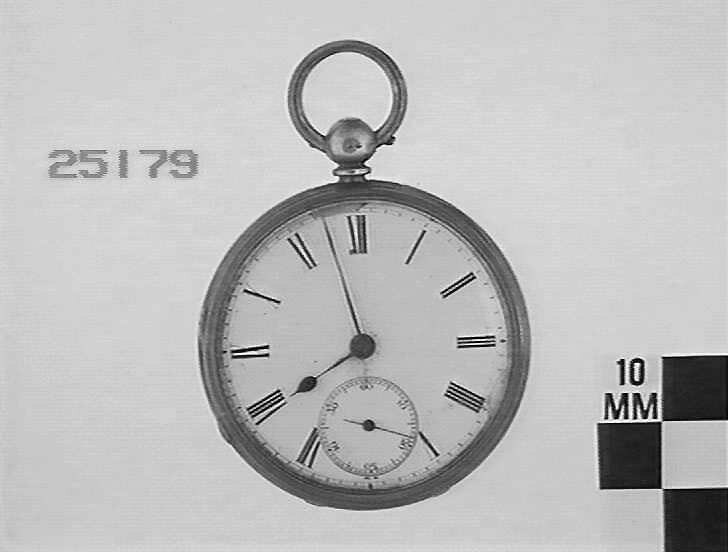
This gentleman's open-face pocket watch was produced by maker Matthias Currie of Greenock, Scotland, around 1868. The watch is housed in a silver case and features a white enamel dial with black Roman numerals for the hours and a subsidiary seconds dial positioned at the six o'clock mark. The watch employs a key-wound spring mechanism and a lever escapement. A removable dust cover over the movement is cut away to expose jewels and the bridge. The piece is inscribed with the serial number 11453 on both the back plate and inside the case. Additionally, an inscription on the outside of the inner case reads 'A. McIntyre, Myrniong, Vic', indicating the owner. The case bears hallmarks corresponding to London, 1867-1868, including the lion, leopard, and a small gothic 'm'. The watch entered the museum collection via a donation from A. McIntyre in 1961.

Front view of the Matthias Currie pocket watch with the seconds dial at six o'clock.
Front view of the Matthias Currie pocket watch with the seconds dial at six o'clock. — Museums Victoria. Rights pending — permission not yet requested. Original source

Catalogue identity

Source
collections.museumsvictoria.com.au
Category
Pocket watch · Open-face key-wound pocket watch
Maker / attribution
Matthias Currie
Reference
Not recorded
Catalogue / lot identifier
ST 25179
Source-reported date
circa 1868
Source-reported place
Scotland
Source-reported serial
11453

Source-reported attribution and specifications are not independent authentication. A listing does not establish present ownership, current display, availability or permission to reproduce.

Object description

Case and Dial

The watch features a silver open-face case. The exterior dial is composed of white enamel, displaying Roman numerals to denote the hours. A subsidiary seconds dial is integrated into the primary dial at the six o'clock position. The case is equipped with a hook at the top, contributing to its overall length measurement of 75 mm.

The silver case includes specific markings indicating its origins and testing. The interior of the case is struck with a London hallmark corresponding to the 1867-1868 period, which includes the lion passant, the uncrowned leopard head, and a small gothic 'm'. The maker's mark 'J.S.' is also present within the case.

Evidence for this section
  • “Silver case, open face.”
  • “White enamel dial has roman numerals and seconds dial at 6.”
  • “Case has London hallmark of 1867-1868 (lion, uncrowned leopard, small gothic m) and 'J.S.'.”

Movement and Mechanism

The timepiece is driven by a key-wound spring mechanism. The power is regulated by a lever escapement. Access to the movement is provided under a removable dust cover.

The dust cover is designed with a cut-away section. This allows for the observation of the bridge and the movement's jewels without full exposure of the internal components. The back plate of the movement is inscribed with the maker's name and location, as well as the serial number 11453.

Evidence for this section
  • “Key wound spring; lever escapement.”
  • “Detachable dust cover is cut away to show jewel and bridge.”
  • “Back plate is marked 'M. Currie, Greenock, 11453'.”

Provenance and Documentation

The watch is associated with the maker Matthias Currie, who operated from 11 Cross Shore Street in Greenock, Scotland, during 1868. This association is documented through historical references to Scottish clock and watchmakers from that era. The watch came into the possession of the museum through a donation from A. McIntyre in December 1961.

The object carries an inscription on the inner case identifying a former owner, 'A. McIntyre, Myrniong, Vic'.

Evidence for this section
  • “Currie was working at 11 Cross Shore St, Greenock in 1868”
  • “Acquisition: Donation from A. McIntyre, 05 Dec 1961”
  • “Outside of inner case is marked 'A. McIntyre, Myrniong, Vic'”

Open research questions

  • What is the identity of the 'J.S.' mark found inside the case?
  • Did Matthias Currie manufacture the complete movement or was it imported for assembly in his Greenock shop?

Source evidence

Recorded claims and source quotations for Matthias Currie Pocket Watch
FieldSource-reported valueSource quotation
MakerMatthias Currie“Matthias Currie, Greenock, Scotland, circa 1868”
Serial Number11453“Back plate is marked 'M. Currie, Greenock, 11453'.”
DialWhite enamel“White enamel dial has roman numerals and seconds dial at 6.”
EscapementLever“lever escapement”
InscriptionA. McIntyre, Myrniong, Vic“Outside of inner case is marked 'A. McIntyre, Myrniong, Vic'”
HallmarksLondon 1867-1868“Case has London hallmark of 1867-1868 (lion, uncrowned leopard, small gothic m)”
Accession NumberST 25179“Registration number: ST 25179”

Visible details

  • White enamel dial with Roman numeral hour markers
  • Subsidiary seconds dial located at six o'clock
  • Presence of a suspension bow at the top of the case

Research qualifications

  • The source attributes the watch to Currie, who was active at 11 Cross Shore St in 1868, but does not specify if he was the manufacturer or the retailer.
  • The precise role of the mark 'J.S.' inside the case is not definitively identified in the provided documentation.

Photograph identity and source facts were screened before import; rights clearance remains pending.

Consulted source

Pocket Watch - Matthias Currie, Greenock, Scotland, circa 1868

Reviewed 2026-10-26 · Record b946aaadad

Terms in this record

Glossary explanations for terms named in this object’s record.