
Skip to content
The Encyclopedia of Horology

Clock · Longcase clock

Longcase clock with integrated barometer

Partially verified

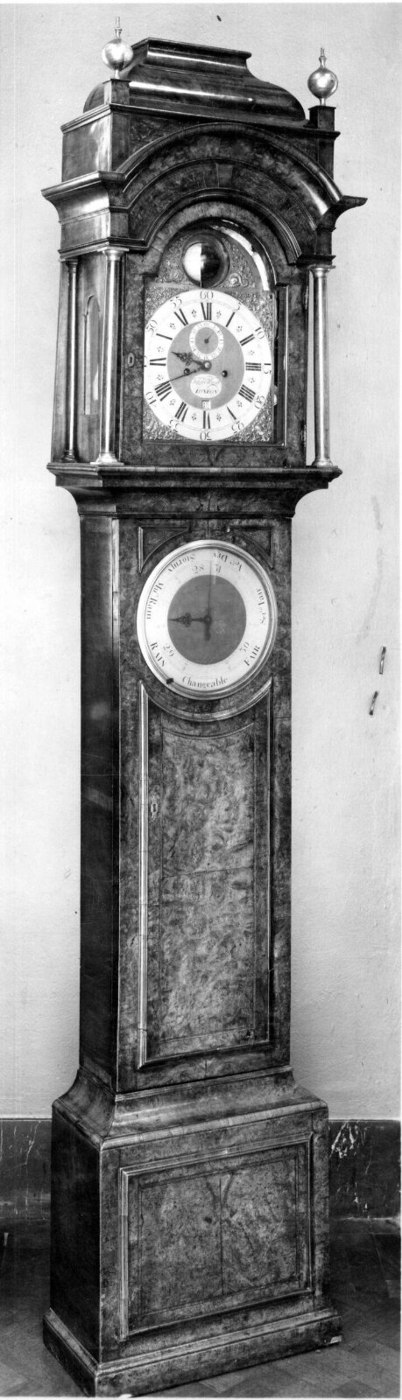
This eight-day longcase clock is constructed from walnut veneer on an oak carcass and features an integrated wheel barometer. The clock movement is weight-driven and features a dead-beat escapement and pendulum regulation. The brass dial includes a subsidiary seconds ring, a calendar aperture, and a globe moon phase indicator positioned in the break-arch. The hood is of a sliding, break-arch design surmounted by a caddy top and is flanked by free-standing columns. The trunk door incorporates a circular silvered dial for the barometer, which operates independently from the clock mechanism. The maker is identified by the inscription 'John Ellicott London' on the dial. and was acquired by the museum via a bequest from C. D. Rotch. The construction includes steel pierced hands and matted brass shutters concealing the winding squares.

The John Ellicott longcase clock and barometer, showing the globe moon in the break-arch and the circular barometer dial in the trunk door.
The John Ellicott longcase clock and barometer, showing the globe moon in the break-arch and the circular barometer dial in the trunk door. — Victoria and Albert Museum. Rights pending — permission not yet requested. Original source

Catalogue identity

Source
collections.vam.ac.uk
Category
Clock · Longcase clock
Maker / attribution
John Ellicott
Reference
Not recorded
Catalogue / lot identifier
W.107:1 to 7-1962
Source-reported date
circa 1725-1750
Source-reported place
London

Source-reported attribution and specifications are not independent authentication. A listing does not establish present ownership, current display, availability or permission to reproduce.

Object description

Case Construction

The case is constructed from walnut veneer on an oak carcass and stands 253 cm in height. The trunk features a full-width rectangular door adorned with moulded borders and herringbone banding. A significant feature is the inclusion of a circular, silvered barometer dial mounted within the upper part of the door, while the internal mechanism is concealed by a mahogany board.

The hood design includes a sliding section with a break-arch, glazed front door, and a caddy top surmounted by finials. The sides of the hood feature rectangular, glazed panels and free-standing columns with brass caps to the front, paired with wooden-capped quarter columns at the rear. The base is rectangular with moulding and herringbone banding, supported by a plain plinth.

Evidence for this section
  • “Walnut veneer on oak carcass.”
  • “Full-width rectangular trunk door with moulded borders enclosing herringbone banding, the upper part containing the circular silvered dial and steel hands of a wheel barometer.”
  • “Sliding hood with break-arch glazed front door cornice and frieze, the whole surmounted by a caddy top”

Dial and Timekeeping

The brass dial measures 16.5 inches in total height, with a 12-inch square central portion. It features a matted centre, brass winding shutters, and an oval silvered plaque engraved with the maker's name. A calendar aperture is located below the plaque, and a subsidiary seconds ring is positioned beneath the XII numeral. The break-arch contains a globe moon indicator flanked by dolphin-design spandrels.

The movement is a weight-driven, eight-day mechanism utilizing a dead-beat escapement and pendulum regulation. It incorporates bolt-and-shutter maintaining power, actuated by a lever on the left side of the movement. The striking train is controlled by a snail and rack with a sprung tail.

Evidence for this section
  • “Centre matted. Winding squares concealed by matted brass shutters.”
  • “Pinned to the dial plate is the silvered brass chapter ring with engraved minute band”
  • “weight driven hour striking of 8-day duration, with dead beat escapement, pendulum regulated.”
  • “Bolt and shutter maintaining power, actuated by decoratively shaped lever on proper left of movement”

Provenance and History

The clock entered the museum collection as part of a bequest from C. D. Rotch.

There is historical speculation regarding the production of the movement. Records from the era indicate that specialized makers such as the Thwaites family supplied movements to prominent retailers including the Ellicotts. While the clock exhibits high-quality construction and precision features such as the dead-beat escapement, whether the components were produced entirely in-house or sourced externally remains a subject of investigation.

Evidence for this section
  • “Bequeathed by Claude Rotch”
  • “The globe moon was fitted, albeit uncommonly on London clocks, between 1720-1750.”
  • “It may be possible that John Junior did not make his movements but rather bought them in.”
  • “Probably the most active of Thwaites customers were the Ellicotts”

Open research questions

  • Are there specific records linking this clock's serial numbers to the Thwaites workshop logs?
  • Did the original design include sound frets as suggested by Goodison?
  • To what extent was the globe moon mechanism influenced by the maker's membership in the Royal Society?

Source evidence

Recorded claims and source quotations for Longcase clock with integrated barometer
FieldSource-reported valueSource quotation
MakerJohn Ellicott“Inscribed 'John Ellicott London'”
MaterialsWalnut, oak, brass“Walnut veneer on oak carcase”
Datecirca 1725-1750“made in about 1725-1750”
Duration8-day“weight driven hour striking of 8-day duration”
Escapementdead beat“with dead beat escapement”
Accession NumberW.107:1 to 7-1962“Accession number: W.107:1 to 7-1962”
BarometerIntegrated in trunk door“The trunk door barometer mechanism operates independently of clock movement.”

Visible details

  • Integrated wheel barometer circular dial within the upper trunk door
  • Globe moon phase indicator located in the break-arch of the clock dial
  • Free-standing columns with brass caps on the sliding hood
  • Walnut veneer panels with herringbone banding

Research qualifications

  • Possible missing sound frets above and below the cornice as suggested by an external opinion
  • Uncertainty regarding whether the movement was manufactured by John Ellicott or purchased from a specialist maker
  • Evidence for exact dating relies on stylistic features common to London horology of the period

Photograph identity and source facts were screened before import; rights clearance remains pending.

Consulted source

Clock and barometer case

Reviewed 2026-11-02 · Record b6cce97dc6

Terms in this record

Glossary explanations for terms named in this object’s record.