
Skip to content
The Encyclopedia of Horology

Clock · Longcase clock

Longcase clock by Daniel Delander

Partially verified

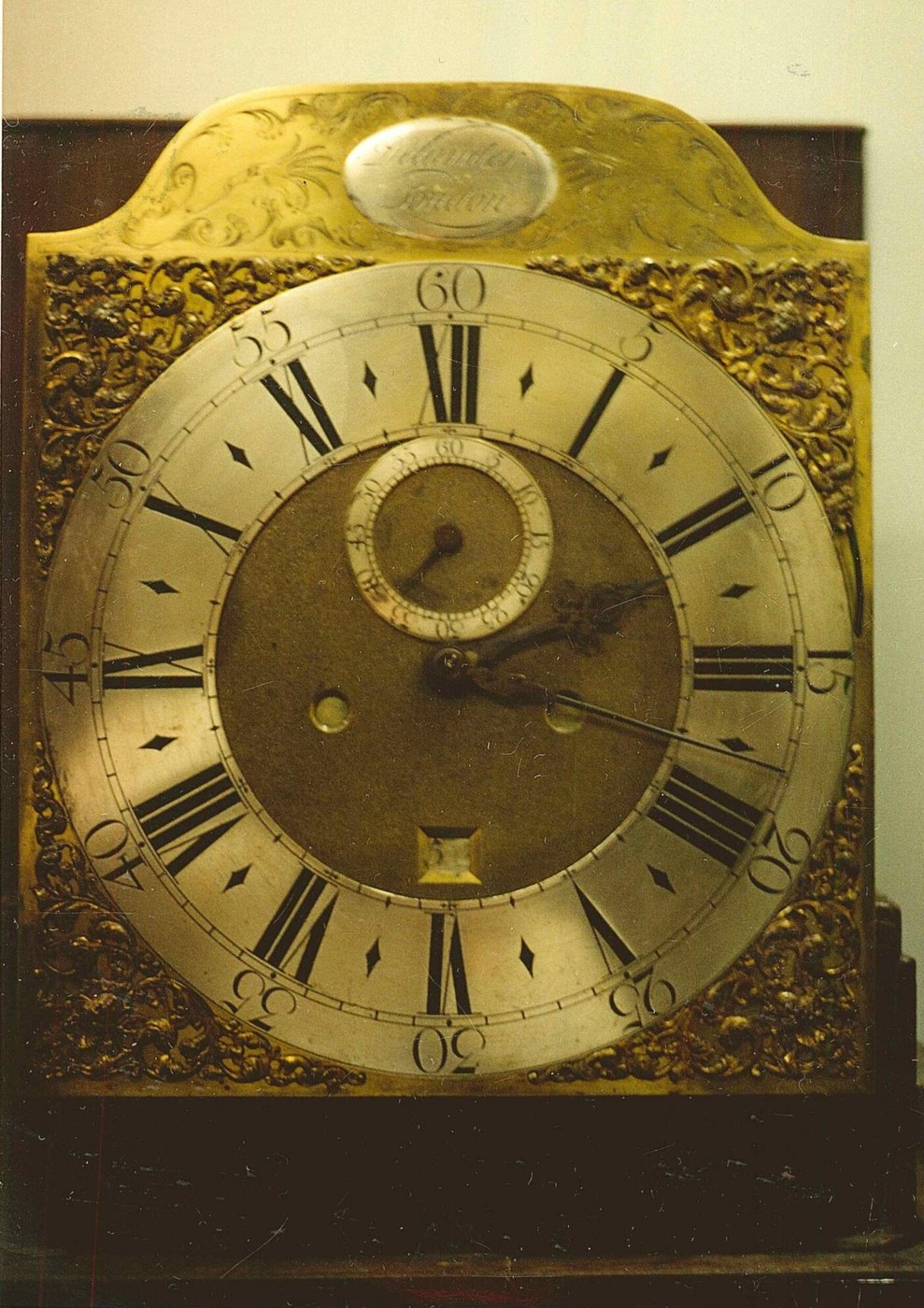
The movement is weight-driven with 8-day duration and an escapement described as an early form of the duplex design. The movement includes five pillars riveted to the backplate and an outside rack striking mechanism. The brass dial features a matted centre, a subsidiary seconds ring, and an aperture for the calendar. The signature "Delander / London" is engraved on a plaque within the break-arch. The case is constructed from mahogany, featuring canted corners on the plinth, trunk, and hood. The hood is surmounted by a caddy top with three brass ball finials. The interior of the trunk shows evidence of being scalloped to accommodate the pendulum swing.

Full view of the mahogany longcase clock by Daniel Delander.
Full view of the mahogany longcase clock by Daniel Delander. — V&A Museum. Rights pending — permission not yet requested. Original source

Catalogue identity

Source
collections.vam.ac.uk
Category
Clock · Longcase clock
Maker / attribution
Daniel Delander
Reference
Not recorded
Catalogue / lot identifier
W.40:1to2-1962
Source-reported date
c.1740
Source-reported place
London

Source-reported attribution and specifications are not independent authentication. A listing does not establish present ownership, current display, availability or permission to reproduce.

Object description

Case Construction

The clock is housed in a mahogany case featuring a plinth, base, trunk, and hood, all designed with canted corners at the front. The base includes a moulded octagonal panel, while the trunk door features an arched top edge. The hood is sliding and fitted with a low break-arch cornice, glazed side panels, and a front glazed door. The top is a caddy design, decorated with three brass ball finials mounted on pedestals. This longcase clock is attributed to Daniel Delander and dated circa 1740.

The interior of the trunk exhibits scalloped sections on both sides at the height of the pendulum bob, suggesting the case was adapted for the movement's specific pendulum requirements. It has been noted that the trunk door color differs from the rest of the case, and there are signs of packed-up hinges and vacant screw holes, indicating historical modifications or restoration to the woodwork.

Evidence for this section
  • “canted corners to front”
  • “caddy top supporting three brass ball finials”
  • “Inside trunk crudely scalloped out on both sides at same height as pendulum bob”
  • “Trunk door colour lighter than the rest of case.”

Dial and Hands

The brass dial comprises a 12-inch square central section with a low break-arch, reaching a total height of 14¼ inches. The centre is matted, with winding squares hidden by matted shutters and a beveled calendar aperture. Foliate engravings surround a central oval plaque in the break-arch engraved "Delander / London". Spandrels depicting a female head with a headdress are pinned to the plate.

The silvered brass chapter ring is pinned to the dial, displaying Arabic numerals at five-minute intervals and Roman hour numerals. A subsidiary seconds ring is pinned below the XII position. Date numerals (1-31) appear on a silvered brass ring operated by pulleys behind the dial. The hands are crafted from steel and feature pierced, chiselled designs.

Evidence for this section
  • “Centre matted, winding squares concealed by matted shutters; square calendar aperture with bevelled edges”
  • “Foliate engravings flank central, oval plaque engraved: Delander / London in break-arch.”
  • “Pinned to the dial plate is the silvered brass chapter ring”
  • “Hands: Steel. Pierced and partially chiselled.”

Movement and Escapement

The 8-day weight-driven movement is built with five pillars riveted to the backplate and pinned to the front. The train utilizes brass wheels with four-spoke crossings, and the striking mechanism is controlled by a near-vertical outside rack. A bolt and shutter maintaining power system is integrated with the front plate. The escapement features a large-diameter locking wheel on a separate cock, while the impulse escape wheel is positioned between the plates.

The pallets are separate, with the impulse pallet riveted to the arbor and the locking pallet located outside the backplate. The pendulum features a double suspension spring, a brass upper rod, a steel strip main rod, and a lead-filled brass bob adjusted by an engraved rating nut. The movement backcock exhibits evidence of past adjustments, including a plugged pivot hole and an additional unused threaded hole.

Evidence for this section
  • “8-day duration with so-called duplex escapement”
  • “Hour striking on bell is controlled by a near vertical outside rack”
  • “impulse pallet (between plates) riveted to pallet arbor; locking pallet (outside backplate)”
  • “Backcock, has plugged hole above the present pallet pivot hole and below, an unused threaded hole.”

Open research questions

  • What is the specific relationship between the Delander duplex escapement and subsequent watch-based duplex mechanisms?
  • Can the case design be definitively linked to a specific cabinetmaker shared with John Ellicott?

Source evidence

Recorded claims and source quotations for Longcase clock by Daniel Delander
FieldSource-reported valueSource quotation
MakerDelander, Daniel“Delander, Daniel (made)”
Datec.1740“c.1740”
Place of originLondon“London (made)”
Accession numberW.40:1to2-1962“W.40:1to2-1962”
Case materialMahogany“Case: Mahogany.”
EscapementDuplex“so-called duplex escapement”
Dimensions245.5 cm x 46 cm x 25.5 cm“Height: 245.5 cm; Width: 46 cm; Depth: 25.5 cm”

Visible details

  • Canted corners on the mahogany case sections
  • Brass dial with matted center and foliate engravings
  • Duplex escapement configuration with separate impulse and locking pallets
  • Outside rack striking mechanism with bell
  • Scalloped trunk interior to accommodate pendulum swing

Research qualifications

  • Absence of the Christian name 'Daniel' on the dial is noted as unusual for the maker
  • Uncertainty regarding whether the clock is a late example completed after the maker's death

Photograph identity and source facts were screened before import; rights clearance remains pending.

Consulted source

Longcase clock

Reviewed 2026-10-26 · Record 9d3d8da340

Terms in this record

Glossary explanations for terms named in this object’s record.