
Skip to content
The Encyclopedia of Horology

Pocket watch · Quarter repeating pocket watch

Lepaute à Paris Quarter Repeating Pendant Watch, No. 540

Partially verified

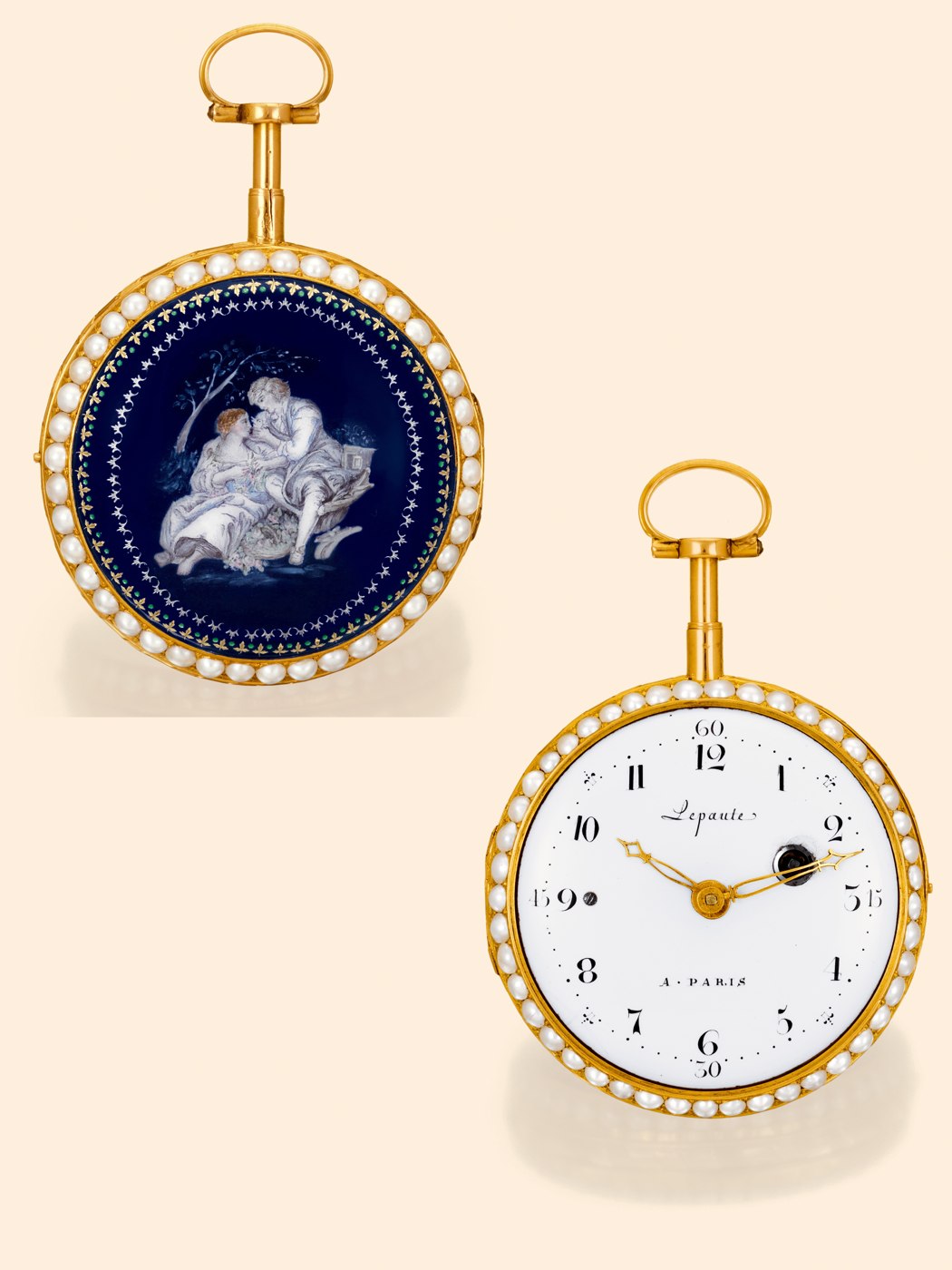
This pendant watch, attributed to Lepaute à Paris and numbered 540, dates to approximately 1780. The object is a quarter repeating watch with a gold two-body case, featuring a sprung hinged bezel set with pearls and a back decorated with a painted enamel scene of lovers in a rustic arbor against a translucent dark blue ground, bordered by gold and silver paillon. The white enamel dial displays Arabic numerals, dot minute divisions, and fleur-de-lys markers for five-minute intervals, complemented by pierced gold cathedral-style hands. Internally, the watch contains a 38 mm frosted gilt full-plate movement with turned pillars. The mechanism includes a fusee with chain, a verge escapement, and a brass three-arm balance with a blued steel flat spring. A pierced and chased continental balance cock sits above the movement, which activates the repeating function by depressing the pendant. The piece is signed on both the dial and movement.

Front view showing the enamel dial and reverse view showing the painted enamel scene with pearl borders.
Front view showing the enamel dial and reverse view showing the painted enamel scene with pearl borders. — Antiquorum. Rights pending — permission not yet requested. Original source

Catalogue identity

Source
catalog.antiquorum.swiss
Category
Pocket watch · Quarter repeating pocket watch
Maker / attribution
Lepaute à Paris
Reference
Not recorded
Catalogue / lot identifier
77
Source-reported date
circa 1780
Source-reported place
Switzerland
Source-reported serial
540

Source-reported attribution and specifications are not independent authentication. A listing does not establish present ownership, current display, availability or permission to reproduce.

Object description

Case and Enamel Decoration

The watch is housed in a two-body gold case. The front features a sprung hinged bezel decorated with pearls. The reverse side displays a painted enamel scene depicting two lovers in a rustic arbor setting. This central image is set against a translucent dark blue enamel background, further enhanced by a gold and silver paillon border and an external border of pearls.

The dial is white enamel, presenting Arabic numerals for the hours. Minute tracking is indicated via dot minute divisions with fleur-de-lys markers at every five-minute interval. The watch utilizes pierced gold hands described as cathedral style, which indicate time against the enamel dial surface.

The auction description reports the watch has a diameter of 51 mm.

Evidence for this section
  • “Two-body, sprung hinged bezel set with pearls”
  • “the back painted with a scene of young lovers in a rustic arbor,translucent dark blue enamel ground”
  • “White enamel, Arabic numerals, dot minute divisions, fleur-de-lys five minute markers”

Movement and Repeating Function

The watch contains a 38 mm frosted gilt, full-plate movement characterized by turned pillars. It employs a traditional fusee and chain power delivery system alongside a verge escapement. The timing assembly consists of a brass three-arm balance regulated by a blued steel flat spring. The assembly is topped with a pierced and chased continental balance cock.

The quarter repeating mechanism is designed to strike the hours and quarters using two hammers on an internal bell. This function is activated by the user depressing the pendant. Both the movement and the dial are signed by the maker.

Evidence for this section
  • “frosted gilt, full plate with turned pillars, fusee with chain,verge escapement”
  • “repeating the hours and quarters with two hammers on a bell activated by depressing the pendant”
  • “Signed on the movement and dial.”

Condition and Attribution

The object is attributed to Lepaute à Paris with a Swiss origin, numbered 540, and assigned a date of circa 1780. The auction house provides a condition report using a grading system where the watch received an AA grade, indicating it is in very good condition.

Specifically, the case is rated as good (3) and the movement is rated as good (3*). The dial is also listed with a grade of 3.

Evidence for this section
  • “Lepaute à Paris,Swiss, No. 540, circa 1780.”
  • “Grading System Grade: AA Very good Case: 3 Good Movement: 3* Good”
  • “Overhaul recommended, at buyer's expense”

Open research questions

  • What is the specific historical relationship between the Lepaute workshop in Paris and the Swiss manufacture indicated for this watch?
  • Could the 'cathedral' hands be a later replacement for the original handset given the period of manufacture?

Source evidence

Recorded claims and source quotations for Lepaute à Paris Quarter Repeating Pendant Watch, No. 540
FieldSource-reported valueSource quotation
MakerLepaute à Paris“Lepaute à Paris”
Serial Number540“No. 540”
Datecirca 1780“circa 1780”
Diameter51 mm“Diam. 51 mm”
Case DecorationPainted enamel scene with pearls“the back painted with a scene of young lovers in a rustic arbor,translucent dark blue enamel ground, gold and silver paillon border, surrounded by a pearl border.”
Movement TypeFull plate fusee“frosted gilt, full plate with turned pillars, fusee with chain,verge escapement”
Repeating MechanismQuarter repeating“repeating the hours and quarters with two hammers on a bell activated by depressing the pendant.”

Visible details

  • Case features a border of pearls
  • Dial includes fleur-de-lys five-minute markers
  • Movement uses two hammers for the quarter repeating function
  • Hands are pierced gold cathedral style

Research qualifications

  • The exact origin of the maker is noted as 'Lepaute à Paris, Swiss' in the source, implying an association between the Paris name and Swiss manufacture.
  • The current working condition of the repeating mechanism is not explicitly confirmed, as the source recommends an overhaul.

Photograph identity and source facts were screened before import; rights clearance remains pending.

Terms in this record

Glossary explanations for terms named in this object’s record.