
Skip to content
The Encyclopedia of Horology

Clock · Lantern clock

Lantern clock by John Pennocke

Partially verified

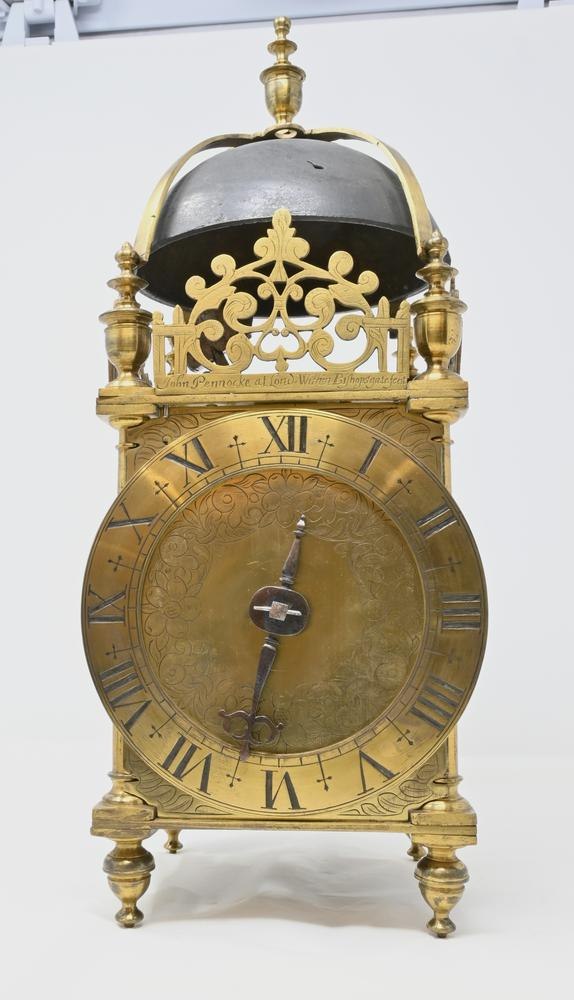
This English brass lantern clock is signed by London maker John Pennocke, dating to circa 1625–1635 or circa 1640 according to British Museum catalogue records. Built with a posted brass frame supported by turned pillars, finials, and feet, the movement was constructed originally with a balance and verge escapement before undergoing conversion to an anchor escapement. The weight-driven clock retains count-wheel striking, but its alarm train, alarm setting disk, pendulum, crutch, doors, and back plate are missing. The pierced front fret is engraved with strapwork and inscribed with Pennocke's signature along the lower border.

Front view of the John Pennocke lantern clock showing the pierced fret, floral engraved dial, chapter ring, and bell superstructure
Front view of the John Pennocke lantern clock showing the pierced fret, floral engraved dial, chapter ring, and bell superstructure — British Museum. Rights pending — permission not yet requested. Original source

Catalogue identity

Source
www.britishmuseum.org
Category
Clock · Lantern clock
Maker / attribution
John Pennocke
Reference
1888,1201.148
Catalogue / lot identifier
Source URL identifies the listing
Source-reported date
1625-1635
Country
England

Source-reported attribution and specifications are not independent authentication. A listing does not establish present ownership, current display, availability or permission to reproduce.

Object description

Identity and Production

The brass lantern clock is attributed to John Pennocke, a maker who is noted in the source to have been active in Bishopsgate, London, between 1630 and 1642. The production date of the object is recorded as 1625-1635.

The maker's signature is located on the lower border of the front fret, inscribed as "John Pennocke at Lond. Within Bishopsgate fecit".

Evidence for this section
  • “Made by: John Pennocke”
  • “Production date 1625-1635”
  • “Signed at the bottom of the front fret: "John Pennocke at Lond. Within Bishopsgate fecit".”

Construction and Dial

The clock is a weight-driven, wall-mounted lantern clock with a posted frame movement constructed primarily of brass. The front fret is pierced with a strapwork pattern and engraved.

The dial plate features an engraved floral pattern within the chapter ring. The center of the dial is open, as the original alarm setting disc is missing. The clock underwent severe over-cleaning in the 19th century, resulting in a loss of original surface; the shallow engraving was subsequently filled with black wax.

Evidence for this section
  • “Weight-driven, wall mounted lantern clock.”
  • “Posted frame movement constructed almost entirely of brass.”
  • “Frets pierced in a patern of strapwork; the front one additionally engraved.”
  • “It is engraved inside the chapterring with a floral patern”
  • “after scraping the now very shallow engraving was filled with black wax.”

Mechanical Modifications

The clock was originally designed with a verge escapement and balance. It has been converted to an anchor escapement with a long pendulum. The alarm mechanism is missing, and the alarm train is described as almost entirely absent.

Other components, including the spider, bell, and top finial, are noted as later replacements. The bell strap is constructed from five brazed parts, and the bell is noted to be too shallow for the hammer to reach properly.

Evidence for this section
  • “Formerly with verge escapement and balance. Now with anchor escapement and long pendulum”
  • “The spider, bell and top finial are all laer replacements.”
  • “the bell strap is built up out of five parts brazed together, and the bell is too shallow to be reached properly by the hammer.”

Open research questions

  • What is the historical context of the 19th-century holes in the bottom plate?
  • Are there further records detailing the clock's history prior to the Octavius Morgan bequest?

Source evidence

Recorded claims and source quotations for Lantern clock by John Pennocke
FieldSource-reported valueSource quotation
Museum number1888,1201.148“Museum number 1888,1201.148”
EscapementAnchor (conversion), verge (original)“Escapement anchor (conversion) verge (original)”
Maker signatureJohn Pennocke at Lond. Within Bishopsgate fecit“Signed at the bottom of the front fret: "John Pennocke at Lond. Within Bishopsgate fecit".”
Height406 mm“Height (over all) - 406 mm.”
ProvenanceBequeathed by Octavius Morgan in 1888“Octavius Morgan bequest; reg.1888,12-1,148.”
Museum number1888,1201.148“Museum number 1888,1201.148”
Overall height406 mm“Height (over all) - 406 mm.”
Missing partsSide doors and back plate are missing“The doors and the back plate missing”

Visible details

  • Pierced strapwork front fret engraved along the lower band with maker signature
  • Dial plate decorated with floral engraving inside the chapter ring, with an open center originally occupied by an alarm disk
  • Brass chapter ring with Roman numerals I through XII, half-hour markers, and inner quarter-hour track
  • Single steel hand with shaped tail and counterpoise mounting
  • Posted brass frame featuring turned corner pillars, top finials, and turned feet
  • Overhead bell supported by arched straps and crowned by a turned finial

Research qualifications

  • Source reports the spider, bell, and top finial are non-original replacements
  • Source notes the original balance and verge escapement were converted to an anchor escapement, with the pendulum and crutch now missing
  • Alarm train, central setting disk, side doors, and back plate are missing
  • Source notes 19th-century over-cleaning scraped the metal and dial engraving, which was subsequently filled with black wax

Photograph identity and source facts were screened before import; rights clearance remains pending.

Consulted source

alarm clock; lantern clock; striking clock; weight-driven clock | British Museum

Reviewed 2026-10-25 · Record bc2bc05236

Terms in this record

Glossary explanations for terms named in this object’s record.