
Skip to content
The Encyclopedia of Horology

Clock · Lantern clock

A 17th Century Lantern Clock, John Knibb of Oxford

Partially verified

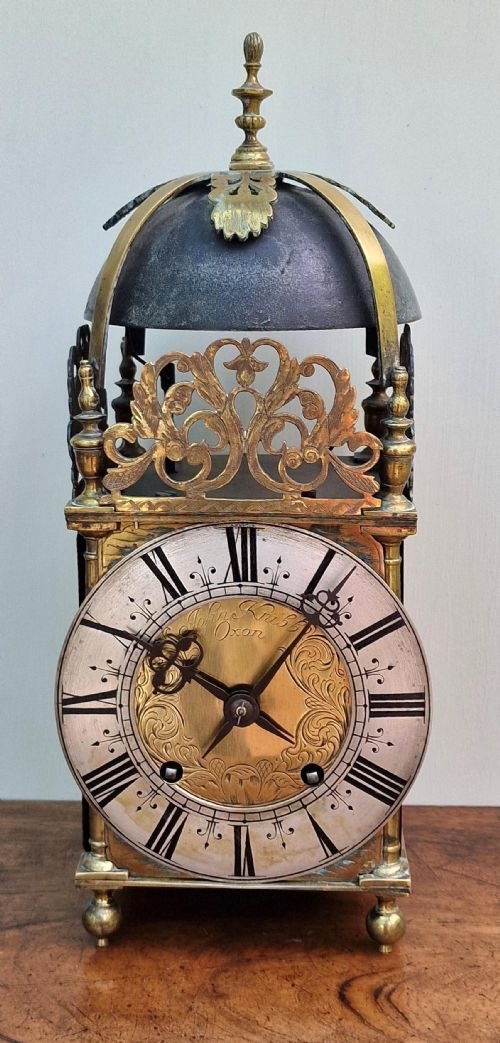
This lantern clock case is attributed by the seller to John Knibb of Oxford and dated to the 17th century (before 1700). The brass case features corner columns, pierced foliate frets, turned finials, ball feet, and a bell surmounted by crossed straps. The dial displays a silvered chapter ring with Roman numerals around an engraved gilt center signed 'John Knibb Oxon'. Originally built as a weight-driven movement, the clock is reported to have been fitted with a later Victorian Winterhalder & Hoffmeier (W&H) eight-day movement with twin winding arbors, striking the hours and half-hours.

Front view of the lantern clock case showing the engraved dial signed John Knibb Oxon and adapted winding apertures
Front view of the lantern clock case showing the engraved dial signed John Knibb Oxon and adapted winding apertures — Kembery Antique Clocks Ltd / Sellingantiques.co.uk. Rights pending — permission not yet requested. Original source

Catalogue identity

Source
www.sellingantiques.co.uk
Category
Clock · Lantern clock
Maker / attribution
John Knibb of Oxford
Reference
Not recorded
Catalogue / lot identifier
SA1078010
Source-reported date
17th century (before 1700)
Country
England

Source-reported attribution and specifications are not independent authentication. A listing does not establish present ownership, current display, availability or permission to reproduce.

Object description

Dial and Case Description

The clock case conforms to classic English lantern clock design, standing on turned feet and featuring turned corner column pillars below finials. The front plate is surmounted by a pierced scrolling fret beneath an arched bell canopy with crossed straps, holding what the seller describes as an original cast bell. The seller also notes side-opening doors enclosing the case sides.

The dial features an engraved center decorated with scrolling foliate designs, inscribed 'John Knibb Oxon' in script across the upper portion. It is surrounded by a silvered chapter ring calibrated with Roman numerals and half-hour fleur-de-lis markers. In the lower center, two winding apertures have been cut into the plate to service the replacement movement, driving a pair of pierced hands.

Evidence for this section
  • “A well engraved dial and surmounted by an original cast bell.”
  • “Side opening doors and standing on turned feet.”
  • “Central dial plate is engraved with foliate scrolls and inscribed in script 'John Knibb Oxon' in the upper half.”
  • “Front dial features a silvered chapter ring with Roman numerals and half-hour fleur-de-lis markers.”

Adapted Mechanism

Originally constructed as a weight-driven mechanism, the clock's movement has been replaced. The dealer states that a later Victorian movement by Winterhalder & Hoffmeier (W&H) has been adapted into the case.

This adapted replacement is an 8-day duration movement that strikes the hours and half-hours on the overhead bell. The dealer notes that internal plates retain the openings where drive ropes originally passed, though the internal movement itself is not depicted in the primary frontal photograph.

Evidence for this section
  • “A later, Victorian W&H mechanism has been adapted to the clock (originally it would have been a weight driven mechanism).”
  • “The pictures show the original plates where the rope would have gone through.”
  • “This strikes the hours and 1/2 hours on the bell and is of 8-day duration.”

Attribution and Dating Context

The seller dates the clock to the 'Before 1700' period and attributes it to John Knibb of Oxford. The listing references Brian Loomes's 'Lantern Clocks & Their Makers', citing Knibb as active from 1664 until his death in 1722.

Because the original weight-driven movement has been replaced with a Victorian mechanism, technical evaluation of the maker's movement work is not possible from the listing. The John Knibb attribution rests on the dial signature, the surviving case elements, and the dealer's assessment of the piece as a 17th-century case.

Evidence for this section
  • “Kembery Antique Clocks Ltd has dated this piece to the Before 1700 period.”
  • “John Knibb of Oxford is documented and illustrated in Loomes 'Lantern Clocks & Their Makers' book as working from 1664 and died in 1722.”
  • “It is a pity that it does not retain the original mechanism but this is still a chance to obtain a 17th century clock in a very original case at an affordable price.”

Open research questions

  • How was the Victorian Winterhalder & Hoffmeier movement secured to the surviving lantern clock frame and plates?
  • Does the dial plate show evidence of moved, plugged, or original dial feet connecting it to the lantern clock frame?
  • Are there any batch numbers, cast marks, or scratch marks visible on the brass case plates, frets, or doors that correspond to Knibb workshop practice?

Source evidence

Recorded claims and source quotations for A 17th Century Lantern Clock, John Knibb of Oxford
FieldSource-reported valueSource quotation
Attributed MakerJohn Knibb of Oxford“A 17th century English lantern clock by the eminent and renowned clockmaking family. Knibb of Oxford.”
Adapted MechanismLater Victorian W&H movement“A later, Victorian W&H mechanism has been adapted to the clock (originally it would have been a weight driven mechanism).”
Striking & Duration8-day duration, strikes hours and half hours“This strikes the hours and 1/2 hours on the bell and is of 8-day duration.”
DimensionsHeight 40 cm, Width 18 cm, Depth 17 cm“Height 15 1/2" / 40cms Width 6 1/2" / 18 cms (inc. chapter ring) Depth 6 1/2" / 17 cms”
Date DeclarationBefore 1700“Kembery Antique Clocks Ltd has dated this piece to the Before 1700 period.”
Maker Historical DatesActive from 1664, died 1722“John Knibb of Oxford is documented and illustrated in Loomes 'Lantern Clocks & Their Makers' book as working from 1664 and died in 1722.”
Case FeaturesSide opening doors and turned feet“Side opening doors and standing on turned feet.”

Visible details

  • Front dial features a silvered chapter ring with Roman numerals and half-hour fleur-de-lis markers.
  • Central dial plate is engraved with foliate scrolls and inscribed in script 'John Knibb Oxon' in the upper half.
  • Two winding apertures are visible in the lower dial center, fitted with modern pierced hands.
  • A pierced scrolling fret surmounts the front plate below an arched bell canopy with crossed straps and a central brass finial.
  • The case rests on turned brass feet and features turned corner column pillars and finials.

Research qualifications

  • The movement is not original; the dealer notes that a later Victorian W&H spring-driven mechanism was adapted into the case.
  • The internal mechanism is not visible in the primary frontal photograph.

Photograph identity and source facts were screened before import; rights clearance remains pending.

Consulted source

A 17th Century Lantern Clock, John Knibb of Oxford | Sellingantiques.co.uk

Reviewed 2026-10-21 · Record 8ca4983d3b

Terms in this record

Glossary explanations for terms named in this object’s record.