
Skip to content
The Encyclopedia of Horology

Clock · Lantern clock

18th-century brass lantern clock by J. Ettry of Horton

Partially verified

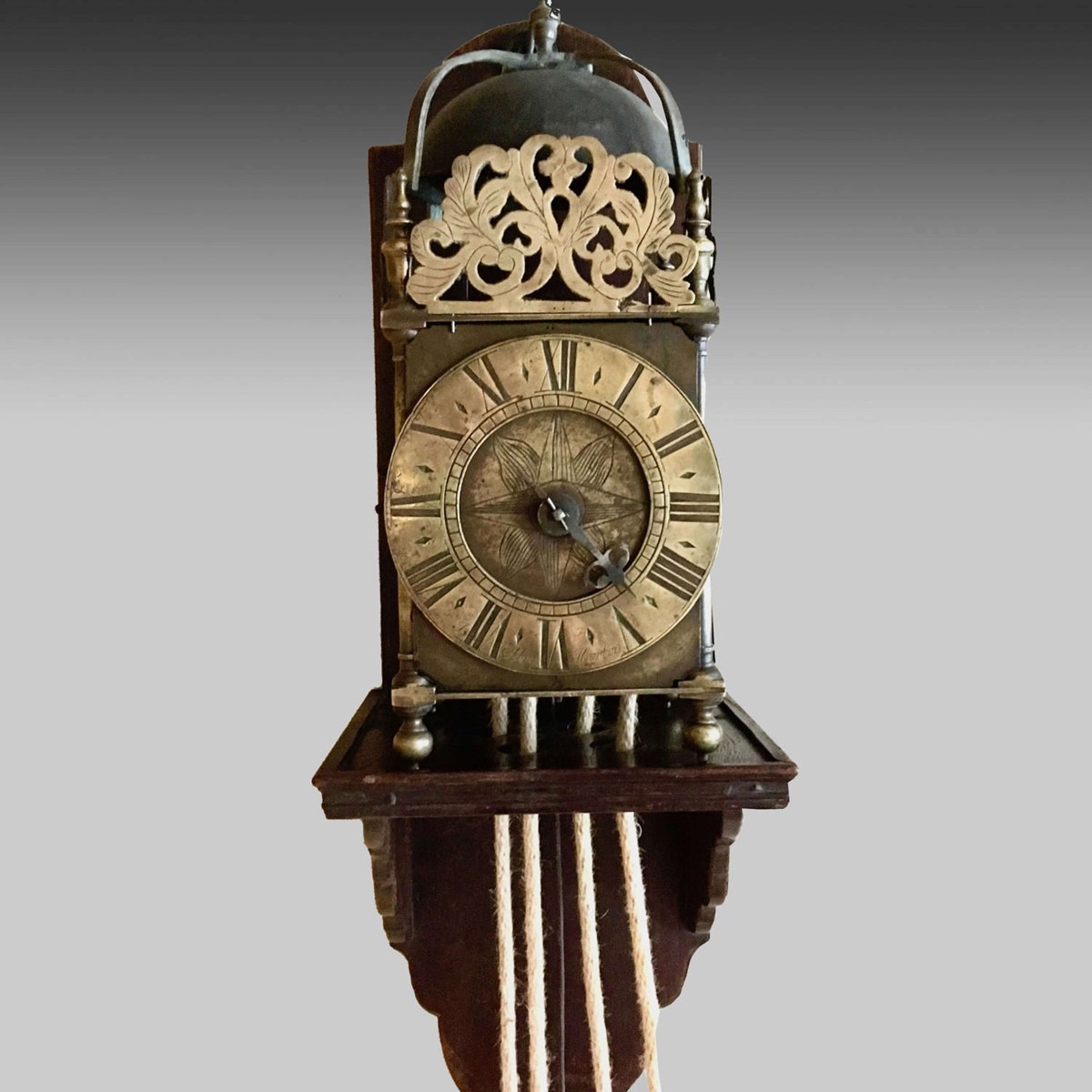
This is an 18th-century English brass lantern clock bearing the engraved dial signature 'J. Ettry. Horton', associated with the Ettry clockmaking family of Horton, Wiltshire. The brass chapter ring features Roman hour numerals and diamond half-hour divisions surrounding an engraved central floral star rosette. According to the seller, the timepiece runs on a 30-hour weight-driven movement striking on the hour under a bell strapped above pierced decorative brass frets. The case stands on four turned ball feet mounted upon a wooden wall bracket.

Frontal view of the brass lantern clock by J. Ettry on an oak wall bracket
Frontal view of the brass lantern clock by J. Ettry on an oak wall bracket — Baggott & Co.. Rights pending — permission not yet requested. Original source

Catalogue identity

Source
www.antiquesboutique.com
Category
Clock · Lantern clock
Maker / attribution
J. Ettry
Reference
1650 (AB-14401)
Catalogue / lot identifier
Source URL identifies the listing
Source-reported date
circa 1720 - 1750
Country
England

Source-reported attribution and specifications are not independent authentication. A listing does not establish present ownership, current display, availability or permission to reproduce.

Object description

Dial and Attribution

The brass dial measures 6 inches (15 cm) in diameter and displays Roman numerals with diamond half-hour divisions. Direct inspection shows a single pierced steel hand mounted to the central arbor and an engraved star and petal motif on the inner dial boss.

The dial is engraved with the maker's name, 'J. Ettry. Horton'. The seller notes that Ettry was a family of clockmakers—Jacob, Joel, and two Johns (father and son)—operating out of Horton, near Devizes, Wiltshire. The dealer dates the clock to English, circa 1720–1750.

Evidence for this section
  • “Lantern Clock Dial Diameter 6” (15cm)”
  • “The brass dial with Roman numerals and diamond half hour divisions.”
  • “Maker’s name, J. Ettry. Horton, engraved to dial.”
  • “Ettry was a well known family of clockmakers, Jacob, Joel & two Johns, father and son, working out of Horton, near Devizes, Wiltshire.”
  • “English, circa 1720 - 1750”
  • “Single pierced steel hand mounted to the central arbor.”
  • “Engraved star and petal motif centered on the inner dial boss.”

Case and Mounting

The clock case is constructed in brass with four turned ball feet, resting on an oak wall bracket. A pierced foliate fret is visible below the overhead bell canopy flanked by turned finials, with the seller stating that decorated, engraved, pierced frets are repeated to the sides.

The dimensions provided for the bracket are 24 inches high, 8 inches wide, and 8.5 inches deep. Cords for weight suspension are visible extending downward through the base of the oak bracket.

Evidence for this section
  • “All standing on four brass ball feet and supported on an oak wall bracket.”
  • “The decorated, engraved, pierced fret repeated to the sides”
  • “Height of Bracket 24” (61cm) Width 8” (20cm) Depth 8.5” (22cm)”
  • “Four brass ball feet resting on an oak wall bracket.”
  • “Four weight or pulley suspension cords extending downward through the base of the bracket.”

Movement and Condition Claims

The dealer describes the movement as a 30-hour clock movement striking on the hour. However, internal mechanical details such as the escapement, train configuration, and side doors are not visible in the provided image.

According to the seller, the piece was originally acquired in need of repair and has been professionally restored to full working order. The specific conservation interventions, replacement parts, or mechanical repairs are not detailed in the source documentation.

Evidence for this section
  • “over the 30-hour clock movement, which strikes on the hour.”
  • “The clock was bought in need of repair and now, having been professionally restored, is in full working order.”

Open research questions

  • Which member of the Ettry family (Jacob, Joel, John Sr., or John Jr.) corresponds to the engraved 'J. Ettry' mark?
  • What escapement is currently fitted to the movement (original verge with short pendulum or a later anchor conversion)?
  • What specific components or repairs were made during the seller-reported professional restoration?

Source evidence

Recorded claims and source quotations for 18th-century brass lantern clock by J. Ettry of Horton
FieldSource-reported valueSource quotation
Maker's signatureJ. Ettry. Horton“Maker’s name, J. Ettry. Horton, engraved to dial.”
Movement duration30-hour“over the 30-hour clock movement, which strikes on the hour.”
Datecirca 1720 - 1750“English, circa 1720 - 1750”
Dial diameter6” (15cm)“Lantern Clock Dial Diameter 6” (15cm)”
MountingOak wall bracket“All standing on four brass ball feet and supported on an oak wall bracket.”
Maker's operational localityHorton, near Devizes, Wiltshire“working out of Horton, near Devizes, Wiltshire.”
Bracket dimensionsHeight 24” (61cm), Width 8” (20cm), Depth 8.5” (22cm)“Height of Bracket 24” (61cm) Width 8” (20cm) Depth 8.5” (22cm)”

Visible details

  • Single pierced steel hand mounted to the central arbor.
  • Engraved star and petal motif centered on the inner dial boss.
  • Pierced foliate fret mounted below the bell canopy, flanking turned finials.
  • Four brass ball feet resting on an oak wall bracket.
  • Four weight or pulley suspension cords extending downward through the base of the bracket.

Research qualifications

  • Internal movement mechanism, escapement type, and side doors are not visible in the photograph.
  • Source notes the clock has undergone professional restoration.

Photograph identity and source facts were screened before import; rights clearance remains pending.

Consulted source

18th century brass lantern clock by J. Ettry of Horton in Antique Lantern Clocks

Reviewed 2026-10-21 · Record 6b70e8393f

Terms in this record

Glossary explanations for terms named in this object’s record.