
Skip to content
The Encyclopedia of Horology

Clock · Mantle clock

L'Afrique Mantle Clock

Partially verified

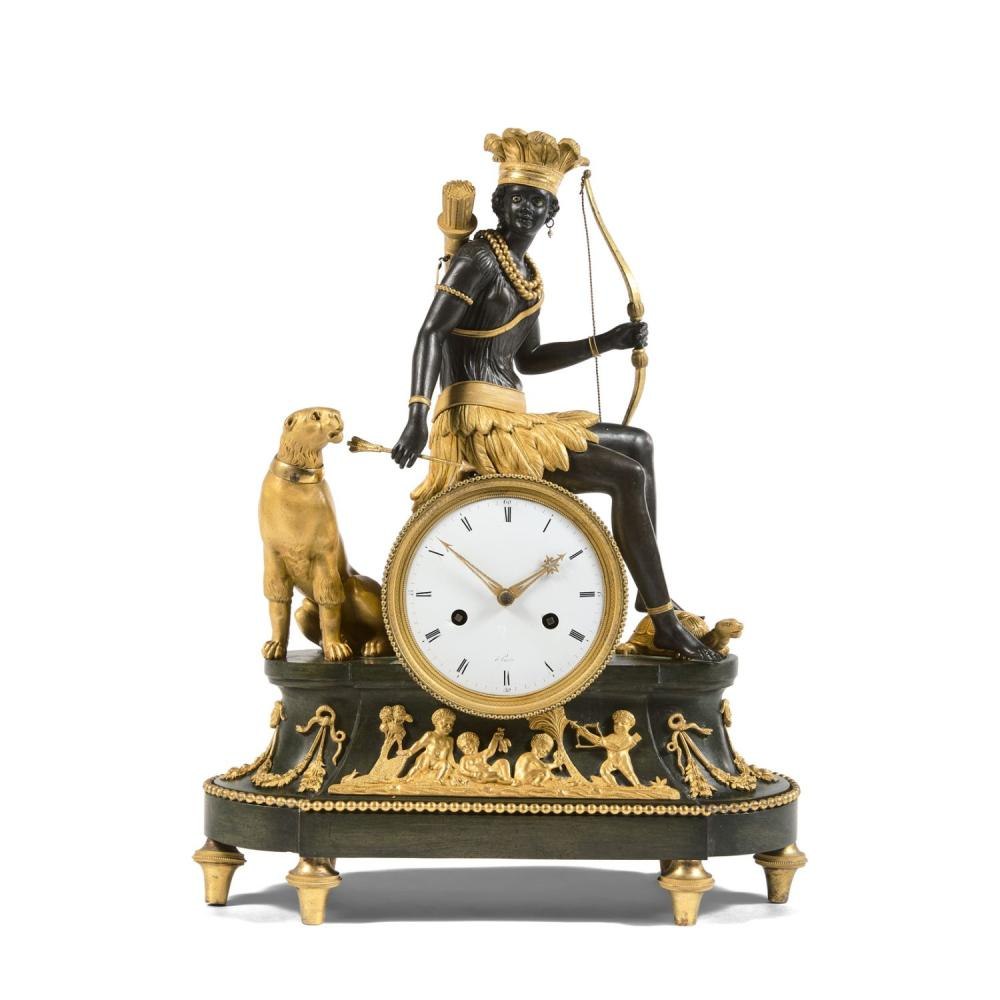
This mantle clock, titled 'L'Afrique' and attributed to Jean-Simon Deverberie, dates to circa 1800. Constructed in gilded and patinated brass, the timepiece features a circular movement with an anchor escapement and strikes the hours and half-hours on a bell, with an external count wheel. The dial is white enamel with Roman hour numerals and Arabic fifteen-minute markers, fitted with 'flèche' hands and a bezel decorated with pearls. The clock is set on an splayed plinth raised on six toupie feet, which is embellished with a frieze of three figures engaged in hunting, fishing, and gathering, overseen by a putto. The main subject is a female figure seated on the clock drum, adorned with a feathered headdress, tunic, and skirt, accompanied by a lioness.

L'Afrique mantle clock, featuring a central huntress figure and a lioness, resting on a plinth with sculptural reliefs.
L'Afrique mantle clock, featuring a central huntress figure and a lioness, resting on a plinth with sculptural reliefs. — Tajan (via Invaluable). Rights pending — permission not yet requested. Original source

Catalogue identity

Source
www.invaluable.com
Category
Clock · Mantle clock
Maker / attribution
Attributed to Jean-Simon Deverberie
Reference
Not recorded
Catalogue / lot identifier
185
Source-reported date
circa 1800
Source-reported place
France

Source-reported attribution and specifications are not independent authentication. A listing does not establish present ownership, current display, availability or permission to reproduce.

Object description

Case and Aesthetic Design

The clock is housed in a case of gilded and patinated brass, centered on a sculptural representation of a huntress. The central figure, seated upon the cylindrical clock housing, wears a feathered crown and a tunic accented with a feathered apron. Behind her is a quiver of arrows, while her left hand grips a bow. To her right, a lioness sits on the plinth. The clock drum is framed by a bezel detailed with a row of pearls, which complements the pearl-adorned splayed plinth below.

The plinth, which is elevated on six toupie feet, serves as a stage for sculptural relief work. It depicts three figures occupied with hunting, fishing, and gathering activities, monitored by a putto aiming an arrow. The lateral ends of the base are finished with decorative garlands featuring leaves and fruits, providing a dense ornamentation consistent with the sculptural theme.

Evidence for this section
  • “socle évase avec six pieds toupie orné d'un rang de perles et d'une scène présentant trois négrillons occupés de la chasse, la pêche et la cueillette”
  • “la chasseresse est assise sur le tambour de l'horloge, carquois de flèches sur son dos et arc à la main gauche”
  • “les côtés ornés des guirlandes de feuilles et de fruits”

Movement and Dial Details

The timepiece utilizes a round movement equipped with an anchor escapement. It provides a striking function for the hours and half-hours, which acts upon a bell. The mechanism incorporates an external count wheel, a feature often associated with clocks of this era.

The white enamel dial features Roman numerals for hours and Arabic numerals for fifteen-minute increments. The time is indicated by brass 'flèche' (arrow-shaped) hands. The auction description notes that the dial bears the inscription 'à Paris', though the piece itself is unsigned by a specific maker. A slight crack is reported on the enamel dial surface.

Evidence for this section
  • “mouvement rond, échappement à ancre, roue de compte à l'extérieur, sonnerie sur timbre”
  • “Cadran en émail blanc (légère fêlure), chiffres romains pour les heures, arabes pour les 15 minutes, aiguilles 'flèche' en laiton doré”
  • “marqué 'à Paris' sur le cadran”

Documentation and Comparative Models

This clock belongs to a series of models historically associated with Jean-Simon Deverberie, dating back to 1798/99 (An VII). The model is documented in various horological publications, including references to draped and undraped variations. Comparisons are drawn to examples housed in public collections, such as the Musée des Arts Décoratifs in Paris, which similarly feature only the 'à Paris' signature designation.

The auction description confirms that while this specific item is attributed to Deverberie, it is noted to have small accidents, losses, and restorations. These historical references serve to situate the object within a broader context of early 19th-century French mantle clock production, particularly those focusing on 'Afrique' themed motifs.

Evidence for this section
  • “Rare modèle d'Afrique, réalisé d'après le modèle de Deverberie (An VII [1798/99]”
  • “Le même model portant, comme ici, uniquement la partie 'à Paris' de la signature se trouve au Musée des Arts Décoratifs, Paris”
  • “(Petits accidents, manques et restaurations)”

Open research questions

  • Could the internal movement markings provide further clarity on the clock's production date or maker?
  • Are there additional archival records that could confirm if this specific unit is the one referenced in the 1978 Saint Omer exhibition catalogue?

Source evidence

Recorded claims and source quotations for L'Afrique Mantle Clock
FieldSource-reported valueSource quotation
Maker attributionAttributed to Jean-Simon Deverberie“ATTRIBUÉE À JEAN-SIMON DEVERBERIE”
Dimensions48 x 37 cm“48 x 37 CM”
Dial markingà Paris“marqué 'à Paris' sur le cadran”
EscapementAnchor“échappement à ancre”
Striking mechanismHours and half-hours on a bell“sonnerie des heures et demi”
Base constructionSix toupie feet“six pieds toupie”
DateCirca 1800“VERS 1800”

Visible details

  • The dial is inscribed 'à Paris' at the base.
  • A quiver of arrows is mounted on the back of the female figure.
  • The base is ornamented with garlands of foliage and fruit at the sides.
  • The figure's left hand holds a bow while her right hand holds an arrow.

Research qualifications

  • The exact identity of the clockmaker remains unconfirmed beyond the attribution to Jean-Simon Deverberie.
  • The specific provenance of this individual example is not detailed beyond its resemblance to documented models.

Photograph identity and source facts were screened before import; rights clearance remains pending.

Terms in this record

Glossary explanations for terms named in this object’s record.