
Skip to content
The Encyclopedia of Horology

Clock · Mantle clock

George III ebonised mantle clock by James McCabe, No. 1556

Partially verified

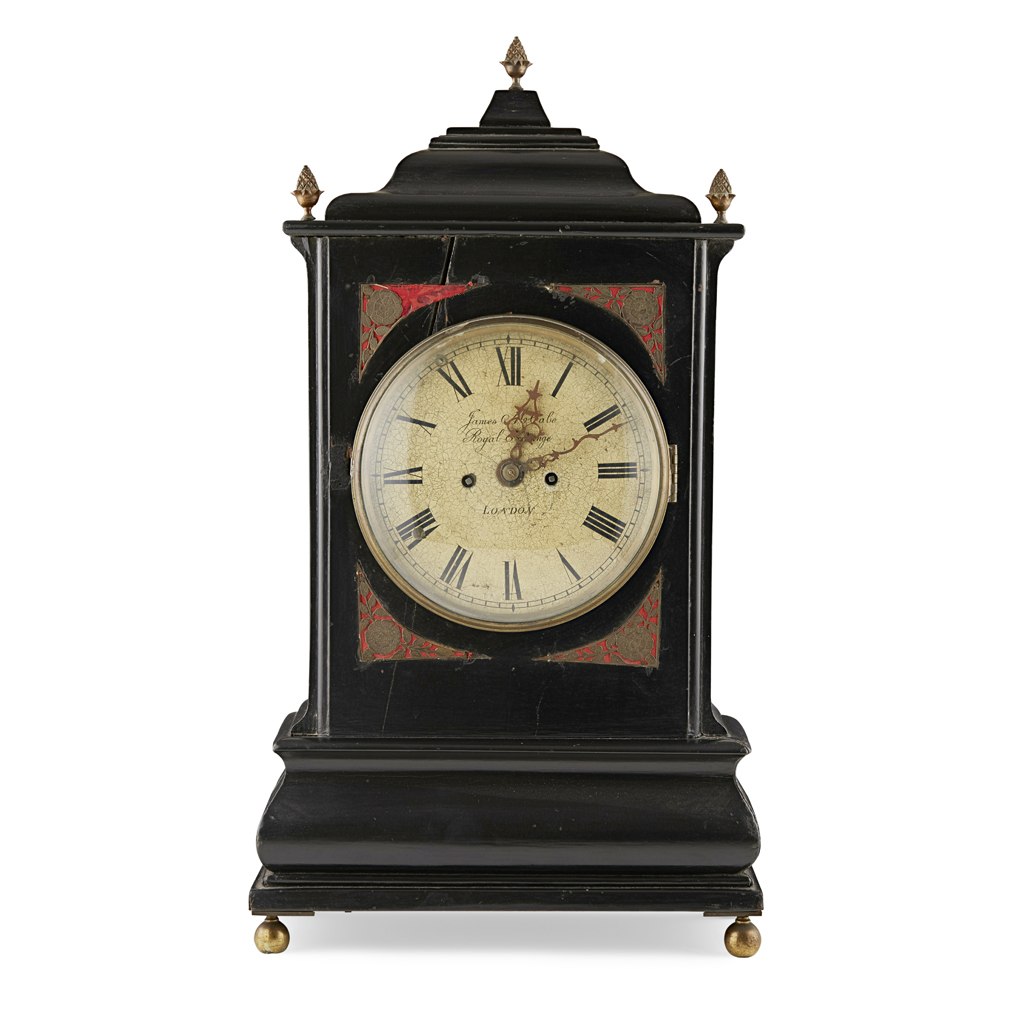
According to the auction catalog, this George III period ebonised mantle clock is attributed to James McCabe of Royal Exchange, London, numbered 1556, and dates to the late 18th century. The inverted bell-top case features brass pinecone finials, corner spandrels backed by red fabric, and an ogee-moulded base resting on brass ball feet. The circular enamel dial displays Roman numerals with two winding apertures. The source reports that the clock is driven by an eight-day double-fusee movement with an anchor escapement striking a bell, and features an engraved signed backplate.

Front view of the George III ebonised mantle clock by James McCabe
Front view of the George III ebonised mantle clock by James McCabe — Lyon & Turnbull. Rights pending — permission not yet requested. Original source

Catalogue identity

Source
www.lyonandturnbull.com
Category
Clock · Mantle clock
Maker / attribution
James McCabe
Reference
Not recorded
Catalogue / lot identifier
131
Source-reported date
Late 18th century
Country
United Kingdom
Source-reported serial
1556

Source-reported attribution and specifications are not independent authentication. A listing does not establish present ownership, current display, availability or permission to reproduce.

Object description

Case and Exterior Construction

The clock is housed in an ebonised inverted bell-top case. It is supported by an ogee-moulded base resting on brass ball feet.

Exterior ornamentation includes three brass pinecone finials, pierced brass rose spandrels, and fret panels on the sides. A vertical crack or seam is noted on the front case door above the dial.

Evidence for this section
  • “inverted bell top ebonised case with brass pine cone finials and pierced brass rose spandrels and fret panels to the sides, on an ogee moulded base with brass ball feet”
  • “Prominent vertical crack or seam visible above the dial on the front case door”

Dial and Visual Features

The clock features a circular enamel dial displaying Roman numerals. It is signed 'James McCabe/ Royal Exchange/ London' and contains two winding holes.

The enamel surface displays heavy crazing.

Evidence for this section
  • “the circular enamelled Roman numeral dial with two winding holes, signed 'James McCabe/ Royal Exchange/ London'”
  • “Circular white dial with Roman numerals and heavy crazing across the enamel surface”

Movement and Inscriptions

The internal mechanism is described as an eight-day double-fusee movement with an anchor escapement, configured to strike a bell.

The backplate is engraved with the maker's details and the serial number 1556.

Evidence for this section
  • “the eight day double-fusee movement with anchor escapement and striking a bell”
  • “the backplate engraved 'James McCabe/ Royal Exchange/ London/ 1556'”

Open research questions

  • What is the cause of the vertical seam above the dial door?
  • Does the serial number 1556 correspond to existing records for James McCabe clocks?

Source evidence

Recorded claims and source quotations for George III ebonised mantle clock by James McCabe, No. 1556
FieldSource-reported valueSource quotation
Dial SignatureJames McCabe, Royal Exchange, London“signed 'James McCabe/ Royal Exchange/ London'”
Backplate InscriptionJames McCabe, Royal Exchange, London, 1556“the backplate engraved 'James McCabe/ Royal Exchange/ London/ 1556'”
Movement MechanismEight-day double-fusee movement with anchor escapement“the eight day double-fusee movement with anchor escapement and striking a bell”
Case DescriptionInverted bell top ebonised case with brass pine cone finials and feet“inverted bell top ebonised case with brass pine cone finials and pierced brass rose spandrels and fret panels to the sides, on an ogee moulded base with brass ball feet”
Dimensions36cm wide, 64cm high, 18cm deep“36cm wide, 64cm high, 18cm deep”

Visible details

  • Inverted bell-top ebonised case surmounted by three brass pinecone finials
  • Circular white dial with Roman numerals and heavy crazing across the enamel surface
  • Two winding apertures flanking the central hand arbor
  • Pierced corner spandrels backed by red fabric framing the circular dial bezel
  • Moulded ogee base raised on round brass ball feet
  • Prominent vertical crack or seam visible above the dial on the front case door

Research qualifications

  • Backplate engraving, movement mechanism, internal bell, and side fret panels are documented by the auctioneer but not visible in the front photograph.

Photograph identity and source facts were screened before import; rights clearance remains pending.

Terms in this record

Glossary explanations for terms named in this object’s record.