
Skip to content
The Encyclopedia of Horology

Clock · Mantle clock

Slark mahogany mantle clock

Partially verified

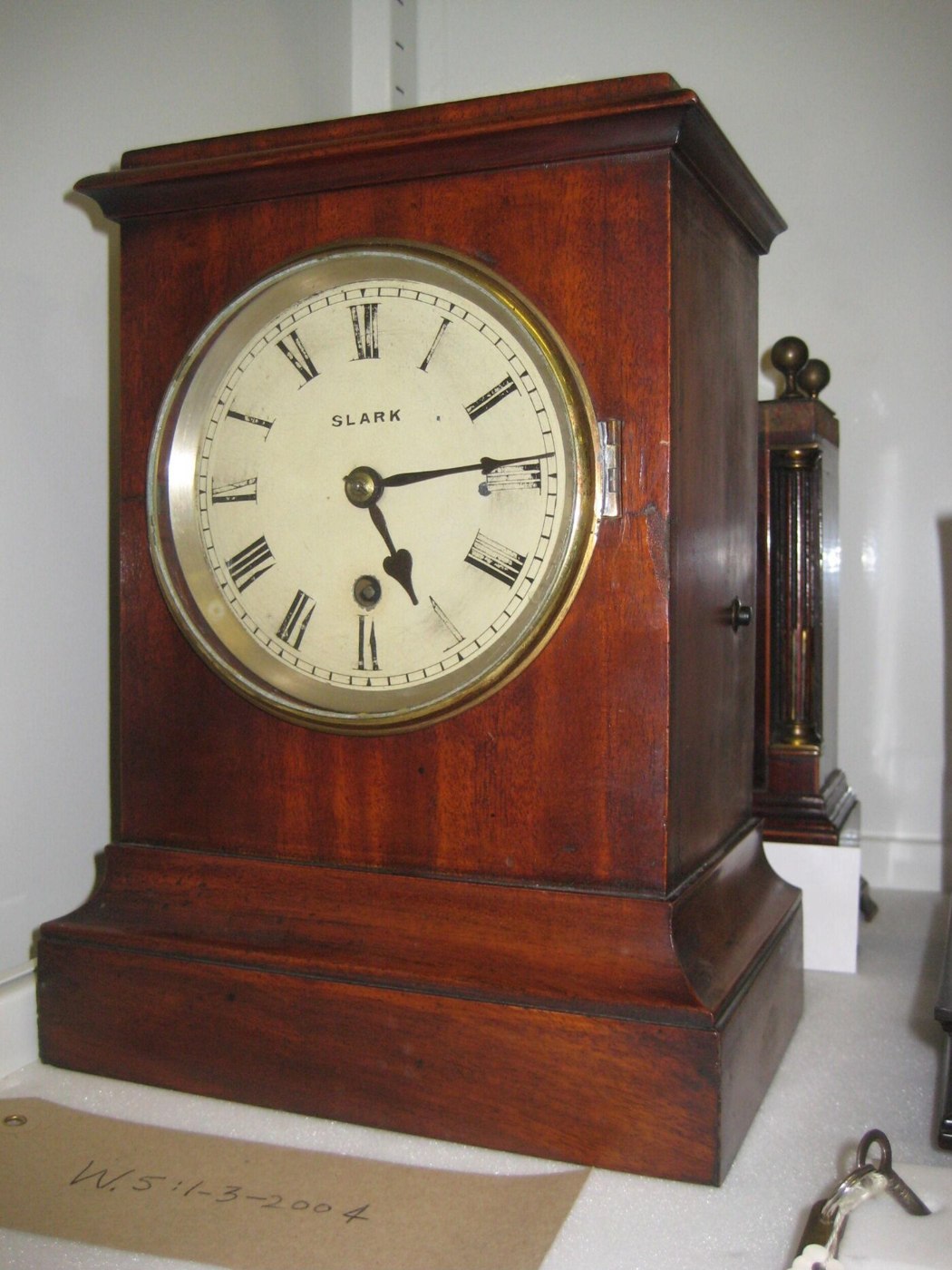
This rectangular mahogany clock is attributed to the period 1850-1900 and is currently housed in the Victoria and Albert Museum collection. The clock face is marked with the name 'Slark', who was potentially William Slark, a watchmaker operating at 70 Brompton Road, London, in 1866. It includes a paper label from the retailer 'C. Sansom, Watch & Clock Maker', located at 2 Montpelier Street, Brompton Road. The clock was formerly utilized by staff within the Museum Superintendent's room. Its construction consists of a plain wooden case set on a plinth, with a single winding hole on the painted dial. , which was acquired for the collection in 2004 as an example of museum administrative history.

Front view of the Slark mahogany mantle clock showing the painted Roman numeral dial and the accession tag W.5:1-3-2004.
Front view of the Slark mahogany mantle clock showing the painted Roman numeral dial and the accession tag W.5:1-3-2004. — Victoria and Albert Museum. Rights pending — permission not yet requested. Original source

Catalogue identity

Source
collections.vam.ac.uk
Category
Clock · Mantle clock
Maker / attribution
Slark
Reference
Not recorded
Catalogue / lot identifier
W.5-2004
Source-reported date
1850-1900
Source-reported place
London, England

Source-reported attribution and specifications are not independent authentication. A listing does not establish present ownership, current display, availability or permission to reproduce.

Object description

Case and Dial Construction

The clock features a plain, rectangular mahogany exterior supported by a base plinth. The construction emphasizes utility over ornamentation, consistent with the requirements for furnishings supplied for public offices during the Victorian period. The clock face displays Roman numerals, though the paint is currently showing signs of wear and rubbing. A single winding hole is located on the dial face.

The case includes a rear glazed door, which provides access to the movement. The hinge mechanism for this door has undergone a repair involving resoldering. While a keyhole is present on the side of the clock to lock the glass, the original key is missing. The exterior veneer is noted to have a section missing on the front of the case to the right of the clock face.

Evidence for this section
  • “Plain rectangular mahogany case on a plinth”
  • “Bit of veneer missing on front of case to Right of face”
  • “Numerals rubbed”
  • “Repair to hinge of glass - resoldered”

Marks, Labels, and Identification

The clock is identified by a 'Slark' signature on the face. Archival research suggests this may be William Slark, a watchmaker recorded at 70 Brompton Road, London, in 1866. A paper label affixed to the clock identifies C. Sansom of 2 Montpelier Street, Brompton Road, as the retailer.

Additional documentation is provided by paper labels located on the inside and outside of the clock. These labels confirm the object was previously assigned for use within the Museum Superintendent's room. Further internal museum markings include 'C1a 11/92' and '4038', which help distinguish this piece as former office equipment.

Evidence for this section
  • “marked 'Slark' on face”
  • “paper label of 'C. Sansom, Watch & Clock Maker, 2 Montpelier Street, Brompton Road, SW'”
  • “The clock also bears paper labels indicating that it was used in the Museum Superintendent's room at one time”

History and Acquisition

The clock was recovered from an office within the museum directorate in 2004 and subsequently accessioned into the permanent collection. It is maintained not only for its timekeeping function but as a primary source for understanding the institutional history and the types of office furniture procured by the museum in the 19th century.

Records indicate that C. Sansom was a recurring supplier for the museum, with other clocks in the collection bearing his label, some specifically identifying his firm as 'Clock Makers to the Department of Science and the South Kensington Museum'. While the clock is now associated with the broader collection, its specific history within the Museum Superintendent’s office serves as an illustration of the daily administrative environment of the South Kensington Museum during the 19th century.

Evidence for this section
  • “Found in Ian Blatchford's Office, Directorate, in 2004”
  • “Accessioned because evidently an early piece of museum furnishing”
  • “Sansom might have made the clock case or simply retailed the clock”

Open research questions

  • Is there any surviving internal movement documentation to definitively link the 'Slark' mark to the 1866 William Slark?
  • Were there other specialized furniture suppliers for the museum that parallel the Sansom and Slark relationship?

Source evidence

Recorded claims and source quotations for Slark mahogany mantle clock
FieldSource-reported valueSource quotation
MakerSlark“Maker: Slark (maker)”
Date1850-1900“Date: 1850-1900”
MaterialsMahogany“Materials and techniques: Mahogany”
RetailerC. Sansom“paper label of 'C. Sansom, Watch & Clock Maker, 2 Montpelier Street, Brompton Road, SW'”
ProvenanceMuseum Superintendent's room“used in the Museum Superintendent's room at one time”
Dimensions29 cm height“Height: 29 cm”
Accession numberW.5-2004“Accession number: W.5-2004”

Visible details

  • Plain rectangular mahogany case on a plinth
  • Roman numeral dial with a single winding hole
  • Visible missing veneer to the right of the face
  • Presence of an internal paper label from C. Sansom

Research qualifications

  • The exact identification of 'Slark' remains a possibility rather than a confirmed fact
  • The specific role of C. Sansom as either maker or retailer is not definitively established

Photograph identity and source facts were screened before import; rights clearance remains pending.

Consulted source

Clock

Reviewed 2026-10-26 · Record 39c5f1c529

Terms in this record

Glossary explanations for terms named in this object’s record.