
Skip to content
The Encyclopedia of Horology

Clock · Mantle clock

French Late 19th-Century 8-Day Mantle Clock in Alabaster Case

Partially verified

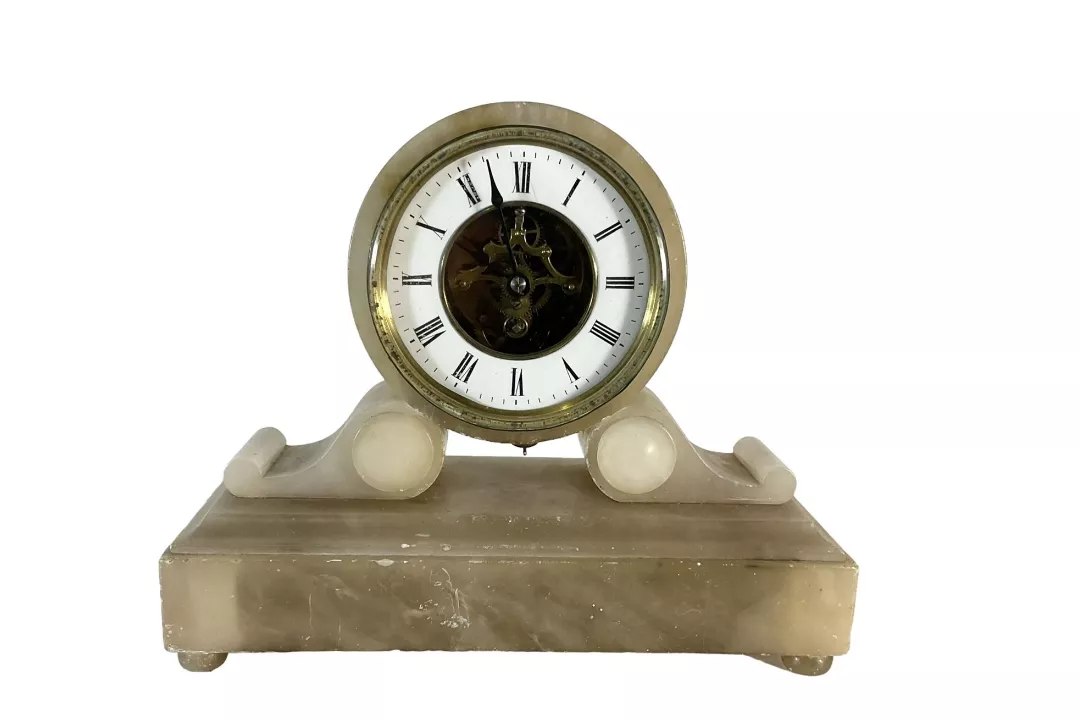
According to the auctioneer, this late 19th-century French mantle clock features an 8-day single-train movement with a tic-tac escapement and integral pendulum, wound and set from the front. The drum movement is mounted in an alabaster case supported by twin scroll brackets upon a stepped rectangular plinth base with small turned feet. A glazed brass bezel encloses an open-center dial showing the brass skeleton movement, escapement, and motion work, framed by a white enamel chapter ring with Roman numerals and spade hands.

Front view of the late 19th-century French alabaster mantle clock
Front view of the late 19th-century French alabaster mantle clock — Duggleby Stephenson of York. Rights pending — permission not yet requested. Original source

Catalogue identity

Source
www.the-saleroom.com
Category
Clock · Mantle clock
Maker / attribution
Not established
Reference
Not recorded
Catalogue / lot identifier
6268
Source-reported date
late 19th century
Country
France

Source-reported attribution and specifications are not independent authentication. A listing does not establish present ownership, current display, availability or permission to reproduce.

Object description

Case Construction

The clock is contained within an alabaster case, which features a drum movement raised on scroll supports and a stepped plinth.

The base of the assembly is finished with small turned feet.

Evidence for this section
  • “French - late 19th century 8-day mantle clock in an alabaster case”
  • “drum movement raised on scroll supports and stepped plinth”

Dial and Visual Mechanics

The timepiece features an open dial displaying the skeleton movement, escapement, and motion work. A glazed brass bezel encloses the display.

An enamel chapter ring is present, featuring Roman numerals and spade hands.

Evidence for this section
  • “open dial displaying the skeleton movement, escapement and motion work”
  • “enamel chapter with Roman numerals and spade hands enclosed within a glazed brass bezel”

Movement and Operation

The clock is an 8-day mantle clock with a single-train tick-tac escapement and an integral pendulum.

The mechanism is designed to be wound and set from the front.

Evidence for this section
  • “8-day mantle clock”
  • “single train tick tac escapement with integral pendulum”
  • “wound and set from the front”

Open research questions

  • What specific type of alabaster was commonly used in late 19th-century French mantle clock production?
  • Are there specific manufacturer signatures or marks commonly hidden on the interior plates of this style of drum clock?

Source evidence

Recorded claims and source quotations for French Late 19th-Century 8-Day Mantle Clock in Alabaster Case
FieldSource-reported valueSource quotation
Case materialAlabaster“late 19th century 8-day mantle clock in an alabaster case”
Movement duration8-day“late 19th century 8-day mantle clock”
EscapementSingle train tick tac escapement with integral pendulum“single train tick tac escapement with integral pendulum”
Dial structureOpen dial displaying skeleton movement and enamel chapter ring“open dial displaying the skeleton movement, escapement and motion work, enamel chapter with Roman numerals”

Visible details

  • Alabaster drum casing supported on two outward-curving scrolled supports.
  • Stepped rectangular plinth resting on small rounded feet.
  • White enamel chapter ring with black Roman numerals and an outer minute track.
  • Skeletonised center revealing brass movement wheels and escapement work.
  • Dark spade hour and minute hands.
  • Visible small marks, natural veining, and light wear along the alabaster surface.

Research qualifications

  • Maker and specific regional origin within France are not stated.
  • Rear movement plate, escapement detail, and pendulum are not visible from the primary front image.

Photograph identity and source facts were screened before import; rights clearance remains pending.

Terms in this record

Glossary explanations for terms named in this object’s record.