
Skip to content
The Encyclopedia of Horology

Clock · Longcase clock

Justin Vulliamy George II Longcase Clock

Partially verified

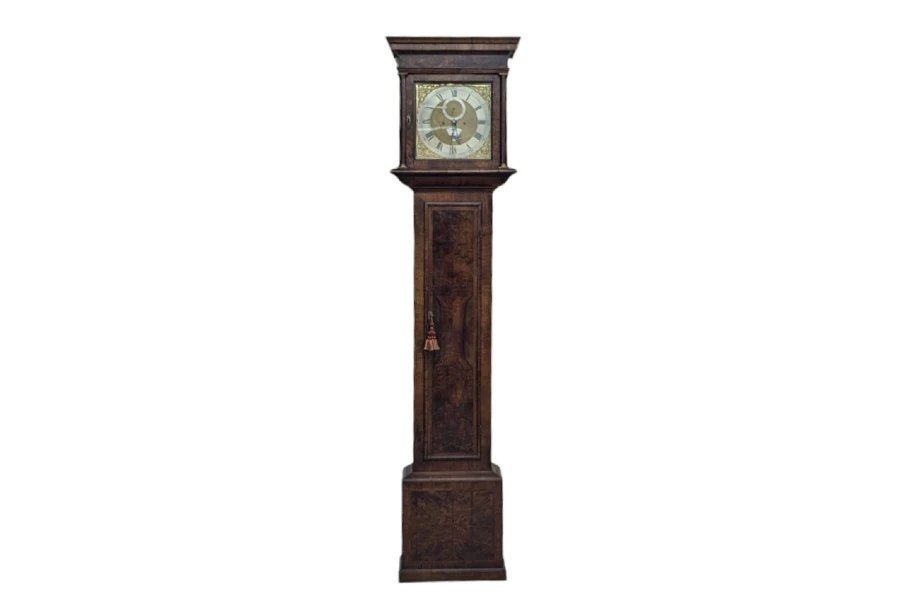
This eight-day longcase clock is attributed to Justin Vulliamy, clockmaker to King George II, and dates to approximately 1744. The timepiece features a five-pillar, key-wound, weight-driven movement equipped with a deadbeat escapement and rack striking mechanism that sounds the full hours on a bell. The brass dial includes a silvered chapter ring with Roman numerals, an outer minute track, and a silvered seconds dial, all complemented by brass foliate spandrels and blued steel hands. A silvered name plaque identifies the maker. The housing is a walnut-veneered oak case topped with a flat-hood featuring brass-mounted columns. The clock stands 218cm high, 50cm wide, and 25cm deep. It retains its original locks and key.

Frontal view of the dial and flat-top hood of the Justin Vulliamy longcase clock.
Frontal view of the dial and flat-top hood of the Justin Vulliamy longcase clock. — W J Morris Clocks. Rights pending — permission not yet requested. Original source

Catalogue identity

Source
wjmorrisclocks.co.uk
Category
Clock · Longcase clock
Maker / attribution
Justin Vulliamy
Reference
Not recorded
Catalogue / lot identifier
Source URL identifies the listing
Source-reported date
circa 1744
Source-reported place
England

Source-reported attribution and specifications are not independent authentication. A listing does not establish present ownership, current display, availability or permission to reproduce.

Object description

Dial and Movement

The clock is powered by an eight-day, weight-driven movement constructed with five pillars. The timekeeping is regulated by a deadbeat escapement, and the clock features a rack striking mechanism designed to chime the full hours on a bell. The weights and the pendulum's brass bob are visible within the case interior.

The square brass dial is adorned with four corner foliate spandrels. The silvered chapter ring displays Roman numerals for the hours and a minute track on the outer edge, accompanied by a silvered seconds dial. A silvered plaque situated on the dial bears the signature of Justin Vulliamy, London, and the time is indicated by blued steel hands.

Evidence for this section
  • “5 pillar 8 day key wound weight driven movement, dead beat escapement, rack striking.”
  • “Striking the full hours to a bell.”
  • “Brass weights, very large brass bob to pendulum.”
  • “Square brass face, silvered chapter ring, Roman numerals, minutes to outer ring, silvered seconds ring, silvered name plaque showing Justin Vulliamy London all surrounded by brass foliate spandrels, blued steel hands.”

Case Construction

The housing consists of an oak case finished with walnut veneers. The upper section features a flat-top hood, which is flanked by brass-mounted columns located on either side of the hood door. The case retains the original locks and key for both the hood and trunk doors.

The auction description reports that the back board of the case has been replaced at some point, with the replacement performed on a like-for-like basis to maintain the object's original appearance. The exterior dimensions of the clock are 218cm in height, 50cm in width, and 25cm in depth.

Evidence for this section
  • “Walnut veneered Oak case, with flat top hood, brass mounted columns to either side of hood door, original locks & key to both doors.”
  • “Back board has been replaced like for like at some point in its life.”
  • “Height 218cm Width 50cm Depth 25cm.”

Historical Context and Attribution

The maker, Justin Vulliamy, is noted as having served as clockmaker to King George II. The source identifies this specific object as a timepiece dating to circa 1744.

The object is currently located in Nantwich, Cheshire, where it is available for viewing at the Dagfields Craft and Antiques centre.

Evidence for this section
  • “Justin Vulliamy ( clock maker to King George 2nd) 8 Day Longcase, circa 1744.”
  • “Sister clock is on display in the Science Museum Londen, No 737.”
  • “Available to view (highly recommended) and purchase in our shop at Dagfields Craft and Antiques, Walgherton, Nantwich, Cheshire CW5 7LG”

Open research questions

  • Can the attribution of the movement and dial to Justin Vulliamy be confirmed through comparison with known Vulliamy archives?
  • Does the number 737 on the Science Museum clock provide a specific chronological benchmark to verify the circa 1744 dating of this object?

Source evidence

Recorded claims and source quotations for Justin Vulliamy George II Longcase Clock
FieldSource-reported valueSource quotation
MakerJustin Vulliamy“Justin Vulliamy ( clock maker to King George 2nd)”
Datecirca 1744“circa 1744.”
Escapementdead beat escapement“dead beat escapement”
Strikingrack striking“rack striking”
Movement5 pillar 8 day key wound“5 pillar 8 day key wound weight driven movement”
Dimensions218cm x 50cm x 25cm“Height 218cm Width 50cm Depth 25cm.”
Case materialWalnut veneered Oak“Walnut veneered Oak case”
Provenance claimScience Museum London“Sister clock is on display in the Science Museum Londen, No 737.”

Visible details

  • Brass weights and large brass bob pendulum visible inside case
  • Blued steel hands on the dial
  • Walnut veneer on the exterior case
  • Square brass face with foliate spandrels

Research qualifications

  • The exact original state of the internal components is not verifiable
  • The 'sister clock' comparison is a claim from the source

Photograph identity and source facts were screened before import; rights clearance remains pending.

Consulted source

Justin Vulliamy George II Longcase

Reviewed 2026-11-02 · Record f284947f42

Terms in this record

Glossary explanations for terms named in this object’s record.