
Skip to content
The Encyclopedia of Horology

Pocket watch · Hunting-cased, keyless pocket watch with independent seconds

Jules Jürgensen Secondes Foudroyantes Pocket Watch

Partially verified

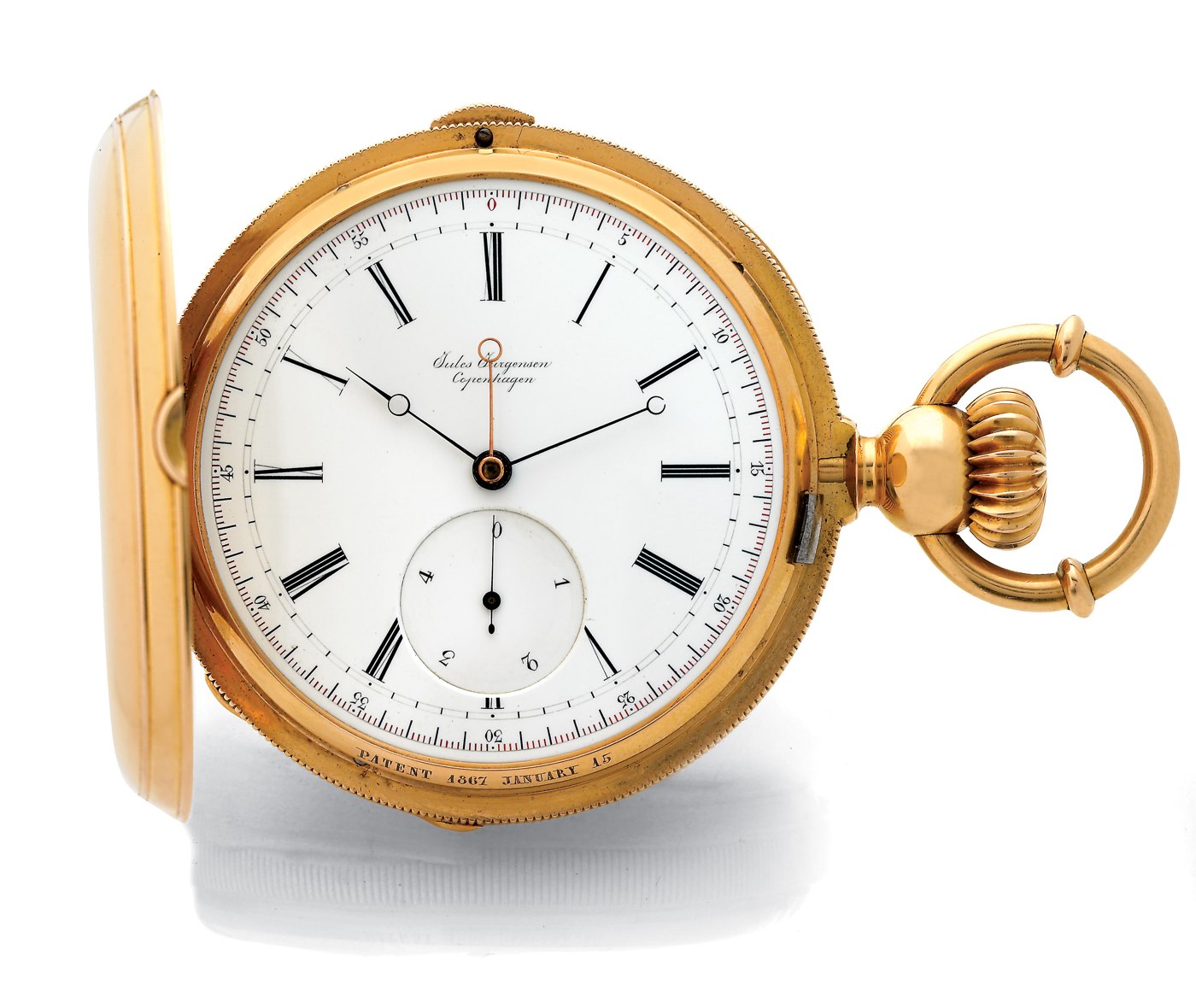
This hunting-cased, keyless pocket watch, numbered 11762, was produced by Jules Jürgensen in Switzerland, specifically for the North American market around 1870. The watch is constructed in 18k pink gold and features a 'bassine et filets' four-body case. The timepiece features Jürgensen's patented bow-setting mechanism, with the bezel engraved 'Patent 1867 January 15'. The white enamel dial displays radial Roman numerals and an outermost 1/5th seconds track. The movement is a 20-ligne nickel caliber, finished with 25 jewels, a straight-line counterpoised lever escapement, and a cut bimetallic compensation balance with an off-center index regulator featuring a Jürgensen micrometer scale. A unique functional aspect includes the independent seconds and diablotine locking automatically when the hunting case cover is closed.

Front view of the Jules Jürgensen hunting-cased watch with the cover open, showing the dial, hands, and crown/bow.
Front view of the Jules Jürgensen hunting-cased watch with the cover open, showing the dial, hands, and crown/bow. — Antiquorum. Rights pending — permission not yet requested. Original source

Catalogue identity

Source
catalog.antiquorum.swiss
Category
Pocket watch · Hunting-cased, keyless pocket watch with independent seconds
Maker / attribution
Jules Jürgensen
Reference
Not recorded
Catalogue / lot identifier
143
Source-reported date
circa 1870
Source-reported place
Switzerland
Source-reported serial
11762

Source-reported attribution and specifications are not independent authentication. A listing does not establish present ownership, current display, availability or permission to reproduce.

Object description

Case and Dial

The timepiece is housed in a four-body, hunting-style case manufactured in 18k pink gold. The case features a 'bassine et filets' design with polished surfaces and an engine-turned case band. A significant horological feature of the case design is the patent bow-setting mechanism, with the bezel clearly engraved indicating a patent date of January 15, 1867. The interior of the case back bears an inscription dated 1905, and the watch is completed with a glazed gold cuvette.

The dial is white enamel, presenting radial Roman numerals for the hours and an outer track graduated for minutes. The outermost perimeter of the dial features a track for 1/5th seconds, which complements the subsidiary 1/5th seconds jump diablotine. The watch is fitted with blued-steel 'Breguet' hands, although the auction description reports that these are damaged.

Evidence for this section
  • “Four-body, "bassine et filets", solid, polished, engine-turned case band”
  • “bezel engraved ?Patent 1867 January 15?”
  • “White enamel with radial Roman numerals, outer minute track, outermost 1/5th seconds divisions”

Movement and Escapement

The watch is powered by a 20-ligne nickel movement containing 25 jewels. It features a tandem winding system and a double-train arrangement that allows for the independent seconds function. The escapement is a straight-line counterpoised lever type, paired with a cut bimetallic compensation balance and a blued steel Breguet balance-spring. Time regulation is handled via an off-center index regulator which incorporates the Jürgensen micrometer scale.

A notable function is the independent seconds and diablotine mechanism, which is designed to lock when the hunting case cover is closed. The movement, along with the dial and case, carries the signatures associated with Jules Jürgensen's production.

Evidence for this section
  • “straight line counterpoised lever escapement, cut bimetallic compensation balance”
  • “independent seconds function and diablotine locked when cover is closed”
  • “off-center index regulator with Jürgensen micrometer scale”

Provenance and Marks

The watch is documented as having been manufactured for the North American market around 1870. The manufacturing is attributed to

The watch bears serial number 11762. The specific auction grading assessment designates the case and movement as 'Good' (grade 3), while the dial is graded as 'Good' (grade 3-01). The watch is described as a hunting-cased, keyless, 18K pink gold pocket watch with the specified complications.

Evidence for this section
  • “Jules Jürgensen, Copenhagen, made in Switzerland, No. 11762”
  • “Made for the North American market circa 1870”
  • “He stamped most of his watches on the pillar plate under the dial: Jules Jürgensen of Copenhagen.”

Open research questions

  • What is the specific text of the 1905 inscription inside the case back?
  • Does the pillar plate exhibit the 'Jules Jürgensen of Copenhagen' stamp as per the firm's standard manufacturing practice mentioned in the source?

Source evidence

Recorded claims and source quotations for Jules Jürgensen Secondes Foudroyantes Pocket Watch
FieldSource-reported valueSource quotation
MakerJules Jürgensen“Jules Jürgensen, Copenhagen, made in Switzerland”
Serial Number11762“No. 11762”
MarketNorth American“Made for the North American market”
Case Material18K pink gold“18K pink gold pocket watch”
Movement Caliber20 ligne“Cal. 20''?”
PatentsPatent 1867 January 15“bezel engraved ?Patent 1867 January 15?”

Visible details

  • Bezel engraved with patent date of 1867
  • White enamel dial with subsidiary diablotine seconds
  • Jürgensen signature on dial
  • Bow-setting crown mechanism visible

Research qualifications

  • Damage to the Breguet hands noted in the auction description
  • Case back contains an undetailed inscription dated 1905

Photograph identity and source facts were screened before import; rights clearance remains pending.

Terms in this record

Glossary explanations for terms named in this object’s record.