
Skip to content
The Encyclopedia of Horology

Marine chronometer · Two-day marine chronometer

John Poole Two-Day Marine Chronometer No. 1064

Partially verified

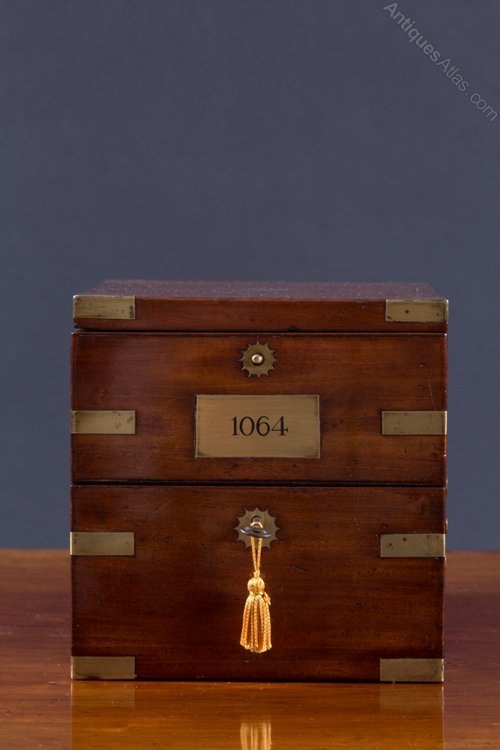
According to the seller, this two-day marine chronometer by John Poole of London, numbered 1064, dates to circa 1846 and is housed in a three-tier brass-bound mahogany box. The case features brass corners, a brass serial plaque reading 1064, and decorated escutcheons. Dealer documentation reports that the movement features a full brass plate, chain fusee, four ringed pillars, ten jewels, and Harrison's maintaining power. It utilizes an Earnshaw-type spring detent escapement with a split bimetallic balance, wedge-shaped compensation weights, a blued steel helical balance spring, and a faceted diamond endstone. The 3 3/4-inch silvered dial carries Roman numerals, subsidiary seconds, and an up/down state-of-wind indicator.

Exterior view of the closed brass-bound mahogany box of John Poole marine chronometer No. 1064
Exterior view of the closed brass-bound mahogany box of John Poole marine chronometer No. 1064 — Olde Time Antique Clocks / Antiques Atlas. Rights pending — permission not yet requested. Original source

Catalogue identity

Source
www.antiques-atlas.com
Category
Marine chronometer · Two-day marine chronometer
Maker / attribution
John Poole
Reference
Not recorded
Catalogue / lot identifier
as729a005
Source-reported date
c. 1846
Country
United Kingdom
Source-reported serial
1064

Source-reported attribution and specifications are not independent authentication. A listing does not establish present ownership, current display, availability or permission to reproduce.

Object description

Housing and External Features

The instrument is contained within a three-tier mahogany box featuring brass corner brackets and side straps. A rectangular brass plaque on the middle tier is engraved with the serial number '1064'.

The base of the case incorporates a scalloped brass escutcheon, and a central brass 'push-button' fixture is positioned on the middle section to facilitate opening the third tier.

Evidence for this section
  • “Three tier mahogany brass bound box with inset carrying handles, decorated brass escutcheon and key to the base, ‘push button’ brass knob opening to the third tier.”
  • “Brass plaque to the front of the box carrying the number 1064.”

Dial and Visual Identification

The 3 3/4-inch dial is silvered and signed 'Poole, London'. It features Roman numerals, original brass hands, and subsidiary indicators for seconds and state-of-wind.

The serial number '1064' is engraved within the seconds ring of the dial.

Evidence for this section
  • “The 3 ¾ inch dial signed ‘Poole, London’ and numbered 1064 within the seconds ring, with Roman numerals, original brass hands and subsidiary dials for up/down (state of wind) and seconds.”

Movement and Escapement Configuration

According to dealer information, the movement consists of a full brass plate with a chain fusee, four ringed pillars, and ten jewels, utilizing Harrison’s maintaining power. The mechanism is housed in a lacquered brass bowl with a screw-down bezel, suspended by a pivoted gimbal system with a knurled locking screw.

The chronometer employs an Earnshaw-type spring detent escapement. Temperature compensation is provided by a split bimetallic balance with wedge-shaped weights, a blued steel helical balance spring, and a faceted diamond endstone.

Evidence for this section
  • “The movement is a full brass plate chain fusee with four ringed pillars and ten jewels with Harrison’s maintaining power. Earnshaw type spring detent escapement with split bi-metallic balance with wedge shaped temperature compensation weights.”
  • “Blued steel helical balance spring and faceted diamond endstone.”

Open research questions

  • To what extent does the serial number '1064' correlate with established chronological records for John Poole?
  • Is there documented historical evidence to support the attribution of the development of auxiliary temperature compensation by John Poole to the year c. 1850?

Source evidence

Recorded claims and source quotations for John Poole Two-Day Marine Chronometer No. 1064
FieldSource-reported valueSource quotation
Maker and SerialJohn Poole, London, No. 1064“A Fine Two Day Marine Chronometer by John Poole, London. No.1064 c.1846”
Case ConstructionThree-tier mahogany brass-bound box“Three tier mahogany brass bound box with inset carrying handles, decorated brass escutcheon and key to the base, ‘push button’ brass knob opening to the third tier.”
EscapementEarnshaw-type spring detent escapement“Earnshaw type spring detent escapement with split bi-metallic balance with wedge shaped temperature compensation weights.”
Dial Specifications3 3/4-inch dial signed Poole, London“The 3 ¾ inch dial signed ‘Poole, London’ and numbered 1064 within the seconds ring, with Roman numerals, original brass hands and subsidiary dials for up/down (state of wind) and seconds.”
Approximate Datec. 1846“C.1846”
Dealer MaintenanceDealer reports the movement was stripped, overhauled, cleaned, and tested.“the movement (in line with all clocks offered for sale by Olde Time) has been stripped down, completely overhauled, cleaned and tested.”

Visible details

  • Three-tier mahogany chronometer box with brass corner brackets and brass side straps.
  • Central rectangular brass plaque on the middle tier engraved with the numeral '1064'.
  • Star-shaped scalloped brass escutcheon on the lower section holding a key adorned with a yellow tassel.
  • Matching scalloped brass escutcheon or push-button fixture positioned centrally above the number plaque.

Research qualifications

  • The internal movement, gimbal mount, and dial are not visible in the provided exterior photograph; their descriptions rely entirely on dealer statements.

Photograph identity and source facts were screened before import; rights clearance remains pending.

Consulted source

Antiques Atlas - Marine Chronometer By John Poole, London as729a005

Reviewed 2026-10-25 · Record 8b45d62032

Terms in this record

Glossary explanations for terms named in this object’s record.