
Skip to content
The Encyclopedia of Horology

Pocket watch · Pocket watch

John Ellicott pocket watch

Partially verified

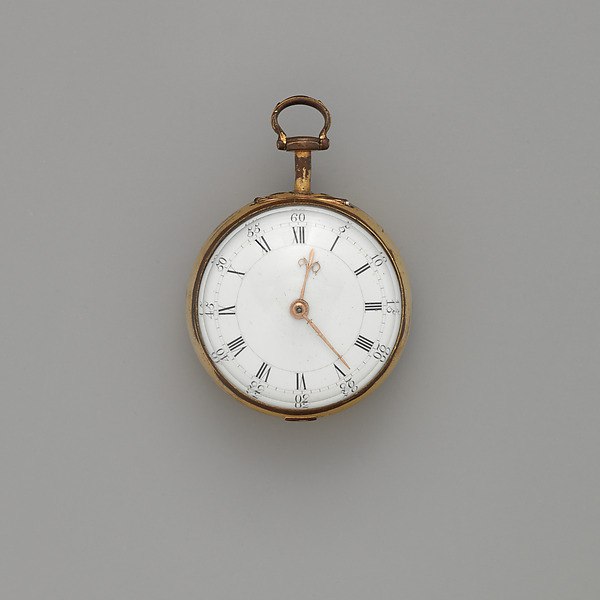
This pocket watch was made by the London-based watchmaker John Ellicott (1706–1772), circa 1760. The object is catalogued as part of The Metropolitan Museum of Art collection, accession number 17.190.1462a, b, and was a gift from J. Pierpont Morgan in 1917. The watch features construction incorporating materials identified by the museum as pinchbeck, tortoiseshell, and enamel, with a recorded diameter of 2 1/8 inches (5.4 cm). The design includes a circular case with a winding aperture on the case back and a white enamel dial with Roman numerals. The watch is classified within the museum's European Sculpture and Decorative Arts department. John Ellicott was a prominent English horologist active in London, known for his scientific contributions, including work on temperature-compensated pendulums and the cylinder escapement. The piece reflects the manufacturing standards and materials used during the mid-eighteenth century in London.

Front view of the John Ellicott pocket watch showing the enamel dial and Roman numerals.
Front view of the John Ellicott pocket watch showing the enamel dial and Roman numerals. — The Metropolitan Museum of Art, New York. Rights pending — permission not yet requested. Original source

Catalogue identity

Source
orbiscollectibles.com
Category
Pocket watch · Pocket watch
Maker / attribution
John Ellicott
Reference
Not recorded
Catalogue / lot identifier
17.190.1462a, b
Source-reported date
ca. 1760
Source-reported place
British

Source-reported attribution and specifications are not independent authentication. A listing does not establish present ownership, current display, availability or permission to reproduce.

Object description

Case and Dial Construction

The object is a pocket watch with an exterior case constructed from pinchbeck, featuring tortoiseshell and enamel components. The case is circular and measures approximately 2 1/8 inches in diameter. The back of the case includes a single, centrally positioned circular aperture for winding the movement.

The dial is finished in white enamel and is marked with Roman numerals for the hours. The watch features a hinged outer cover which protects the dial and includes a crystal. The aesthetic design remains consistent with the materials recorded by the museum for this accession.

Evidence for this section
  • “Pinchbeck, tortoiseshell, enamel”
  • “Diameter: 2 1/8 in. (5.4 cm)”

Attribution and History

The watch is attributed to the London-based watchmaker John Ellicott, who was active during the eighteenth century. Ellicott, a Fellow of the Royal Society, maintained workshops in London, specifically at Austin Friars Street and later at Swithin’s Alley near the Royal Exchange. The watch is dated to approximately 1760, which corresponds to the period when his son, Edward, joined the family business.

The object was acquired by The Metropolitan Museum of Art in 1917 as part of a gift from J. Pierpont Morgan. It is held under the department of European Sculpture and Decorative Arts and is officially documented under accession number 17.190.1462a, b.

Evidence for this section
  • “Watch made by John Ellicott (British, 1706–1772), dated ca. 1760”
  • “Gift of J. Pierpont Morgan, 1917.”

Documentation and Research

The information presented in this record is derived from the documentation provided by The Metropolitan Museum of Art. The museum identifies the object as a watch within its horological holdings. While the attribution to John Ellicott is consistent with his active years in London, the source suggests that individual components, such as cases, may have been supplied by external makers.

Further research is required to verify the specific internal movement details and confirm how this individual piece fits into the wider context of eighteenth-century London watchmaking production. There are currently no catalogue references recorded for this specific accession number.

Evidence for this section
  • “The Metropolitan Museum of Art holds this object as 17.190.1462a, b.”
  • “cases and movements were often supplied by different makers”

Open research questions

  • Can internal movement signatures or serial numbers be identified to further confirm the John Ellicott attribution?
  • Does the case bear any secondary hallmarks that indicate the specific case-maker contracted by the Ellicott workshop?

Source evidence

Recorded claims and source quotations for John Ellicott pocket watch
FieldSource-reported valueSource quotation
MakerJohn Ellicott“Watch made by John Ellicott (British, 1706–1772)”
Dateca. 1760“dated ca. 1760”
MaterialsPinchbeck, tortoiseshell, enamel“Pinchbeck, tortoiseshell, enamel”
Dimensions2 1/8 in. (5.4 cm)“Diameter: 2 1/8 in. (5.4 cm)”
Accession Number17.190.1462a, b“17.190.1462a, b”
Credit LineGift of J. Pierpont Morgan, 1917“Gift of J. Pierpont Morgan, 1917.”
OriginLondon, British“British, London”

Visible details

  • White enamel dial with Roman numeral hour markers.
  • Circular case exterior with central winding aperture.
  • Hinged outer case cover with visible crystal.
  • Pinchbeck casing material.

Research qualifications

  • Museum attribution and dating are based on institutional records which require wider independent verification.
  • Internal hallmarks, movement signatures, and serial numbers are not documented in the provided source.

Photograph identity and source facts were screened before import; rights clearance remains pending.

Consulted source

Watch by John Ellicott, British, London, ca. 1760

Reviewed 2026-11-02 · Record de3fffe8cf

Terms in this record

Glossary explanations for terms named in this object’s record.