
Skip to content
The Encyclopedia of Horology

Clock · Longcase clock

John Ellicott Longcase Clock

Partially verified

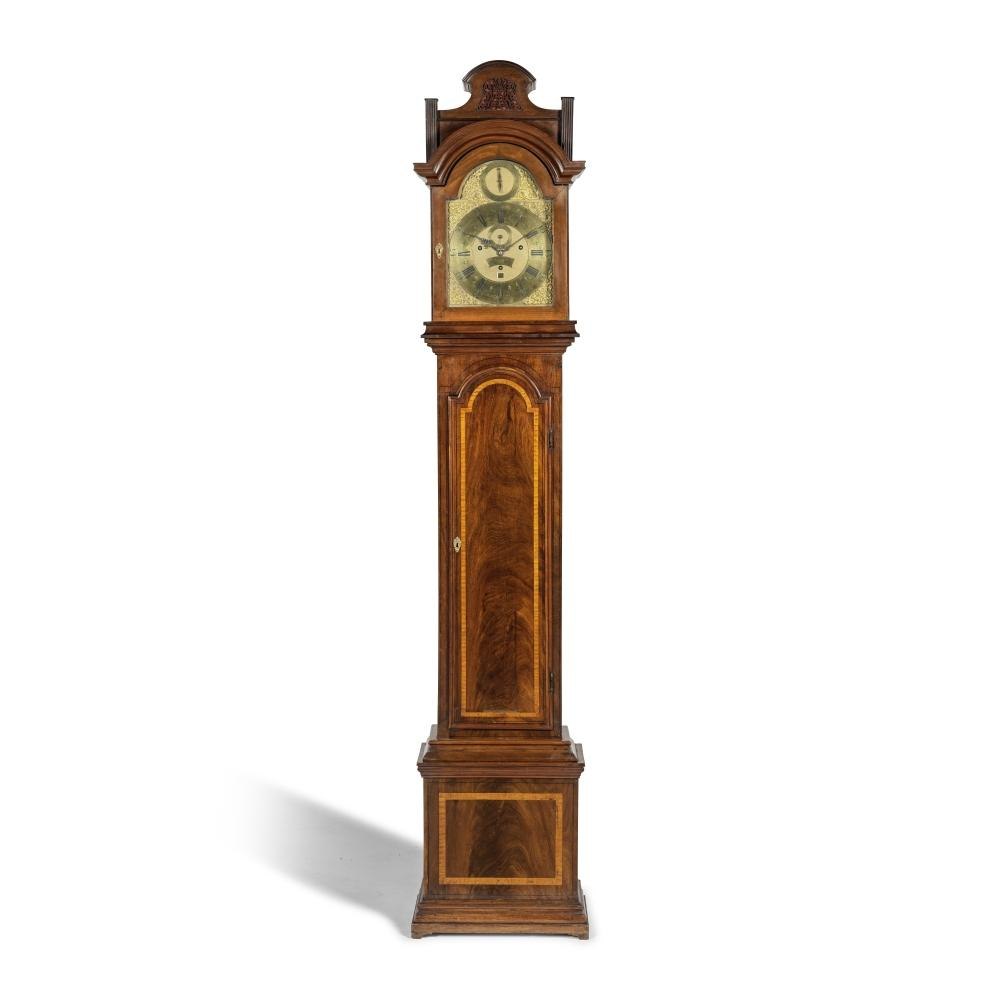
This mid-18th century longcase clock features a movement by John Ellicott, London, housed within a case of later construction. The clock measures 250cm in height. Its 12-inch break-arch brass dial displays a silvered chapter ring with Roman and Arabic numerals, complemented by fleur-de-lys half-hour markers. The matted center includes a subsidiary seconds dial and a calendar aperture. The arch houses a strike/silent subsidiary dial. The movement is substantial, utilizing a deadbeat escapement with adjustable steel pallets. It features an hour-striking train controlled by a rack and snail system on a large bell, while the quarters are struck on a train of eight bells operated by a pinned barrel. The later case is characterized by a moulded architectural pediment, pierced sound fret with red silk backing, and inlaid doors. The clock is provided with a case key and a winding key.

John Ellicott longcase clock with 12-inch break-arch dial, housed in a later case.
John Ellicott longcase clock with 12-inch break-arch dial, housed in a later case. — Bonhams (via Invaluable). Rights pending — permission not yet requested. Original source

Catalogue identity

Source
www.invaluable.com
Category
Clock · Longcase clock
Maker / attribution
John Ellicott
Reference
Not recorded
Catalogue / lot identifier
280
Source-reported date
mid 18th century
Source-reported place
United Kingdom

Source-reported attribution and specifications are not independent authentication. A listing does not establish present ownership, current display, availability or permission to reproduce.

Object description

Dial and Timekeeping

The timepiece is equipped with a 12-inch break-arch brass dial designed for comprehensive time and calendar indication. The chapter ring is silvered and features both Roman and Arabic numerals, with traditional fleur-de-lys half-hour markers. The central portion of the dial is matted, providing visual contrast for the subsidiary seconds dial and the calendar aperture. Three winding squares are integrated into the dial layout, indicating the weight-driven configuration for time, hour strike, and quarter strike functions.

In the arch of the dial, a subsidiary strike/silent dial is located, allowing for control over the acoustic features. The dial is signed on an applied name plaque reading 'John Ellicott, London', and is framed by six cast brass spandrels, which support the aesthetic structure of the dial plate.

Evidence for this section
  • “The brass 12 inch break-arch dial with silvered Roman and Arabic chapter ring”
  • “signed on a applied name plaque John Ellicott, London”
  • “with strike/silent subsidiary dial in the arch.”

Movement Construction

The movement is identified as a substantial piece attributed to John Ellicott, featuring a deadbeat escapement equipped with adjustable steel pallets. This configuration is engineered for precision, allowing for the regulated transmission of power from the weight-driven trains.

The striking mechanism is complex, employing a rack and snail system to govern the hour strike on a single large bell. For the quarter-hour intervals, the clock utilizes a separate train of eight bells and corresponding hammers, actuated by a pinned barrel system. The auction description confirms the functional status of these mechanical assemblies, stating that the clock is currently ticking and striking.

Evidence for this section
  • “The substantial movement with deadbeat escapement with adjustable steel pallets”
  • “striking the hours on a large bell via a rack and snail system”
  • “the quarters sounding on a run of 8 bells and hammers mounted above via a pined barrel.”

Case and Exterior

The clock is housed in a case constructed at a later date than the movement. The exterior design follows a standard longcase architecture, featuring a moulded architectural pediment at the summit, situated above a pierced sound fret that is backed with red silk. The door of the trunk is decorated with inlay and is fitted with a brass escutcheon that matches the one found on the front of the clock.

The structure terminates in a moulded plinth base, giving the total height of the object as 250cm. The assembly includes a single case key and a winding key as provided accessories for operation and maintenance.

Evidence for this section
  • “Mouvement d'horloge de parquet, sonnant les quart du milieu du XVIIIe siècle dans une caisse d'époque postérieure”
  • “The case surmounted by a moulded architectural pediment above a pierced sound fret backed in red silk”
  • “250cm high.”

Open research questions

  • What is the estimated date of the later case construction?
  • Is the movement's deadbeat escapement original to the Ellicott manufacture or a later modification?

Source evidence

Recorded claims and source quotations for John Ellicott Longcase Clock
FieldSource-reported valueSource quotation
MakerJohn Ellicott, London“John Ellicott, London”
Datemid 18th century“mid 18th century”
Dial Width12 inches“12 inch break-arch dial”
Height250cm“250cm high”
Escapementdeadbeat escapement“deadbeat escapement with adjustable steel pallets”
Quarter Chime8 bells“quarters sounding on a run of 8 bells”
Conditionfunctional“Currently ticking and striking”

Visible details

  • Break-arch dial with strike/silent subsidiary in the arch
  • Case features an inlaid trunk door and plinth base
  • Movement includes three winding squares on the dial face
  • Dial signature is on an applied name plaque

Research qualifications

  • The case is explicitly described as being of a later period than the movement
  • Provenance details are limited to a private collector

Photograph identity and source facts were screened before import; rights clearance remains pending.

Terms in this record

Glossary explanations for terms named in this object’s record.