
Skip to content
The Encyclopedia of Horology

Pocket watch · Pendant watch

Johann Holtzmann Neo-Renaissance Pendant Watch

Partially verified

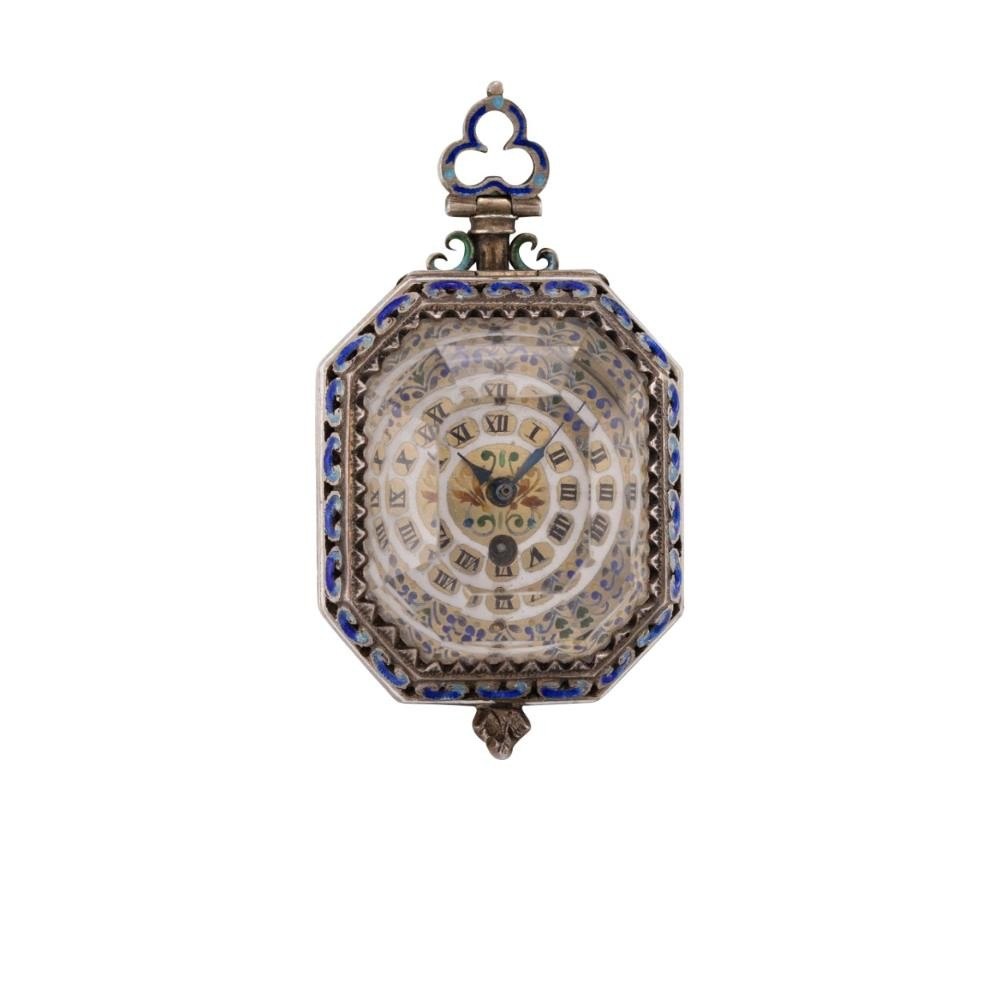
This pendant watch is an ornamental timepiece featuring an octagonal case constructed from faceted rock crystal and a silver frame decorated with polychrome cloisonné enamel. The dial also utilizes polychrome cloisonné enamel, featuring Roman numerals arranged in cartouches and equipped with blued arrow-shaped hands. The internal mechanism is a round full plate movement utilizing a chain and fusee transmission system, a verge escapement, and a three-arm brass balance. According to historical records, the object is attributed to the late 19th-century historicism movement. While the ornamental housing and dial reflect a Renaissance style, the internal verge movement is dated to the early 19th century. This combination suggests that the watch was constructed or re-cased during the 1870s to align with prevailing aesthetic tastes of that period. The watch dimensions are approximately 33 x 38 mm.

Front view of the octagonal pendant watch showing the enamel dial, blued hands, and rock crystal and silver frame.
Front view of the octagonal pendant watch showing the enamel dial, blued hands, and rock crystal and silver frame. — Auktionen Dr. Crott / Invaluable. Rights pending — permission not yet requested. Original source

Catalogue identity

Source
orbiscollectibles.com
Category
Pocket watch · Pendant watch
Maker / attribution
Johann Holtzmann
Reference
Not recorded
Catalogue / lot identifier
6289a78d79
Source-reported date
circa 1870
Source-reported place
Vienna

Source-reported attribution and specifications are not independent authentication. A listing does not establish present ownership, current display, availability or permission to reproduce.

Object description

Case and Dial

The structural integrity of the case is provided by faceted rock crystal, which acts as both a protective cap and a cup for the internal components. This combination of materials and decorative techniques is intended to mimic historical aesthetics from the Renaissance era.

The dial continues the decorative theme, also composed of polychrome cloisonné enamel. It features Roman numerals set within distinct cartouches arranged around the central axis. Time is indicated by blued arrow-shaped hands, providing a contrast to the detailed enamel background. The design is described as part of the late 19th-century historicism trend, which sought inspiration from earlier artistic periods.

Evidence for this section
  • “Silver frame with polychrome Cloisonné enamel, faceted rock crystal cap and cup.”
  • “Polychrome Cloisonné enamel, cartouches with Roman numerals, blued arrow-shaped hands.”

Movement and Construction

The internal mechanism is a round full plate movement, a form consistent with older timekeeping traditions. It employs a chain and fusee transmission system designed to regulate power delivery to the train. The escapement is a verge type, paired with a three-arm brass balance to govern the oscillation frequency.

The provenance of the movement deviates from the date of the case construction. Records indicate that the movement originates from the early 19th century. Within the context of the Neo-Renaissance style, the watch was assembled by fitting the older, period-appropriate movement into a newly fabricated case and dial. This method of construction was a feature of the historicism period, where antique mechanisms were integrated into ornamental housings.

Evidence for this section
  • “Round full plate movement, chain/fusee, verge escapement, three-arm brass balance.”
  • “the verge movement dating from the early 19th century was fitted with a new case and a new, Renaissance-style dial.”

Provenance and Identification

The object is identified in archival records under the lot number 6289a78d79, associated with the name Johann Holtzmann. The watch is classified as a Vienna Neo-Renaissance pendant watch, specifically dating to approximately 1870. The classification is noted as a probable attribution, reflecting the need for further validation of its history and assembly.

Documentation remains limited, with no formal catalogue references recorded for this item. Research notes suggest that while the physical components are described in detail, confirmation of the wider type and full maker attribution remains a subject for ongoing scholarly examination.

Evidence for this section
  • “Probable”
  • “Credible evidence exists but classification is not fully established.”
  • “Vienna Neo-Renaissance style pendant watch”

Open research questions

  • Does the movement contain any specific hallmarks or maker signatures to confirm its early 19th-century origin?
  • Are there similar documented examples of Johann Holtzmann works that exhibit this specific blend of 19th-century movements in later historicist cases?

Source evidence

Recorded claims and source quotations for Johann Holtzmann Neo-Renaissance Pendant Watch
FieldSource-reported valueSource quotation
MakerJohann Holtzmann“Johann Holtzmann”
Datecirca 1870“circa 1870”
Dimensions33 x 38 mm“33 x 38 mm”
Case constructionSilver frame with polychrome Cloisonné enamel, faceted rock crystal cap and cup.“Silver frame with polychrome Cloisonné enamel, faceted rock crystal cap and cup.”
Dial descriptionPolychrome Cloisonné enamel, cartouches with Roman numerals, blued arrow-shaped hands.“Polychrome Cloisonné enamel, cartouches with Roman numerals, blued arrow-shaped hands.”
Movement typeRound full plate movement, chain/fusee, verge escapement, three-arm brass balance.“Round full plate movement, chain/fusee, verge escapement, three-arm brass balance.”
Design originVienna Neo-Renaissance style“Vienna Neo-Renaissance style”

Visible details

  • Octagonal pendant housing with crystal panels
  • Polychrome cloisonné enamel inlay on the silver case frame
  • Blued arrow-shaped hour and minute hands
  • Verge escapement visible in the movement description

Research qualifications

  • The historic accuracy of the association between the movement and case requires verification
  • Wider type attribution and specific maker connection are subject to further research

Photograph identity and source facts were screened before import; rights clearance remains pending.

Consulted source

Johann Holtzmann - Neo-Renaissance

Reviewed 2026-11-02 · Record 04e675896f

Terms in this record

Glossary explanations for terms named in this object’s record.