
Skip to content
The Encyclopedia of Horology

Clock · Longcase clock

James Drury London Walnut Longcase Clock

Partially verified

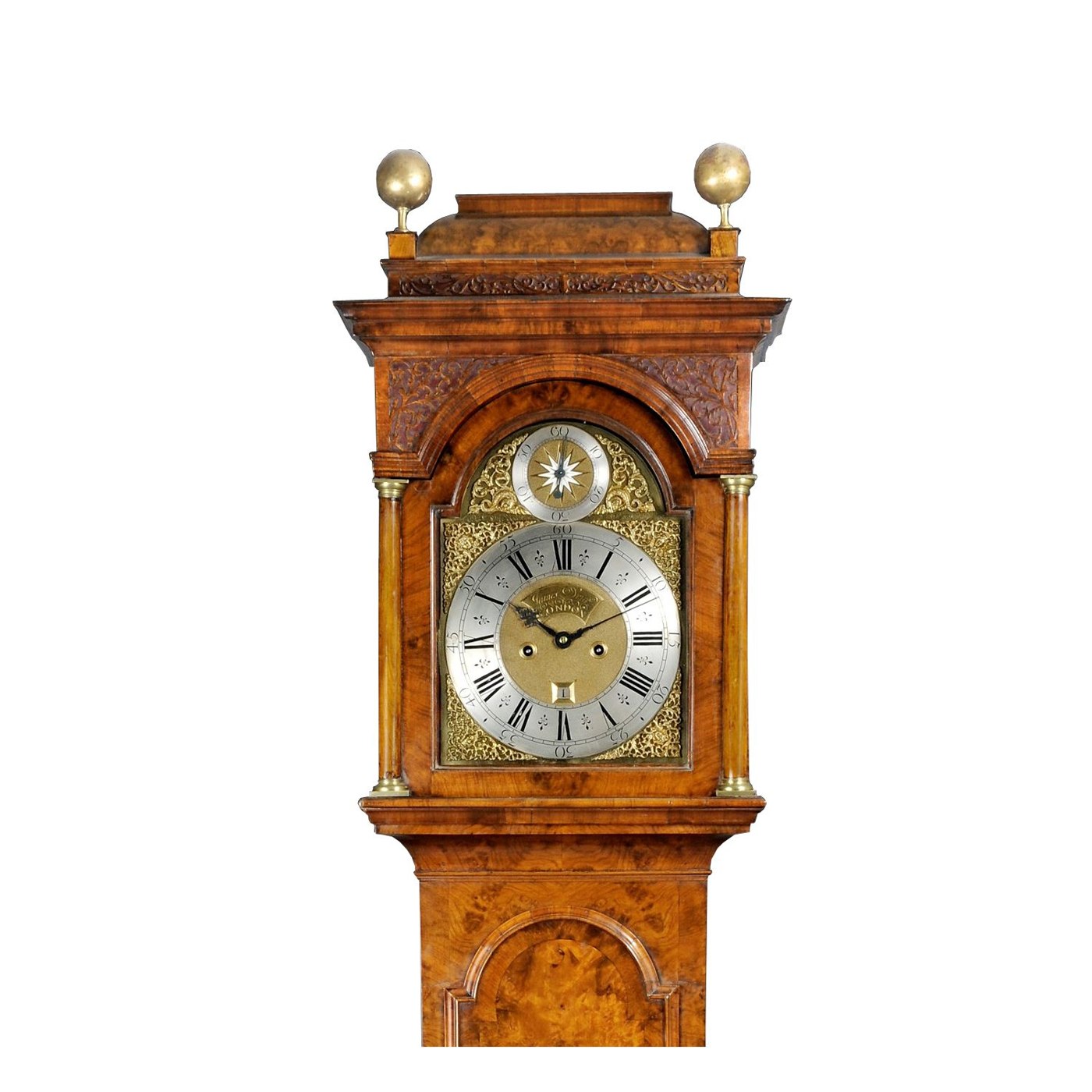
This eight-day longcase clock is attributed to the maker James Drury of London, dated circa 1730. The case is constructed with walnut veneer, featuring a break-arch hood topped with a caddy and brass ball finials, and a trunk with a cross-banded door standing on a staggered double plinth. The movement is weight-driven with an anchor escapement and strikes the hours on a bell using a rack and snail system. The brass break-arch dial includes a matted centre, applied silvered chapters with Roman numerals, and a calendar aperture. A regulation dial in the arch features a silvered chapter ring and a steel hand. The dial is signed "James Drury London" on a cartouche below the twelve-hour mark and includes applied brass spandrels. The clock measures 244 cm in height. Provenance is listed as a private collection in the U.K.

Front view of the walnut longcase clock by James Drury, showing the dial and hood detail.
Front view of the walnut longcase clock by James Drury, showing the dial and hood detail. — Dorset Antique Clocks. Rights pending — permission not yet requested. Original source

Catalogue identity

Source
www.dorsetantiqueclocks.co.uk
Category
Clock · Longcase clock
Maker / attribution
James Drury
Reference
Not recorded
Catalogue / lot identifier
Source URL identifies the listing
Source-reported date
circa 1730
Source-reported place
United Kingdom

Source-reported attribution and specifications are not independent authentication. A listing does not establish present ownership, current display, availability or permission to reproduce.

Object description

Case Construction

The clock is housed in a walnut-veneered case that features a caddy-top break-arch hood. This hood is ornamented with large brass ball finials and sound frets situated below the arch. The glazed door of the hood is flanked by walnut pillars fitted with brass Doric capitals and bases.

The trunk of the clock is designed with a cross-banded break-arch door. The base section matches this cross-banded detail and the entire structure rests on a staggered double plinth. The primary material noted throughout the exterior is figured walnut veneer.

Evidence for this section
  • “The wonderfully figured walnut veneered case with caddy to the break arch hood, this being mounted by large brass ball finials with sound frets below and following the arch to the glazed door with tapering walnut pillars and brass Doric capitals and bases.”
  • “The trunk with cross banded break arch door having matched cross banded base and standing on staggered double plinth.”

Dial and Regulation

The dial is a break-arch brass design with a matted center and applied silvered engraved chapters. The primary chapter ring displays Roman numerals and Arabic five-minute markings. A silvered calendar aperture is present, and the signature 'James Drury London' is engraved on a plain cartouche positioned below the numeral twelve.

A regulation mechanism is integrated into the arch of the dial, which utilizes an engraved silvered chapter ring and a steel hand. This feature adjusts the clock via a cam located on the back of the dial. The dial plate includes a star-shaped cutout and applied brass spandrels, accompanied by a pair of blued steel hands.

Evidence for this section
  • “An attractive break arch brass dial with matted centre and applied silvered engraved chapters.”
  • “Unusually to the arch is an engraved silvered chapter ring and steel hand for regulating the clock via a cam to the back of the dial, having chamfered star cut into the dial plate reminiscent of work by Daniel Quare, with applied brass spandrels and finished by a pair of finely cut blued steel hands.”

Movement and Functionality

The movement is a weight-driven, two-train mechanism designed to function for eight days. It incorporates an anchor escapement and utilizes a seconds pendulum. The clock provides an hourly strike, which is achieved through a rack and snail striking system acting upon a single bell.

The maker, James Drury, is identified as a member of the Clockmakers Company, with his membership noted as occurring in 1728. The clock's mechanical configuration is described as consistent with early 18th-century production standards for longcase timepieces.

Evidence for this section
  • “A fine early 18th century striking eight day longcase clock. The two train weight driven movement with anchor escapement and seconds pendulum sounding the hours upon a single bell via the rack and snail striking system.”
  • “Made by the accomplished Clockmaker James Drury, who was a distinguished member of the Clockmakers Company in 1728.”

Open research questions

  • What is the specific connection between this clock and the work of Daniel Quare mentioned in the description?
  • Are there any original makers marks on the movement plates to confirm the attribution to James Drury?

Source evidence

Recorded claims and source quotations for James Drury London Walnut Longcase Clock
FieldSource-reported valueSource quotation
MakerJames Drury“Made by the accomplished Clockmaker James Drury”
Datecirca 1730“CIRCA. 1730”
Height244 cm“Height: 96″ or 244 cm”
Movement TypeEight-day striking“striking eight day longcase clock”
EscapementAnchor“anchor escapement”
SignaturesJames Drury London“signed, James Drury London”
ProvenancePrivate collection, UK“Provenance: Private collection – U.K.”

Visible details

  • Large brass ball finials surmounting the caddy top
  • Regulating dial located in the break-arch with star-shaped aperture detail
  • Blued steel hands
  • Matched cross-banded base

Research qualifications

  • Date is provided as an approximate circa date
  • Regulation feature is described as reminiscent of Daniel Quare, not confirmed as his work

Photograph identity and source facts were screened before import; rights clearance remains pending.

Consulted source

ANTIQUE WALNUT LONGCASE CLOCK BY JAMES DRURY OF LONDON

Reviewed 2026-11-02 · Record ec4bca7d3d

Terms in this record

Glossary explanations for terms named in this object’s record.