
Skip to content
The Encyclopedia of Horology

Pocket watch · Pendant watch

Isaac Phelippon Enamel Pendant Watch

Partially verified

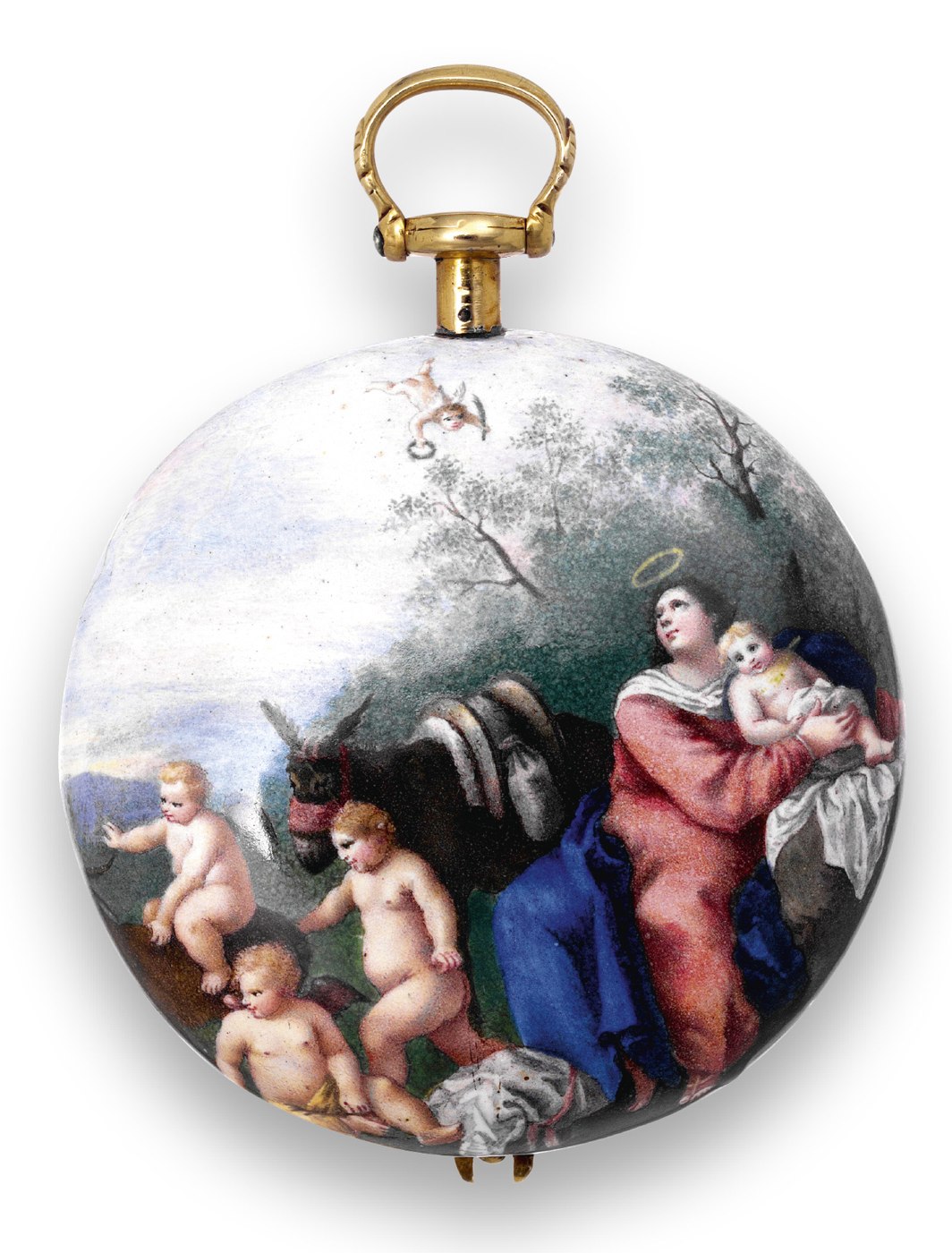
This pendant watch comprises an early painted enamel gold case, estimated at circa 1670 and possibly of Augsburg origin, housing a later English movement signed by Isaac Phelippon of London, numbered 350 and dated to circa 1780. The 48.5 mm watch features a two-body 'bassine' case with a hinged gold bezel and detailed enamel work depicting the Rest on the Flight into Egypt. The interior of the case is decorated with a rural landscape. The 42 mm frosted gilt full-plate movement is powered by a fusee and chain, regulated by a verge escapement with a plain steel balance and flat balance spring. The dial is white enamel with Roman numerals and an outer five-minute Arabic numeral track. The watch underwent a transformation where the original movement was replaced in the 18th century, a practice employed to incorporate updated horological technology into aesthetically significant or precious cases.

Rear view of the pendant watch showing the painted enamel scene of the Rest on the Flight into Egypt.
Rear view of the pendant watch showing the painted enamel scene of the Rest on the Flight into Egypt. — Antiquorum. Rights pending — permission not yet requested. Original source

Catalogue identity

Source
catalog.antiquorum.swiss
Category
Pocket watch · Pendant watch
Maker / attribution
Isaac Phelippon
Reference
Not recorded
Catalogue / lot identifier
122
Source-reported date
circa 1670 (case); circa 1780 (movement)
Source-reported place
England (movement); possibly Augsburg (case)
Source-reported serial
350

Source-reported attribution and specifications are not independent authentication. A listing does not establish present ownership, current display, availability or permission to reproduce.

Object description

Case and Enamel Decoration

The two-body 'bassine' case is constructed from 20K gold and features a rounded edge. The exterior is decorated with finely painted enamel illustrating a scene from the Rest on the Flight into Egypt, which includes the Madonna and Child, a donkey, a goat, and two angels. The interior of the case is painted with a rural landscape.

The enamel technique employed on the case is associated with the German school, particularly the work attributed to Augsburg. The layout of the enamel scene is considered unconventional for the late 17th century due to the lack of a ring separating the back from the band, a feature commonly found in examples from that period.

Evidence for this section
  • “Two-body, "bassine" with rounded edge”
  • “The case features an unusual technique of enamel painting reminiscent of the German school, especially that of Augsburg.”
  • “The disposition of the enamel scene, without the ring dividing the back from the band, which was typically present during the second half of the 17th century, is also unusual.”

Movement and Dial

The 42 mm movement is a frosted gilt full-plate design featuring cylindrical pillars, a fusee and chain transmission, and a verge escapement. It is equipped with a plain steel balance, a flat balance spring, and a single-footed cock. The watch is wound via an aperture positioned at 4 o'clock on the dial.

The white enamel dial displays radial Roman numerals for the hours and an outer track with five-minute Arabic numerals. The movement is signed and numbered 350, with its origin attributed to London around 1780. The replacement of the original movement with this later version reflects 18th-century efforts to upgrade existing, expensive watch cases with current technological advancements.

Evidence for this section
  • “frosted gilt full plate with cylindrical pillars, fusee and chain, verge escapement, plain steel balance with flat balance spring, single-footed cock.”
  • “winding aperture at 4.”
  • “It was a common practice in the 18th century to replace the movement in a particularly expensive or beautiful watch case, to take advantage of technological advances in horology.”

Reported Condition

The auction description reports the object as being in good overall condition. According to the stated grading system, the case is assigned a grade of 'Good' while the movement is described as 'Good' and 'Later original'.

The dial is also noted as 'Good', although the report specifies that the hands have been replaced and the watch has undergone restoration.

Evidence for this section
  • “Grading System Grade: AA Very good”
  • “Movement: 3-22* Good Later original”
  • “Overhaul recommended, at buyer's expense”
  • “HANDS Replaced”

Open research questions

  • What is the specific provenance of this watch before its entry into the current auction collection?
  • Can the case painter be identified through comparative analysis with known 17th-century Augsburg enamel works?

Source evidence

Recorded claims and source quotations for Isaac Phelippon Enamel Pendant Watch
FieldSource-reported valueSource quotation
Case makerPossibly Augsburg“Enamel Pendant Watch Case possibly Augsburg.”
Movement makerIsaac Phelippon“Movement by Isaac Phelippon, London”
Serial number350“No. 350.”
Case dimensions48.5 mm“Diam. 48.5 mm.”
Movement dimensions42 mm“M. 42 mm.”
Dial detailsWhite enamel with Roman and Arabic numerals“White enamel with painted radial Roman numerals, outer minute track with five-minute Arabic numerals”
EscapementVerge“verge escapement”
Movement materialsFrosted gilt“frosted gilt full plate”

Visible details

  • Case back features a scene of the Madonna and Child, a donkey, and angels
  • Inner case surface decorated with a painted rural landscape
  • Dial includes a winding aperture at the 4 o'clock position
  • Case features a hinged gold bezel decorated with foliage

Research qualifications

  • Case origin is only possibly Augsburg
  • Attribution of the case to circa 1670 remains speculative

Photograph identity and source facts were screened before import; rights clearance remains pending.

Terms in this record

Glossary explanations for terms named in this object’s record.