
Skip to content
The Encyclopedia of Horology

Marine chronometer · Two-day marine chronometer

Henri Motel Marine Chronometer No. 59

Partially verified

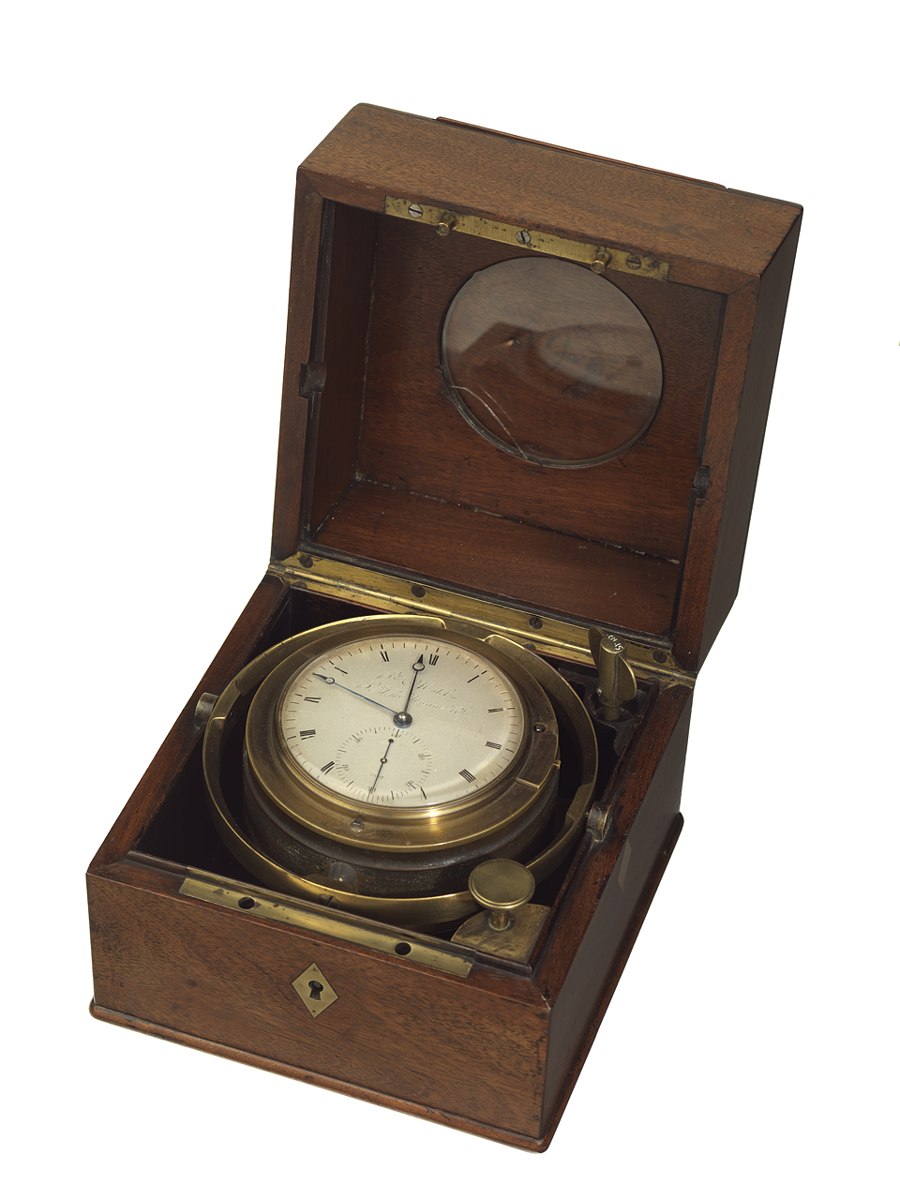
According to Royal Museums Greenwich, this marine chronometer numbered 59 was constructed by Henri Motel in Paris and dates to circa 1800 or circa 1820. Housed in a two-tier mahogany box fitted with brass gimbals, the instrument features a 79 mm matt-silvered brass dial signed by Motel as Horloger de la Marine Royale, paired with blued steel hands and an auxiliary seconds register. The Louis Berthoud-style full plate fusee movement utilizes four polished steel pillars, curled brass plate finishing, Harrison's maintaining power, and a pivoted-detent escapement on a navette platform. The source notes a Motel-type four-arm bimetallic balance, a blued steel conical balance spring, and specialized front-winding and locking mechanisms.

Overall view of Henri Motel marine chronometer No. 59 in opened mahogany box with brass gimbals
Overall view of Henri Motel marine chronometer No. 59 in opened mahogany box with brass gimbals — National Maritime Museum, Greenwich, London, Caird Collection. Rights pending — permission not yet requested. Original source

Catalogue identity

Source
www.rmg.co.uk
Category
Marine chronometer · Two-day marine chronometer
Maker / attribution
Henri Motel
Reference
ZAA0016
Catalogue / lot identifier
Source URL identifies the listing
Source-reported date
circa 1800
Country
France
Source-reported serial
59

Source-reported attribution and specifications are not independent authentication. A listing does not establish present ownership, current display, availability or permission to reproduce.

Object description

Box Construction and Mounting

The chronometer is housed in a two-tier mahogany box measuring 135 mm high, 165 mm wide, and 165 mm deep. It features a sliding dovetailed lid with a central brass diamond inlay and a glazed porthole. A two-pronged, double-throw lock secures the box, which also includes a diamond-shaped brass escutcheon on the front.

The instrument is mounted in lacquered brass gimbals. A locking arrangement, actuated by a knob on the front right, lowers an arbor to engage a 'see-saw' mechanism, which centers and secures the movement bowl.

Evidence for this section
  • “Plain, two-tier mahogany box, 135mms high, 165mms wide and 165mms deep, with a sliding dovetailed lid inset into the top.”
  • “The box has an inlaid brass diamond escutcheon on front”
  • “Motel’s own locking arrangement in which a cradle rises up under the owl to secure the whole assembly.”

Movement Architecture

The movement is a one-day full plate fusee type with four polished steel pillars, finished with curled decoration. It is secured within a 96.8 mm brass drum using a 'secret locking' system that requires specific alignment and rotation to engage or release.

The chronometer includes a front-winding arrangement and an integrated stop/start device controlled by a steel square on the bezel, marked with 'A' and 'M' for stop and start functions.

Evidence for this section
  • “Louis Berthoud type, one-day full plate fusee movement with four highly polished steel pillars”
  • “the movement employs Motel’s secret locking, based on the designs of Louis Berthoud.”
  • “At the ‘6 o’clock’ position on the bezel there is a steel square, actuated with the winding key, for stop/start function.”

Dial, Escapement, and Balance

The 79.0 mm matt-silvered brass dial is signed 'H ri Motel / H ger de la Marine R le' and 'N59'. Records indicate the central area of the dial was modified from behind, likely for re-engraving the signature.

The escapement is a pivoted-detent type on a navette-style platform. The bimetallic balance features four tapered steel arms with brass segments containing platinum and gold screws, regulated by a blued steel conical balance spring.

Evidence for this section
  • “The 79.0mm matt-silvered brass dial has roman hour numerals and a seconds dial”
  • “The whole of the area across the middle of the dial has been ‘knocked out’ from behind, apparently to enable the signature to be re-engraved”
  • “Typical Louis Berthoud-type pivoted-detent escapement mounted on a pointed oval ‘navette’ type platform”

Open research questions

  • What is the significance of the 'N.39' engraving on the lid inlay?
  • What is the origin of the '79' scratched on the underside of the lid?
  • How should the conflicting 'circa 1800' and 'c.1820' dating in the source be interpreted?

Source evidence

Recorded claims and source quotations for Henri Motel Marine Chronometer No. 59
FieldSource-reported valueSource quotation
MakerMotel, Henri“Creator: Motel, Henri”
Date Madecirca 1800“Date made: circa 1800”
Box ConstructionTwo-tier mahogany box measuring 135 mm high, 165 mm wide, and 165 mm deep“Plain, two-tier mahogany box, 135mms high, 165mms wide and 165mms deep, with a sliding dovetailed lid inset into the top.”
Dial SignatureSigned H ri Motel / H ger de la Marine R le and N59“The dial is signed: “H ri Motel / H ger de la Marine R le“ in the upper half and: “N59” in the seconds dial.”
Movement Plate InscriptionEngraved Construite par / Hri Motel / N.59“The upper plate is engraved on top: “Construite par / Hri Motel / N.59””
Escapement TypeLouis Berthoud-type pivoted-detent escapement“Typical Louis Berthoud-type pivoted-detent escapement mounted on a pointed oval ‘navette’ type platform”
MainspringUnsigned 20th-century replacement“The mainspring was braced in the barrel about 100 round from the hook (brace now missing) and is an unsigned, 20th century replacement.”

Visible details

  • Open mahogany box displaying the silvered dial suspended in brass gimbals with a winding key stowed in the rear right corner
  • Underside of the upper box lid contains a brass-bezeled circular viewing porthole
  • Diamond-shaped brass keyway escutcheon mounted on the front face of the lower box tier

Research qualifications

  • The source gives conflicting dates: 'c.1820' in the heading text and 'circa 1800' in the metadata fields
  • The source reports the mainspring is a 20th-century replacement and green velvet side lining inside the bowl is missing
  • The source notes that glass is missing from the circular panel under the sliding lid

Photograph identity and source facts were screened before import; rights clearance remains pending.

Consulted source

59 | Royal Museums Greenwich

Reviewed 2026-10-25 · Record 46c621800b

Terms in this record

Glossary explanations for terms named in this object’s record.