
Skip to content
The Encyclopedia of Horology

Clock · Table clock

German Drum Table-Clock

Partially verified

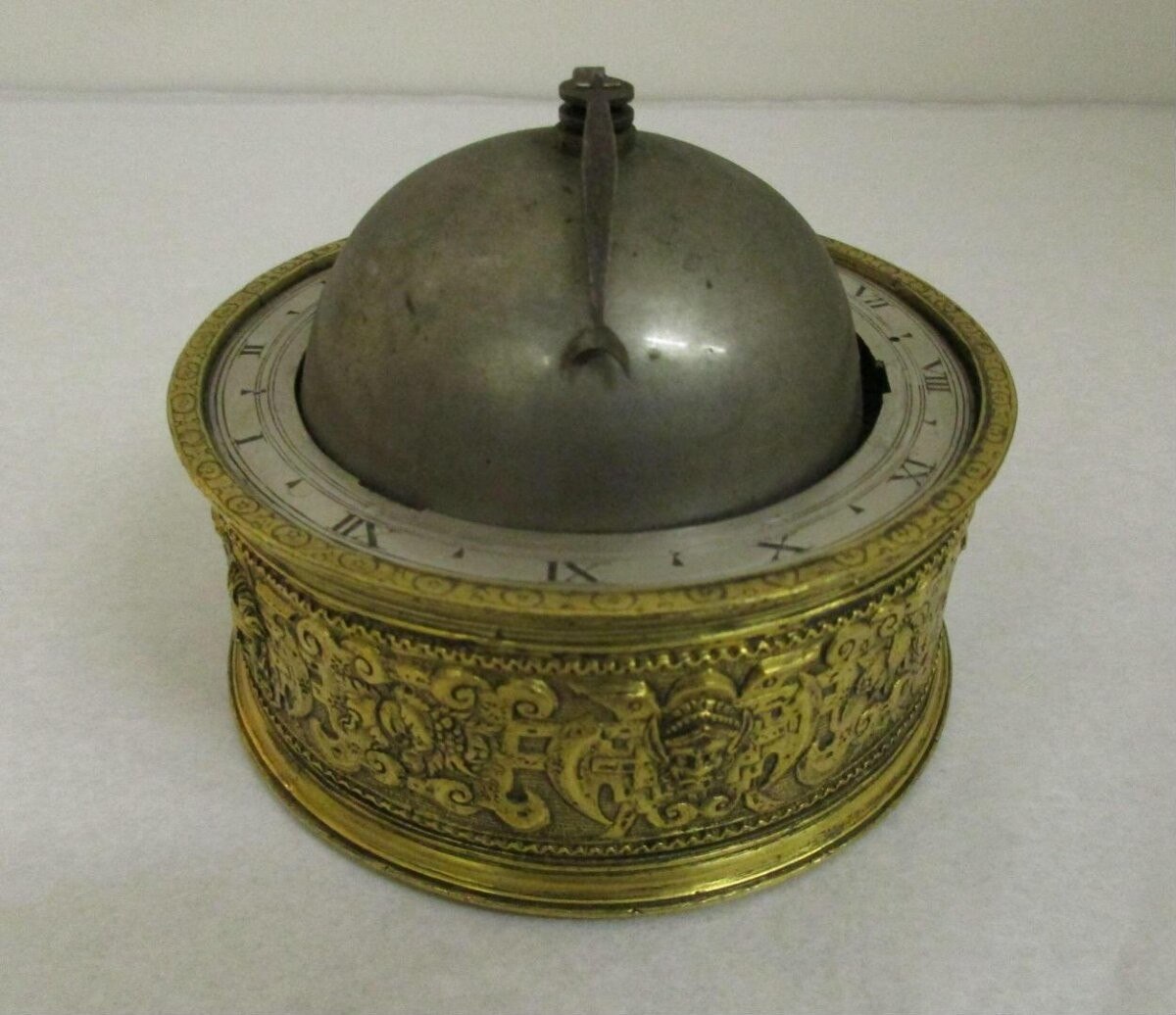
This German table clock, dated 1581, features a drum-shaped gilt-metal case decorated with cast and chased cartouche work and fruit. The base cover bears the engraved motto "posui deum adiutorem meum" alongside depictions of arabesque foliage, hounds, and hares. The internal construction utilizes iron for the movement plates and turned pillars. The clock contains a going train with a fusee, a chain, and a dumb-bell-shaped bar balance, the latter of which is considered a replacement. A striking train is also present, featuring an external count-wheel driven by reduction gearing. A large bell protrudes through the center of the silvered chapter ring, which is engraved with Roman numerals. The current single curved double-ended hour hand is a Museum-made renewal. Historical additions, including three lion feet and a figure pointer, were removed as they were not original.

Top view of the drum-shaped clock showing the chapter ring and bell.
Top view of the drum-shaped clock showing the chapter ring and bell. — Victoria and Albert Museum. Rights pending — permission not yet requested. Original source

Catalogue identity

Source
collections.vam.ac.uk
Category
Clock · Table clock
Maker / attribution
Not established
Reference
Not recorded
Catalogue / lot identifier
M.141-1913
Source-reported date
1581
Source-reported place
Germany

Source-reported attribution and specifications are not independent authentication. A listing does not establish present ownership, current display, availability or permission to reproduce.

Object description

Case and Exterior Details

The drum-shaped housing is constructed of gilt-metal, with sides adorned through casting and chasing techniques featuring cartouche work and fruit. The base cover is notable for its intricate engraving, which includes arabesque foliage interspersed with figures of hounds and hares.

The upper surface supports a silvered chapter ring, measuring 10.4 cm in diameter, which features engraved Roman numerals for the hours and marks for half-hour intervals. A large bell, measuring 7.6 cm in diameter, sits centrally within this ring. The base cover is pierced with two specific holes, labeled W for the going train and S for the striking train, facilitating manual winding of the mechanism.

Evidence for this section
  • “Gilt-metal drum-shaped case, the side cast and chased with cartouche work and fruit in relief.”
  • “engraved on the outside with arabesque foliage and including hounds and hares and the motto "posui deum adiutorem meum".”
  • “This cover is pierced with two winding holes marked W for going train and S for striking train.”

Movement and Escapement

The internal mechanism is built upon iron plates and pillars. The going train is powered by a fusee and chain, both composed of iron. Time regulation is achieved through a plain straight bar balance shaped like a dumb-bell, which is understood to be a later renewal. The striking train is similarly constructed of iron, with the exception of a renewed fanfly.

An external count-wheel with internal teeth provides the striking regulation, operated by reduction gearing connected to the second wheel of the striking train. A decorative fixed brass cover shields the count-wheel interior, accompanied by a brass finger pointer that indicates the hour most recently struck. The movement now operates with an unprotected mainspring, though it is suggested it may have originally functioned with a resting barrel.

Evidence for this section
  • “Movement plates 4 inches diameter, iron, the turned pillars are also iron.”
  • “Plain straight bar balance of dumb-bell shape, probably a renewal.”
  • “External count-wheel with internal teeth, driven by reduction gearing from the second wheel of the striking train.”

History and Provenance

The object entered the Museum collection in 1913, having been purchased from the J.H. Fitzhenry collection. At the time of acquisition, the clock included several components that were later identified as modern additions. These included a pierced gilt-metal dome placed over the bell, which was secured by three silver clips.

Additional non-original elements removed after acquisition included three silver lion-shaped feet and a female figure equipped with a pointer designed to indicate the time. The removal of these elements has restored the clock to a form closer to its original state, as the Museum noted these components were modern accretions rather than historical parts of the 1581 manufacture.

Evidence for this section
  • “When bought, the clock had a pierced gilt-metal dome covering the bell (attached by three silver clips), three silver lion feet and a female figure with pointer to show the time.”
  • “These were all modern additions and were removed.”
  • “Purchased from the collection of J.H.Fitzhenry, 1913”

Open research questions

  • What is the exact provenance of the movement components that are not documented as renewals?
  • Are there extant examples of similar 1581 German drum clocks that retain their original feet or balance wheels?

Source evidence

Recorded claims and source quotations for German Drum Table-Clock
FieldSource-reported valueSource quotation
Accession NumberM.141-1913“M.141-1913”
MaterialGilt-metal, iron, steel, silver“Gilt-metal drum-shaped case”
Movement MaterialIron“Movement plates 4 inches diameter, iron, the turned pillars are also iron.”
InscriptionPOSVI DEVM ADIVTOREM MEVM“engraved on the outside with arabesque foliage and including hounds and hares and the motto "posui deum adiutorem meum”
Dial Diameter10.4 cm“Silvered chapter ring (10.4 cm) diameter”
Bell Diameter7.6 cm“large bell (7.6 cm diameter)”

Visible details

  • Gilt-metal case with cast and chased relief ornament
  • Central bell protruding through the chapter ring
  • Engraved motto on the base cover

Research qualifications

  • The silvered chapter ring may be a renewal.
  • The dumb-bell shaped balance is likely a renewal.
  • The single hour hand is a modern replacement made in the Museum.

Photograph identity and source facts were screened before import; rights clearance remains pending.

Consulted source

German Drum Table-Clock

Reviewed 2026-11-02 · Record 4fa838d30f

Terms in this record

Glossary explanations for terms named in this object’s record.