
Skip to content
The Encyclopedia of Horology

Pocket watch · Verge pocket watch

George IV 18ct Gold Verge Pocket Watch

Partially verified

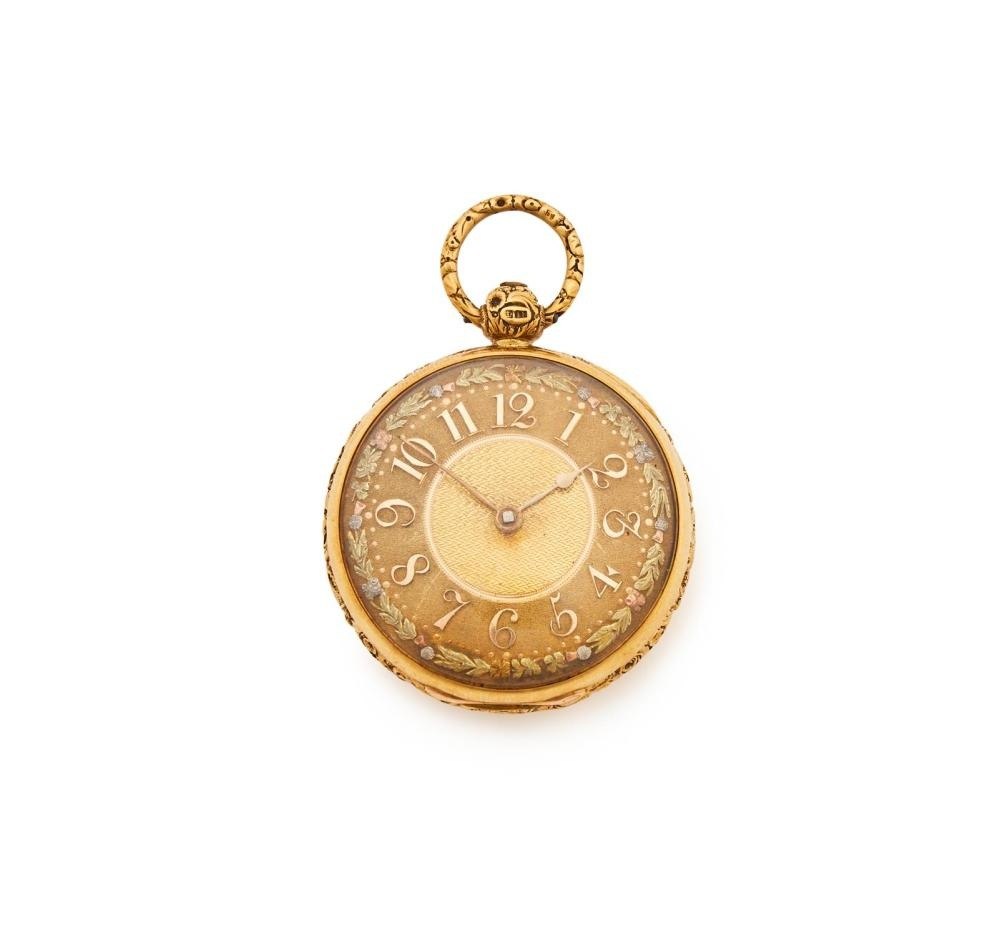
This 18ct gold pocket watch is identified as a George IV era verge piece, dated 1827. It features a frosted gilt full-plate single fusee movement with four columnar pillars pinned through the backplate. The verge escapement is regulated by a flat-rimmed sprung steel three-arm balance, which includes a faceted diamond endstone and a regulation arm operating against a slow/fast sector. The backplate is finished with a foliate-engraved backcock featuring a grotesque mask and a raised mainspring pivot plate signed by John Butt, London. The tri-colour gold dial presents an engine-turned center surrounded by a matted chapter ring with raised Arabic hour numerals, framed by a decorative band of foliage. Housed in a consular case with an engine-turned rear cover and relief floral decoration, the watch includes a suspension post and bow at twelve o'clock, with assay marks for Sheffield 1827.

Front view of the 18ct gold verge pocket watch showing the tri-colour gold dial and engine-turned decoration.
Front view of the 18ct gold verge pocket watch showing the tri-colour gold dial and engine-turned decoration. — Dreweatts 1759 Fine Sales / Invaluable. Rights pending — permission not yet requested. Original source

Catalogue identity

Source
orbiscollectibles.com
Category
Pocket watch · Verge pocket watch
Maker / attribution
John Butt
Reference
Not recorded
Catalogue / lot identifier
199031991
Source-reported date
1827
Source-reported place
United Kingdom
Source-reported serial
452

Source-reported attribution and specifications are not independent authentication. A listing does not establish present ownership, current display, availability or permission to reproduce.

Object description

Movement and Escapement

The watch is powered by a frosted gilt full-plate movement utilizing a single fusee system and four columnar pillars, which are pinned through the backplate. The timing is controlled by a verge escapement paired with a flat-rimmed, three-arm steel balance spring.

Regulation is achieved via a dedicated arm that moves against an engraved slow and fast sector. The movement is finished with a foliate-engraved backcock, which incorporates a central grotesque mask, alongside a raised, shaped mainspring pivot plate that serves as a location for the maker's signature and serial number.

Evidence for this section
  • “frosted gilt full-plate single fusee movement with four columnar pillars pinned through the backplate and verge escapement”
  • “flat-rimmed sprung steel three-arm balance”
  • “backplte applied with a foliate engraved backcock decorated with a grotesque mask”

Case and Dial Design

The exterior features a consular-style gold case displaying an engine-turned pattern on the rear cover. A distinct feature of the case is the relief floral band decoration encircling the perimeter, complemented by a matching suspension post and bow located at the twelve o'clock position. The bezel is hinged and fitted with convex glazing.

The dial is constructed from tri-colour gold and centers on an engine-turned surface. The surrounding chapter ring is matted and features raised Arabic hour numerals, which are enclosed within a decorative band of raised foliage. Time is indicated by a pair of gilt spade hands.

Evidence for this section
  • “the consular case with engine-turned rear cover, hinged convex-glazed bezel and relief floral band decoration to circumference”
  • “the tri-colour gold dial with engine-turned centre within matted chapter ring incorporating raised Arabic hour numerals”
  • “with gilt spade hands”

Signatures and Marks

The movement backplate identifies the maker as John Butt of Bond Street, London, and includes the individual serial number 452. The case bears hallmarks for the Sheffield assay office, dated to 1827. The maker of the case itself is recorded as W.M.

While a maker named John Butt is noted in historical horological texts, the source acknowledges that his recorded working period in London is cited as being before 1761, presenting a discrepancy with the 1827 date on this specific timepiece.

Evidence for this section
  • “raised shaped mainspring pivot plate engraved JOHN BUTT, Bond Street, LONDON, 452”
  • “marks for Sheffield 1827, case maker W.M.”
  • “A John Butt is recorded in Baillie, G.H. Watchmakers & Clockmakers of the World as working in London before 1761.”

Open research questions

  • Does the 1827 Sheffield hallmark confirm a later manufacture for John Butt than the period currently cited in reference literature?
  • Could the serial number 452 be linked to other known examples from this maker to verify production volume or chronology?

Source evidence

Recorded claims and source quotations for George IV 18ct Gold Verge Pocket Watch
FieldSource-reported valueSource quotation
MakerJohn Butt“JOHN BUTT, Bond Street, LONDON”
Assay locationSheffield“marks for Sheffield 1827”
Dial materialTri-colour gold“the tri-colour gold dial”
Gross weight91 grams“Gros weight 91 grams.”
Case dimensions4.5 cm“the case 4.5cm (1.75ins) diameter.”
Movement plate diameter4 cm“The pillar plate 4cm (1.5625ins) diameter”

Visible details

  • Tri-colour gold dial with engine-turned texture
  • Raised Arabic numerals within a floral-decorated chapter ring
  • Relief floral band decoration on the case circumference
  • Gilt spade hands

Research qualifications

  • The winding key provided with the watch is not of the correct size.
  • Historical record discrepancy noted regarding maker's working dates compared to the watch's 1827 date.

Photograph identity and source facts were screened before import; rights clearance remains pending.

Consulted source

GEORGE IV 18CT GOLD VERGE POCKET WATCH

Reviewed 2026-11-02 · Record 73f43f6c42

Terms in this record

Glossary explanations for terms named in this object’s record.