
Skip to content
The Encyclopedia of Horology

Clock · Longcase clock

George III Mahogany Musical and Automaton Longcase Clock by Samuel Smith

Partially verified

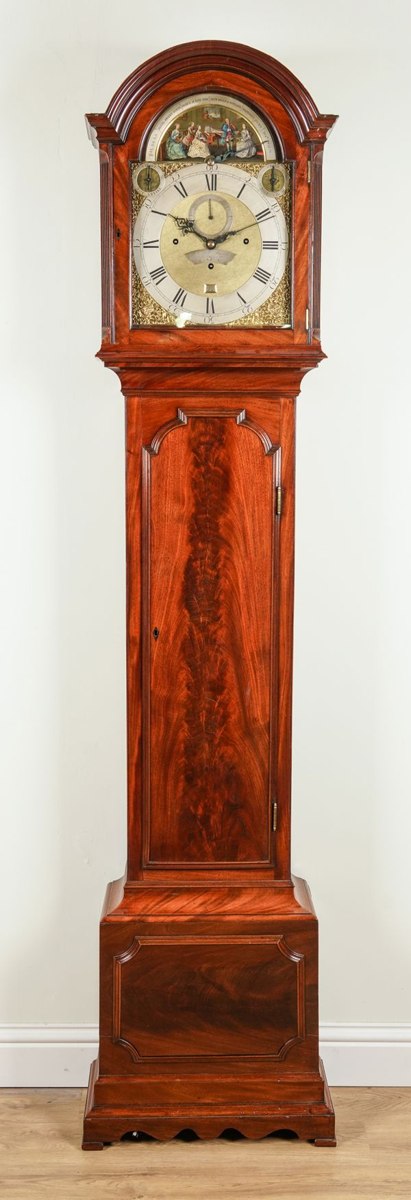
According to the auction catalogue, this George III mahogany longcase clock dates to circa 1780 and is signed by Samuel Smith of London. The case stands 232 cm high, featuring an arched hood with glazed panel door, fluted canted angles, and a flame-veneered trunk door set over a shaped base and plinth with bracket feet. The 13-inch arched brass dial includes a painted quintet with three automaton musicians and a selector for six tunes. The silvered chapter ring surrounds a matted dial centre, seconds subsidiary, strike and chime selectors, and a date aperture. The movement is reported as a three-train mechanism with six knopped pillars and an anchor escapement.

George III mahogany musical and automaton longcase clock by Samuel Smith
George III mahogany musical and automaton longcase clock by Samuel Smith — Bellmans. Rights pending — permission not yet requested. Original source

Catalogue identity

Source
app.bellmans.co.uk
Category
Clock · Longcase clock
Maker / attribution
Samuel Smith
Reference
Not recorded
Catalogue / lot identifier
1250
Source-reported date
circa 1780
Country
United Kingdom

Source-reported attribution and specifications are not independent authentication. A listing does not establish present ownership, current display, availability or permission to reproduce.

Object description

Case Construction

The mahogany longcase clock features an arched hood with a glazed panel door, flanked by fluted canted angles. The trunk includes a flat-top arched door with flame veneer, positioned above a shaped panel base, twin-stepped plinth, and bracket feet.

The clock is recorded as 232 cm high. It is noted that the oak seatboard is a replacement.

Evidence for this section
  • “The broken arch hood with glazed panel door, flanked to each side by a fluted canted angle”
  • “the trunk inset with a flat-top arched panel door, with fine flame veneer”
  • “above a shaped panel base and twin stepped plinth, on bracket feet”
  • “232cm high”
  • “The oak seaboard is a replacement.”

Dial and Musical Features

The 13-inch arched brass dial features a painted scene of three automaton musicians and a tune selector hand for six musical selections. The chapter ring is silvered, surrounding a matted center with a seconds subsidiary and a date aperture.

The dial includes subsidiary selectors for strike and chime functions. The signature escutcheon is engraved 'Samuel Smith LONDON'.

Evidence for this section
  • “the 13in arched brass dial decorated with a painted quintet with three automata musicians”
  • “tune selector hand for six tunes”
  • “with silvered chapter ring enclosing a matted centre with seconds subsidiary and signature escutcheon engraved Samuel Smith LONDON, with date aperture above the VI”
  • “above subsidiaries for STRIKE / NOT STRIKE and CHIME / NOT CHIME”

Movement

The movement is a three-train mechanism featuring six knopped pillars and an anchor escapement. It is equipped to strike the hour on a large bell and play a carillon of six bells.

The movement is housed within the case. Included accessories noted are a brass flat rod pendulum, three brass-covered weights, and two door keys.

Evidence for this section
  • “the substantial three train movement with six knopped pillars, playing on a carillon of six bells, striking the hour on a larger single bell, with anchor escapement”
  • “With brass flat rod pendulum.”
  • “Three substantial brass covered weights.”
  • “Two keys for the door locks.”

Open research questions

  • Verify the attribution of the tune 'Home Sweet Home' to a clock dated circa 1780, as the song was composed in 1823.

Source evidence

Recorded claims and source quotations for George III Mahogany Musical and Automaton Longcase Clock by Samuel Smith
FieldSource-reported valueSource quotation
Maker attributionSamuel Smith, London“By Samuel Smith, London circa 1780”
Height232 cm“232cm high”
Dial dimensions13 inches“the 13in arched brass dial”
Movement descriptionThree-train movement with six knopped pillars, anchor escapement, carillon of six bells, and hour bell“the substantial three train movement with six knopped pillars, playing on a carillon of six bells, striking the hour on a larger single bell, with anchor escapement”
Condition noteOak seatboard is a replacement“The oak seaboard is a replacement.”
Maker and DateSamuel Smith, London, circa 1780“By Samuel Smith, London circa 1780”
Musical RepertoireFal La La, Home Sweet Home, March in Rob Roy, Blue Bells of Scotland, Mariners Hymn, 104th Psalm“FAL LA LA / HOME SWEET HOME / MARCH IN ROB ROY / BLUE BELLS OF SCOTLAND / MARINERS HYMN / 104th PSALM”
ProvenanceWoolley & Wallis, Salisbury, 5 October 2016, lot 216“PROVENANCE : Woolley & Wallis, Salisbury, 5 October 2016, lot 216.”

Visible details

  • Tall polished mahogany longcase clock with an arched hood and bracket feet
  • Trunk door fronted with richly figured flame mahogany veneer
  • Arched dial showing a painted scene of musicians in the upper arch above the main chapter ring
  • Silvered chapter ring with Roman hour numerals and subsidiary dials flanking the upper corners

Research qualifications

  • Internal three-train movement, bells, pendulum, and weights are enclosed in the case and not visible in the photograph.
  • The auction house notes that the oak seatboard is a replacement.

Photograph identity and source facts were screened before import; rights clearance remains pending.

Consulted source

Reviewed 2026-10-22 · Record 2fd8c89c1e

Terms in this record

Glossary explanations for terms named in this object’s record.