
Skip to content
The Encyclopedia of Horology

Clock · Longcase clock

George III mahogany longcase clock, John Holmes

Partially verified

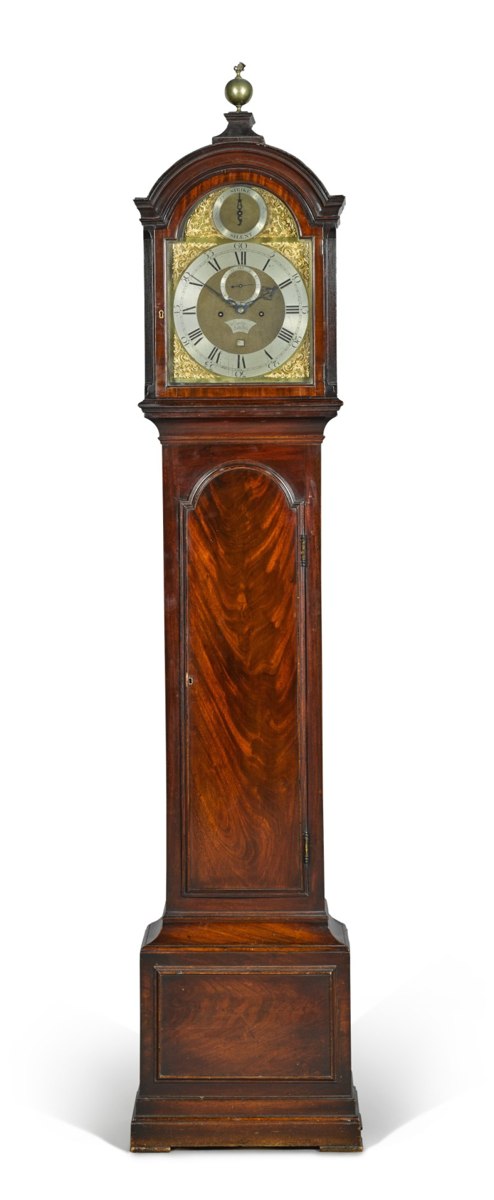
This George III longcase clock is attributed to John Holmes in London, dated circa 1775. Standing 229 cm high, the mahogany case is constructed with an arched hood crowned by moulded cresting and a single ball finial, reeded canted corners, and foliate side frets. Below, the trunk displays a finely moulded broken-arch door over a panelled plinth on a stepped base. The 12-inch arched dial includes rococo spandrels, a matted centre, subsidiary seconds dial, date aperture, a strike/silent dial in the arch, and a silvered plaque signed 'Holmes, London'. According to the source, the movement features five knopped pillars, anchor escapement with reduced recoil, maintaining power, a Ludlam-type wood rod pendulum with roller suspension, and rack striking on a later coiled gong.

George III mahogany longcase clock by John Holmes, London, circa 1775
George III mahogany longcase clock by John Holmes, London, circa 1775 — Sotheby's. Rights pending — permission not yet requested. Original source

Catalogue identity

Source
www.sothebys.com
Category
Clock · Longcase clock
Maker / attribution
John Holmes
Reference
Not recorded
Catalogue / lot identifier
56
Source-reported date
circa 1775
Country
United Kingdom

Source-reported attribution and specifications are not independent authentication. A listing does not establish present ownership, current display, availability or permission to reproduce.

Object description

Case Architecture and Composition

The clock is housed in a mahogany case standing 229 cm (7 ft 6 in) high. Observation of the exterior shows an arched hood surmounted by a central brass ball finial on a small decorative crest, while the cataloguing notes moulded cresting, reeded canted corners, and foliate side frets.

Below the hood, the trunk door shows flame mahogany figuring with an arched top moulding, described in the lot description as a finely moulded broken-arch trunk door. The trunk terminates in a panelled plinth with rectangular mouldings set over a stepped base.

Evidence for this section
  • “229cm 7ft 6in high”
  • “the case with moulded cresting and single ball finial above reeded canted hood corners and foliate side frets, finely moulded broken-arch trunk door and panelled plinth with stepped base”
  • “Arched hood surmounted by a central brass ball finial with a small decorative crest.”
  • “Trunk door shows flame mahogany figuring with an arched top moulding.”
  • “Lower plinth base features rectangular moulding above a stepped base.”

Dial Configuration

The 12-inch dial features gilt rococo spandrels around a silvered chapter ring, with an upper strike/silent dial located within the arch.

The matted dial centre incorporates a subsidiary seconds dial, a date aperture, and a silvered plaque signed 'Holmes, London'.

Evidence for this section
  • “12-inch dial with rococo spandrels, matted centre with subsidiary seconds dial and date aperture, signed on a silvered plaque Holmes, London , strike/silent dial in the arch”
  • “Brass dial has gilt rococo spandrels, a silvered chapter ring, subsidiary seconds dial, and an upper strike/silent dial within the arch.”

Reported Horological Movement

The source describes a substantial movement assembled with five knopped pillars, fitted with maintaining power and an anchor escapement with reduced recoil.

The pendulum assembly is catalogued as a Ludlam-type wood rod pendulum with a roller suspension. The striking mechanism uses rack striking, recorded as operating on a later coiled gong rather than a bell.

Evidence for this section
  • “the substantial movement with five knopped pillars, anchor escapement with reduced recoil, maintaining power, roller suspension to the Ludlam-type wood rod pendulum”
  • “rack striking on a later coiled gong”

Open research questions

  • What physical alterations or mounting marks remain on the seatboard and backplate from the installation of the later coiled gong?
  • Are any serial numbers, dates, or workshop marks stamped on the movement plates, as none are recorded in the auction listing?
  • What is the condition and originality of the roller suspension and Ludlam-type wood rod pendulum assembly?

Source evidence

Recorded claims and source quotations for George III mahogany longcase clock, John Holmes
FieldSource-reported valueSource quotation
Maker SignatureHolmes, London“signed on a silvered plaque Holmes, London”
Dial Size12-inch“12-inch dial with rococo spandrels”
EscapementAnchor escapement with reduced recoil“anchor escapement with reduced recoil”
PillarsFive knopped pillars“the substantial movement with five knopped pillars”
Height229cm (7ft 6in)“229cm 7ft 6in high”
Striking MechanismRack striking on a later coiled gong“rack striking on a later coiled gong”
Pendulum TypeLudlam-type wood rod with roller suspension“roller suspension to the Ludlam-type wood rod pendulum”
Maintaining PowerPresent“maintaining power”

Visible details

  • Arched hood surmounted by a central brass ball finial with a small decorative crest.
  • Trunk door shows flame mahogany figuring with an arched top moulding.
  • Brass dial has gilt rococo spandrels, a silvered chapter ring, subsidiary seconds dial, and an upper strike/silent dial within the arch.
  • Lower plinth base features rectangular moulding above a stepped base.

Research qualifications

  • Internal movement, pendulum, weights, and coiled gong are not visible in the photograph.
  • The source notes that the coiled gong is later.

Photograph identity and source facts were screened before import; rights clearance remains pending.

Consulted source

A George III mahogany longcase clock, John Holmes, London, circa 1775

Reviewed 2026-10-21 · Record 5eaa20f6e7

Terms in this record

Glossary explanations for terms named in this object’s record.