
Skip to content
The Encyclopedia of Horology

Pocket watch · Pocket watch

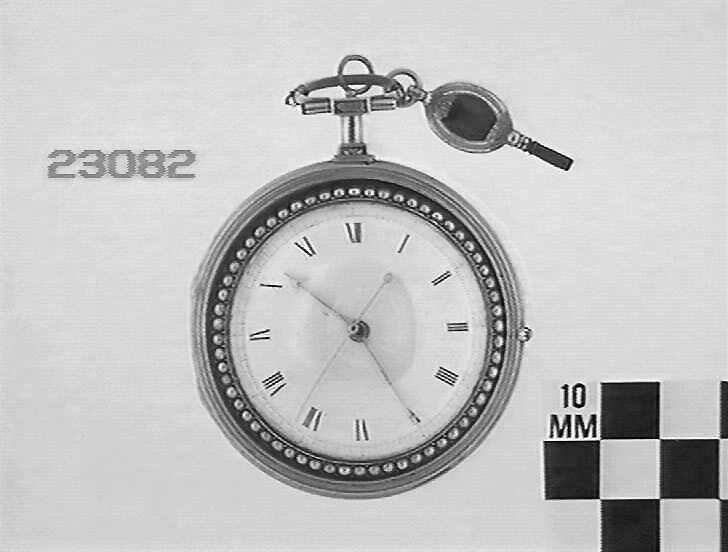
Gents pocket watch in gilt pair case

Partially verified

This gents pocket watch, dating to the mid 19th century, features a gilt pair case construction. The inner case is decorated with circles of pearls on both the front and back, with the back originally featuring blue enamel work that is now largely chipped. The white enamel dial displays Roman numerals and includes a center sweep hand, which can be arrested by a lever mechanism located at the back of the case; this lever applies pressure to the balance wheel via a small arm. The watch is accompanied by a winding key with blue enamel inlay. According to the donor, Mr. William Henry Ingram, this timepiece was carried during the 1857 siege of Lucknow. The object is registered as ST 23082 in the collection of Museums Victoria.

Gilt pair case pocket watch with winding key
Gilt pair case pocket watch with winding key — Museums Victoria. Rights pending — permission not yet requested. Original source

Catalogue identity

Source
collections.museumsvictoria.com.au
Category
Pocket watch · Pocket watch
Maker / attribution
Not established
Reference
Not recorded
Catalogue / lot identifier
ST 23082
Source-reported date
mid 19th century
Source-reported place
Not established
Source-reported serial
4206

Source-reported attribution and specifications are not independent authentication. A listing does not establish present ownership, current display, availability or permission to reproduce.

Object description

Case and Dial

The watch is housed in a gilt pair case. The outer component is designed with an open front and a glass back, allowing for the visibility of the inner case. The inner case itself exhibits decorative circles of pearls on both the front and rear surfaces. A layer of blue enamel was originally applied to the reverse of the inner case, though this finish is significantly degraded and mostly missing.

The dial is composed of white enamel and features Roman numerals for hour markers. It is equipped with a center sweep hand, a feature that distinguishes it from standard time-only displays of the period. The dial remains visible through the protective glass of the outer case front.

Evidence for this section
  • “Gilt pair case. Outer case has open front & glass back. Inner case decorated front and back with circles of pearls.”
  • “Back once covered with blue enamel, but now mostly chipped off. White enamel dial has roman numerals and centre sweep hand”

Movement and Function

The mechanical movement is activated by a key-wound spring mechanism. The power is transmitted via a cylinder escapement, which was a common configuration for watches of this era. A specific feature is the secondary control mechanism; a lever located on the back of the case allows the user to stop the center sweep hand.

When engaged, this lever acts upon an internal light arm, which then presses against the balance wheel to halt the motion. The winding key provided with the watch is decorated with a blue enamel insert.

Evidence for this section
  • “Key wound spring; cylinder escapement.”
  • “centre sweep hand which can be stopped by small lever in back of case that presses a light arm against the balance wheel.”
  • “Key has blue enamel insert.”

Provenance and Registration

The watch was acquired by the museum in 1949 as part of a bequest from Mr. William Henry Ingram. Included with the administrative record is a claim that the watch was present during the 1857 siege of Lucknow, part of the Indian Rebellion. This information is preserved as part of the donor's provided history for the object.

The object is catalogued within the museum's science and measurement collection under the registration number ST 23082. An identifying mark, '4206', is found on the pendant of the case, which serves as a unique identifier for the internal construction of the watch. No manufacturer is currently identified for the piece.

Evidence for this section
  • “Said by donor to have been carried in the siege of Lucknow during the Indian Rebellion, 1857.”
  • “Acquisition: Bequest from Mr William Henry Ingram, 10 May 1949”
  • “Registration number: ST 23082”
  • “Pendant is marked '4206'.”

Open research questions

  • Does the pendant mark '4206' correspond to a known maker's serial sequence?
  • Can the specific lever-stop mechanism be identified as a proprietary design of a known maker?

Source evidence

Recorded claims and source quotations for Gents pocket watch in gilt pair case
FieldSource-reported valueSource quotation
Registration numberST 23082“Registration number: ST 23082”
Datemid 19th century“Mid 19th Century”
Case descriptionGilt pair case with pearls“Gilt pair case. Outer case has open front & glass back. Inner case decorated front and back with circles of pearls.”
Movement typeKey wound cylinder escapement“Key wound spring; cylinder escapement.”
ProvenanceBequest from Mr William Henry Ingram“Acquisition: Bequest from Mr William Henry Ingram, 10 May 1949”
Provenance claimSiege of Lucknow 1857“Said by donor to have been carried in the siege of Lucknow during the Indian Rebellion, 1857.”
Serial mark4206“Pendant is marked '4206'.”

Visible details

  • Case decorated with pearls
  • White enamel dial with Roman numerals
  • Blue enamel winding key included
  • Lever mechanism on case back for stopping seconds hand

Research qualifications

  • Historical provenance during the siege of Lucknow relies solely on donor testimony
  • Origin of manufacture is unknown

Photograph identity and source facts were screened before import; rights clearance remains pending.

Consulted source

Pocket Watch - Mid 19th Century

Reviewed 2026-10-26 · Record 5a576ad572

Terms in this record

Glossary explanations for terms named in this object’s record.