
Skip to content
The Encyclopedia of Horology

Pocket watch · Verge fusee pocket watch

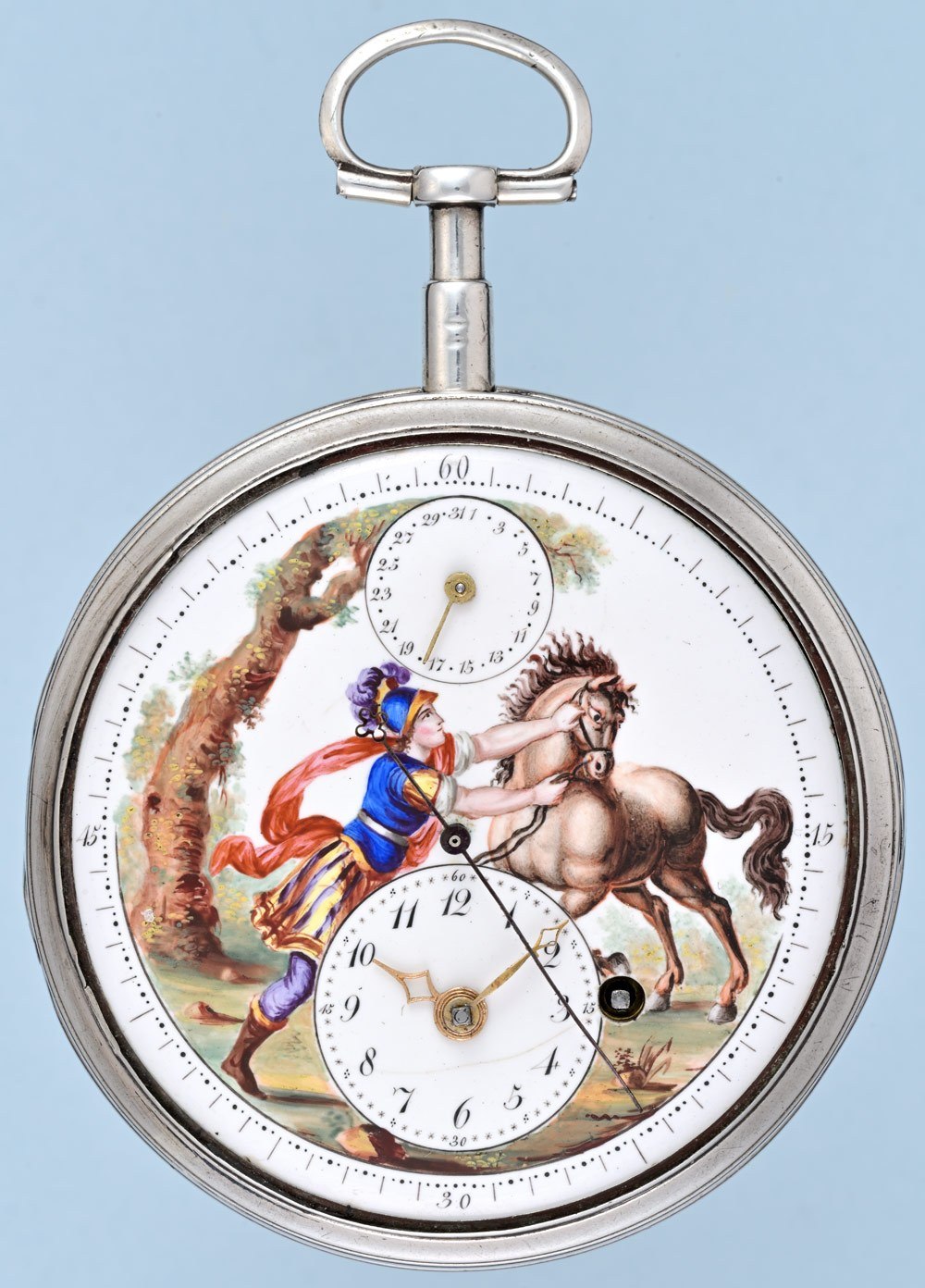
French late 18th-century calendar pocket watch with centre seconds

Partially verified

This antique pocket watch is a French manufacture originating from the late 18th century. It is constructed with a silver consular case featuring a silver pendant and bow, with a maker's mark "HM" recorded on the case. The watch utilizes a gilt fusee movement with a verge escapement. The balance cock is intricately pierced and engraved and supports a polished steel coqueret. It features a three-arm gold balance with a blued steel hairspring and a silver regulator disc with a gilded indicator. The white enamel dial is painted with a polychrome scene depicting a soldier restraining a horse. The dial layout includes a central blued steel seconds hand, a subsidiary dial for hours and minutes at the 6 o'clock position with Arabic numerals and gold hands, and a calendar display at the 12 o'clock position. Winding is performed directly through the dial.

Front view of the French late 18th-century silver pocket watch showing the enamel dial and central seconds.
Front view of the French late 18th-century silver pocket watch showing the enamel dial and central seconds. — Pieces of Time. Rights pending — permission not yet requested. Original source

Catalogue identity

Source
zamanito.com
Category
Pocket watch · Verge fusee pocket watch
Maker / attribution
HM
Reference
Not recorded
Catalogue / lot identifier
Source URL identifies the listing
Source-reported date
late 18th century
Source-reported place
France

Source-reported attribution and specifications are not independent authentication. A listing does not establish present ownership, current display, availability or permission to reproduce.

Object description

Case and Dial

The watch is housed in a silver consular-style case, which includes a plain silver finish and a round pendant and bow. The case is marked with the initials 'HM', as noted in the auction documentation.

The dial is composed of white enamel and decorated with a polychrome miniature painting depicting a soldier restraining a horse. Time is indicated via a subsidiary dial at the 6 o'clock position equipped with gold hands and Arabic numerals. A secondary subsidiary dial for the calendar display is positioned at 12 o'clock. A central seconds hand made of blued steel sweeps the dial, which is wound directly through a dial-side aperture.

Evidence for this section
  • “قاب نقره‌ای از نوع کنسولار (consular case)”
  • “نشان سازنده با حروف «HM» روی آن حک شده است”
  • “صفحه ساعت از جنس مینای سفید بوده و عمل کوک ساعت مستقیماً از روی صفحه انجام می‌شود”

Movement and Escapement

The watch operates on a full-plate, gilt-finished movement powered by a fusee system. The escapement is a traditional verge type. The balance wheel is a three-arm gold design paired with a blued steel hairspring.

The balance cock is highly decorative, featuring fine piercing and engraving. A polished steel coqueret is mounted onto the bridge. Regulation of the timekeeping is controlled by a silver disc positioned on the plate, which is accompanied by a gilded indicator.

Evidence for this section
  • “موتور ساعت دارای ساختار تمام‌پلیت طلاکاری‌شده (full plate gilt fusee)”
  • “خروس تعادل (bridge cock) دارای تراش‌کاری و کنده‌کاری مشبک و بسیار ظریفی است”
  • “رقاصک (balance) سه پره طلایی با فنر مویی حلزونی فولادی آبی‌شده کار می‌کند”

Condition and Attribution

The watch is attributed to a French origin in the late 18th century. The auction description notes the presence of the 'HM' maker's mark on the case, which serves as a primary identifier for the watch's origin.

Regarding the watch's state, the provided source documentation explicitly states that it has not provided information regarding current working order. Potential collectors are advised by the source to independently verify the health of the fusee chain, the operation of the calendar mechanism, the functionality of the central seconds, and the condition of the enamel paint on the dial.

Evidence for this section
  • “این اثر یک ساعت جیبی عتیقه فرانسوی متعلق به اواخر قرن هجدهم میلادی است”
  • “منبع به پیشینه سرویس یا کارکرد فعلی اشاره‌ای نکرده است”

Open research questions

  • Can the 'HM' maker's mark be definitively linked to a specific French silversmith of the late 18th century?
  • Does the central seconds mechanism utilize an independent train or a different configuration common to French verge watches of this period?

Source evidence

Recorded claims and source quotations for French late 18th-century calendar pocket watch with centre seconds
FieldSource-reported valueSource quotation
Maker's MarkHM“نشان سازنده با حروف «HM» روی آن حک شده است”
EscapementVerge“چرخ‌دنگ ورج (verge escapement)”
Dial DecorationPolychrome enamel painting“نقاشی میناکاری رنگارنگ (polychrome enamel) ظریف آن است که صحنه مهار یک اسب توسط یک سرباز را به تصویر می‌کشد”
Movement ConstructionFull plate gilt fusee“ساختار تمام‌پلیت طلاکاری‌شده (full plate gilt fusee)”
Case TypeConsular“قاب نقره‌ای از نوع کنسولار (consular case)”
CountryFrance“مبدا ساخت: فرانسه (طبق منبع)”
DatingLate 18th century“اواخر قرن هجدهم میلادی”

Visible details

  • Polychrome enamel scene on the dial featuring a soldier and a horse
  • Gilt full-plate movement with pierced bridge cock
  • Silver consular case with HM maker's mark
  • Direct-dial winding aperture

Research qualifications

  • Working condition of the calendar mechanism and seconds hand is unverified
  • The integrity and continuity of the enamel paint on the dial require independent inspection

Photograph identity and source facts were screened before import; rights clearance remains pending.

Consulted source

Silver Painted Dial Centre Seconds Calendar Verge

Reviewed 2026-11-02 · Record 002e0b85bd