
Skip to content
The Encyclopedia of Horology

Marine chronometer · Vertical marine chronometer

Ferdinand Berthoud La Montre à Longitude Verticale No. 46

Partially verified

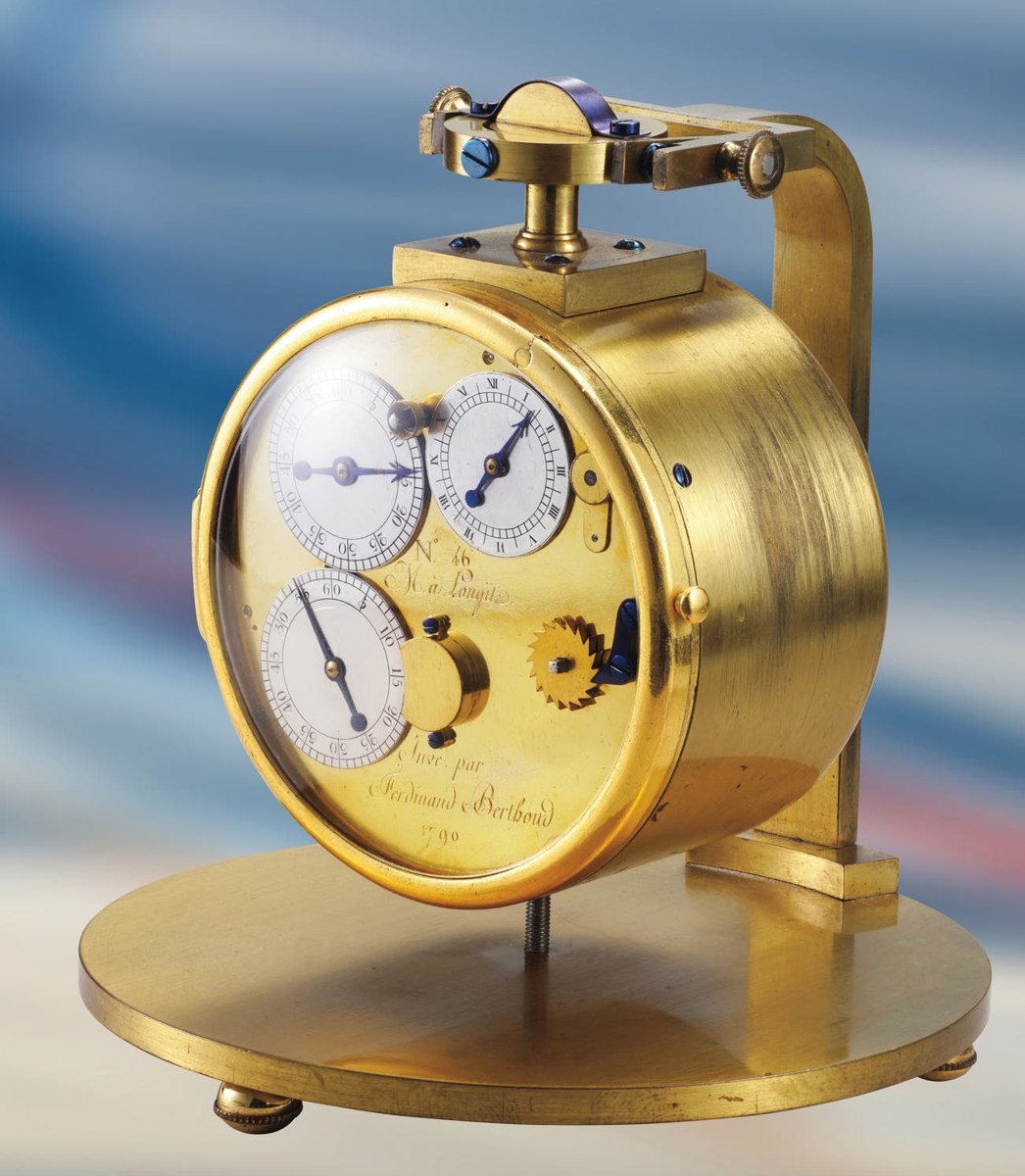
Completed in 1790, La Montre à Longitude Verticale No. 46 is a brass vertical marine chronometer designed by Ferdinand Berthoud and constructed by Vincent Martin. Source notes describe the instrument as a versatile precision timekeeper conceived to serve at sea, as a deck or pocket watch, and as a desk timepiece via its detachable gimballed suspension. The movement features a manual fusée and chain, maintaining power, a detached pivoted detent escapement, and temperature compensation combining steel and copper. The front dial plate integrates three enamel subsidiary dials for time indications, exposed clickwork, and engraved signatures.

Ferdinand Berthoud vertical marine chronometer No. 46 mounted on a brass suspension stand.
Ferdinand Berthoud vertical marine chronometer No. 46 mounted on a brass suspension stand. — Phillips. Rights pending — permission not yet requested. Original source

Catalogue identity

Source
www.phillips.com
Category
Marine chronometer · Vertical marine chronometer
Maker / attribution
Ferdinand Berthoud
Reference
Not recorded
Catalogue / lot identifier
91
Source-reported date
1790
Country
France
Source-reported serial
46

Source-reported attribution and specifications are not independent authentication. A listing does not establish present ownership, current display, availability or permission to reproduce.

Object description

Object Identity and Documentation

Completed in 1790, this vertical marine chronometer, designated No. 46, was constructed by Vincent Martin, described as Berthoud’s foremost pupil and 'horloger de la Marine' in Brest, working to Berthoud's specifications.

The instrument is documented in Ferdinand Berthoud’s contemporary technical literature; specifically, the opening 22 pages of his 1792 publication, 'Traité des Montres à Longitudes', are devoted to this chronometer. It is also featured on the frontispiece of his 1802 work, 'Histoire de la Mesure du Temps'.

Evidence for this section
  • “Completed in 1790, M.M. No. 46”
  • “constructed by Vincent Martin, Berthoud’s foremost pupil and horloger de la Marine”
  • “the opening 22 pages of which are devoted to the present chronometer, No. 46.”
  • “he selected it for inclusion in the frontispiece of his Histoire de la Mesure du Temps, published in 1802”

Construction and Dial Configuration

The timepiece is housed in a 72mm cylindrical brass drum case. It features a detachable gimballed mounting for marine use or table-top display, though the associated brass stand is catalogued as a modern recreation.

The gilded dial plate is engraved 'No. 46 / M.e à Longit.de' and 'Inve. par / Ferdinand Berthoud / 1790'. Three white enamel subsidiary dials display hours, minutes, and seconds, while the dial plate also features an exposed clickwork ratchet and blued steel click.

Evidence for this section
  • “Dimensions 72mm diameter”
  • “Accompanied by brass stand (modern recreation)”
  • “Gilded dial plate engraved 'No. 46 / M.e à Longit.de' and 'Inve. par / Ferdinand Berthoud / 1790'.”
  • “Three white enamel subsidiary dials display hours, minutes, and seconds under a glazed front.”
  • “Exposed clickwork ratchet and blued steel click visible on the dial plate.”

Technical Specifications

The movement incorporates a manual fusée and chain with maintaining power. It utilizes a detached pivoted detent escapement and a balance beating at a frequency of 2 Hz (14,400 vph).

For temperature compensation, Berthoud used a system employing steel and copper, noting this as a departure from traditional grid-iron designs.

Evidence for this section
  • “detached pivoted detent escapement and a fusee with maintaining power”
  • “beating at a frequency of 2 Hz (14,400 vph)”
  • “replaced the traditional grid-iron temperature compensation with a simpler system employing steel and copper.”

Open research questions

  • What specific technical differences exist between the steel and copper compensation system on No. 46 and the grid-iron designs common to the period?
  • Are there archival records in Brest detailing the collaborative process between Vincent Martin and Ferdinand Berthoud during the assembly of No. 46?
  • To what extent does the modern brass stand mimic the mechanical design of the 18th-century gimballed mount described in Berthoud's Traité?

Source evidence

Recorded claims and source quotations for Ferdinand Berthoud La Montre à Longitude Verticale No. 46
FieldSource-reported valueSource quotation
Case Number46“Case No 46”
Year1790“Year 1790”
MaterialBrass“Material Brass”
Dimensions72mm diameter“Dimensions 72mm diameter”
EscapementDetached pivoted detent escapement“detached pivoted detent escapement”
ConstructorVincent Martin“constructed by Vincent Martin, Berthoud’s foremost pupil”
Frequency2 Hz (14,400 vph)“beating at a frequency of 2 Hz (14,400 vph)”

Visible details

  • Three white enamel subsidiary dials display hours, minutes, and seconds under a glazed front.
  • Gilded dial plate engraved 'No. 46 / M.e à Longit.de' and 'Inve. par / Ferdinand Berthoud / 1790'.
  • Exposed clickwork ratchet and blued steel click visible on the dial plate.
  • Cylindrical brass drum case suspended by a gimbal pivot arm on an arched brass stand resting on a circular base with feet.

Research qualifications

  • The brass stand is catalogued by the source as a modern recreation rather than an original 18th-century component.
  • Internal escapement and gear train are not visible in the photograph.

Photograph identity and source facts were screened before import; rights clearance remains pending.

Consulted source

Ferdinand Berthoud The Geneva Watch Auction: XXIV

Reviewed 2026-10-22 · Record 555917bafa

Terms in this record

Glossary explanations for terms named in this object’s record.