
Skip to content
The Encyclopedia of Horology

Clock · Electromagnetic mantel clock

Eureka Clock Co. Ltd. striking electromagnetic '1000 day' mantel clock

Partially verified

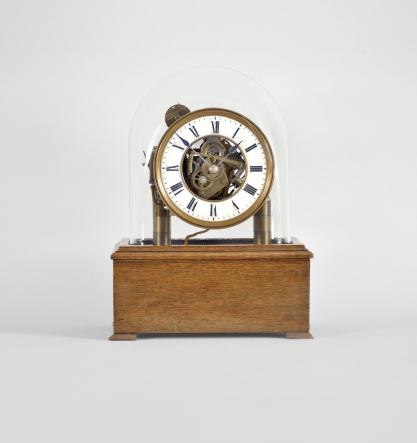
This striking electromagnetic '1000 day' mantel clock by the Eureka Clock Co. Ltd., London, dates to circa 1910 and bears serial number 196. Supported by two cylindrical brass pillars above a rectangular oak base, it is enclosed beneath a conforming arched glass dome. The timepiece features an open-center white enamel dial with black Roman numerals and blued steel spade hands, displaying the internal brass movement. It is fitted with spotted brass plates, a prominent vertical bimetallic balance, and an electrically activated rack striking train striking on a rear gong.

Eureka Clock Co. Ltd. striking electromagnetic '1000 day' mantel clock under glass dome, circa 1910
Eureka Clock Co. Ltd. striking electromagnetic '1000 day' mantel clock under glass dome, circa 1910 — Schmitt Horan & Co.. Rights pending — permission not yet requested. Original source

Catalogue identity

Source
www.schmitt-horan.com
Category
Clock · Electromagnetic mantel clock
Maker / attribution
Eureka Clock Co. Ltd.
Reference
Not recorded
Catalogue / lot identifier
122
Source-reported date
circa 1910
Country
Not established
Source-reported serial
196

Source-reported attribution and specifications are not independent authentication. A listing does not establish present ownership, current display, availability or permission to reproduce.

Object description

Movement and Mechanism

The clock is a Eureka Clock Co. Ltd. mantel clock, identified as a striking electromagnetic '1000 day' model, serial number 196. It contains a Eureka 'short' movement with spotted brass plates and a large, vertical bimetallic balance, along with an electrically activated rack striking train.

The condition of the movement includes old lacquer, tarnish, and oxide on the gong stand and gong. While the clock is described as running and the striking as functional, it is reported that the gathering pallet does not advance the rack fully to the next tooth.

Evidence for this section
  • “Eureka Clock Co. Ltd., London, a rare, striking electromagnetic "1000 day" mantel clock”
  • “supporting a Eureka " short" movement with spotted brass plates and large, vertical bimetallic balance, and electrically activated rack striking”
  • “serial #196.”
  • “movement in old lacquer and with tarnish, gong stand and gong with oxide, running, striking functional, but the gathering pallet is not advancing the rack fully to the next tooth.”

Dial and Case

The clock features a white enamel dial with Roman numerals and an open center, paired with blued steel spade hands. The hands exhibit specks of oxide.

The mechanism is housed on a rectangular oak base beneath a conforming glass dome. Both the oak base and the dome are noted as being in good condition.

Evidence for this section
  • “roman numeral white enamel dial with open center, and blued steel spade hands”
  • “hands with specks of oxide”
  • “the rectangular oak base with conforming glass dome”
  • “oak base and dome good”

Historical Documentation

Serial number 196 is recorded in Dr. Alan Shenton's book 'The Eureka Clock' on page 29 and pictured on the following two pages. The clock was included in the 1958 'Pendulum to Atom' exhibition and the 1976/77 'Electrifying Time' exhibition.

The source documents a prior sale of the clock at Christie's, London, on October 15, 1986, as lot 133. Regarding the striking mechanism, the source notes that while Lionel Asprey filed patents for a Eureka striking design in 1913, no clocks are known to have been made to his specification.

Evidence for this section
  • “This clock, number 196, is discussed in Dr. Alan Shenton's book "The Eureka Clock", page 29”
  • “It was shown at the "Pendulum to Atom" exhibition in 1958, and again at the " Electrifying Time" exhibition in 1976/ 77.”
  • “The clock was later sold at Christies, London, October 15, 1986, lot 133.”
  • “While patent papers showing a striking mechanism for use in Eureka clocks were filed by Lionel Asprey in 1913, no clocks are known to have been made to his specification.”

Open research questions

  • Are there records detailing the specific modifications made to the 'short' movement to incorporate the rack striking train?
  • Does the 1913 Asprey patent represent the design intent for this specific movement despite the source's note that no clocks were known to be made to that specification?

Source evidence

Recorded claims and source quotations for Eureka Clock Co. Ltd. striking electromagnetic '1000 day' mantel clock
FieldSource-reported valueSource quotation
MakerEureka Clock Co. Ltd., London“Eureka Clock Co. Ltd., London, a rare, striking electromagnetic "1000 day" mantel clock”
Serial Number196“serial #196.”
Base and DomeRectangular oak base with conforming glass dome“the rectangular oak base with conforming glass dome”
DialRoman numeral white enamel dial with open center“roman numeral white enamel dial with open center, and blued steel spade hands”
Striking TrainElectrically activated rack striking“electrically activated rack striking”
MakerEureka Clock Co. Ltd.“Eureka Clock Co. Ltd., London”
Datingcirca 1910“CIRCA: 1910”
Dimensions11in x 8in x 6in“DIMENSIONS: 11in x 8in x 6in”

Visible details

  • Tall arched clear glass dome enclosing the mechanism and resting on the wooden base
  • Molded rectangular wooden base with visible grain and corner plinth feet
  • Open center white enamel chapter ring displaying black Roman numerals
  • Blued steel spade hands at the dial center
  • Internal brass movement components visible through the open dial aperture and dome

Research qualifications

  • Source notes the striking gathering pallet does not advance the rack fully to the next tooth
  • Operational condition of electrical circuitry and power source is not verified

Photograph identity and source facts were screened before import; rights clearance remains pending.

Consulted source

Lots 118 - 157: Rare Electric Clocks from The Arthur Bjornestad Collection

Reviewed 2026-10-25 · Record 99ae8b909a

Terms in this record

Glossary explanations for terms named in this object’s record.