
Skip to content
The Encyclopedia of Horology

Pocket watch · Musical pocket-knife watch

Double-bladed pocket-knife with integrated watch and music

Partially verified

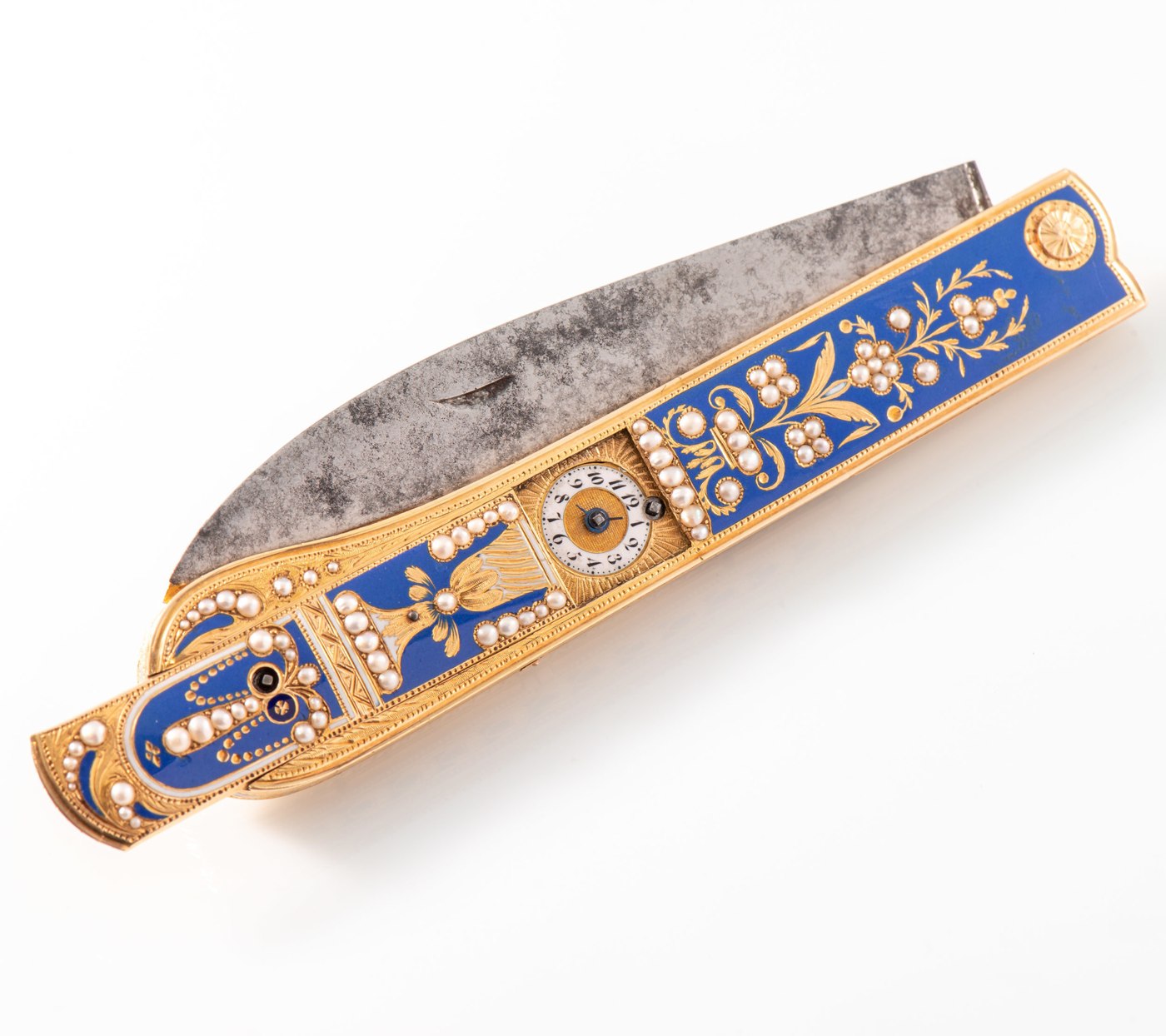
This 18K yellow gold, enamel, and pearl-set pocket-knife contains an integrated watch and a musical mechanism. Attributable to the Genevan workshops of Piguet & Capt or Piguet & Meylan, the object was manufactured for the Chinese market. The white enamel dial features suspended Breguet numerals and blued steel hands. The gold casing is embellished with sky-blue champlevé enamel, floral motifs, urns, and half-pearls, while the back panel displays a polychrome enamel plaque of birds and fruit. Two folding blades are provided, one in steel for cutting and one in gold for peeling fruit. The oblong movement consists of a cylinder escapement, gilded brass plates, a going barrel, and a pin-barrel musical mechanism with four vibrating blades. The watch and musical movement are wound via squares revealed by a sliding panel on the front. This is one of a limited number of such mechanical knives documented.

Double-bladed pocket-knife with integrated watch and musical mechanism, displaying the white enamel dial and blue champlevé enamel decoration.
Double-bladed pocket-knife with integrated watch and musical mechanism, displaying the white enamel dial and blue champlevé enamel decoration. — Antiquorum. Rights pending — permission not yet requested. Original source

Catalogue identity

Source
catalog.antiquorum.swiss
Category
Pocket watch · Musical pocket-knife watch
Maker / attribution
Piguet & Capt or Piguet & Meylan
Reference
Not recorded
Catalogue / lot identifier
457
Source-reported date
circa 1805-1815
Source-reported place
Switzerland

Source-reported attribution and specifications are not independent authentication. A listing does not establish present ownership, current display, availability or permission to reproduce.

Object description

Case and External Decoration

The object functions as a luxury pocket-knife with dual folding blades, one steel and one gold, intended for handling fruit. The exterior of the gold mount is decorated with intricate taille-douce engraving and sky-blue champlevé enamel featuring urns and floral patterns. Half-pearls are set along the edges and decorative elements of the casing.

The back panel displays a polychrome enamel plaque over a pink ground, depicting birds and fruit. A sliding section on the front allows access to the watch dial, which is finished in white enamel with suspended Breguet numerals, as well as the winding squares required for the timekeeping and musical mechanisms.

Evidence for this section
  • “Yellow gold tapered mount, the edges with decoration engraved in taille-douce (fine cut), with parts in sky blue champlevé enamel with floral decorations and urns set with half-pearls”
  • “the front panel has a sliding lower part to reveal the watch and its winding square, as well as the winding square of the music mechanism.”
  • “the second one made of gold is used to peel fruits so as not to oxidize them.”

Movement and Musical Mechanism

The movement is contained within an oblong, roughly rectangular housing composed of gilded brass plates. It utilizes a cylinder escapement with a steel wheel and a monometallic three-arm balance. Timekeeping regulation is managed via a polished steel index-regulator, and the assembly is powered by a going barrel.

The musical function is achieved through a pinned cylinder mechanism, consistent with the invention by Antoine Favre-Salomon. It features four vibrating blades arranged to play a single melody, which is released by a dedicated catch located on the case.

Evidence for this section
  • “Oblong movement, more or less rectangular, full plates, gilded brass, going barrel, cylinder escapement (steel wheel)”
  • “in continuity, pin-barrel (“piqué”) musical mechanism with gearing and set of four vibrating blades superimposed, playing one melody”

Provenance and Historical Context

This object belongs to a small group of luxury musical pocket-knives produced in Geneva during the early 19th century for the export market. These novelties were popular among wealthy Chinese clientele during the late 18th and early 19th centuries, following established trade channels through Guangzhou.

The auction description notes its attribution to either Piguet & Capt or Piguet & Meylan, both of which were notable for their specialization in musical and automaton movements.

Evidence for this section
  • “Only a small group of Geneva-made gold and enamel pocket-knives with folding blades from the early 19th century is known.”
  • “The example proposed here is remarkably compact for its complexity, incorporating a watch and a musical mechanism. This object is the second known of its kind. It is paired with the pocket-knife in the Patek Philippe Museum in Geneva (Inv. S-316).”

Open research questions

  • Can physical examination of the movement confirm a specific attribution between the Piguet & Capt or Piguet & Meylan partnerships?
  • Are there records in the Patek Philippe Museum archives that provide further provenance for the item prior to its 1995 auction appearance?

Source evidence

Recorded claims and source quotations for Double-bladed pocket-knife with integrated watch and music
FieldSource-reported valueSource quotation
Material18K yellow gold, enamel and pearls“18K yellow gold, enamel and pearls”
EscapementCylinder“cylinder escapement (steel wheel)”
Musical MechanismPin-barrel with four vibrating blades“pin-barrel (“piqué”) musical mechanism with gearing and set of four vibrating blades superimposed”
MarketChinese market“made for the Chinese market”
Dial FeaturesWhite enamel with suspended Breguet numerals“White colour enamel dial, with suspended “Breguet” numerals”
Maker AttributionPiguet & Capt or Piguet & Meylan“Attributable to Piguet & Capt or Piguet & Meylan”
Yearcirca 1805-1815“Year circa 1805-1815”
ConditionVery good“Grading System Grade: Case: 2 Very good Movement: 2 Very good Dial: 2-01 Very good”

Visible details

  • Integrated watch dial with suspended Arabic numerals
  • Two folding knife blades, one steel and one gold
  • Case exterior adorned with champlevé enamel and half-pearls
  • Sliding panel on the knife body housing winding squares

Research qualifications

  • Attribution shared between two potential partnerships
  • Exact production date is estimated within a ten-year range

Photograph identity and source facts were screened before import; rights clearance remains pending.

Terms in this record

Glossary explanations for terms named in this object’s record.