
Skip to content
The Encyclopedia of Horology

Clock · Rolling ball clock

Dent of London Congreve Rolling Ball Clock by Andrew Fell

Partially verified

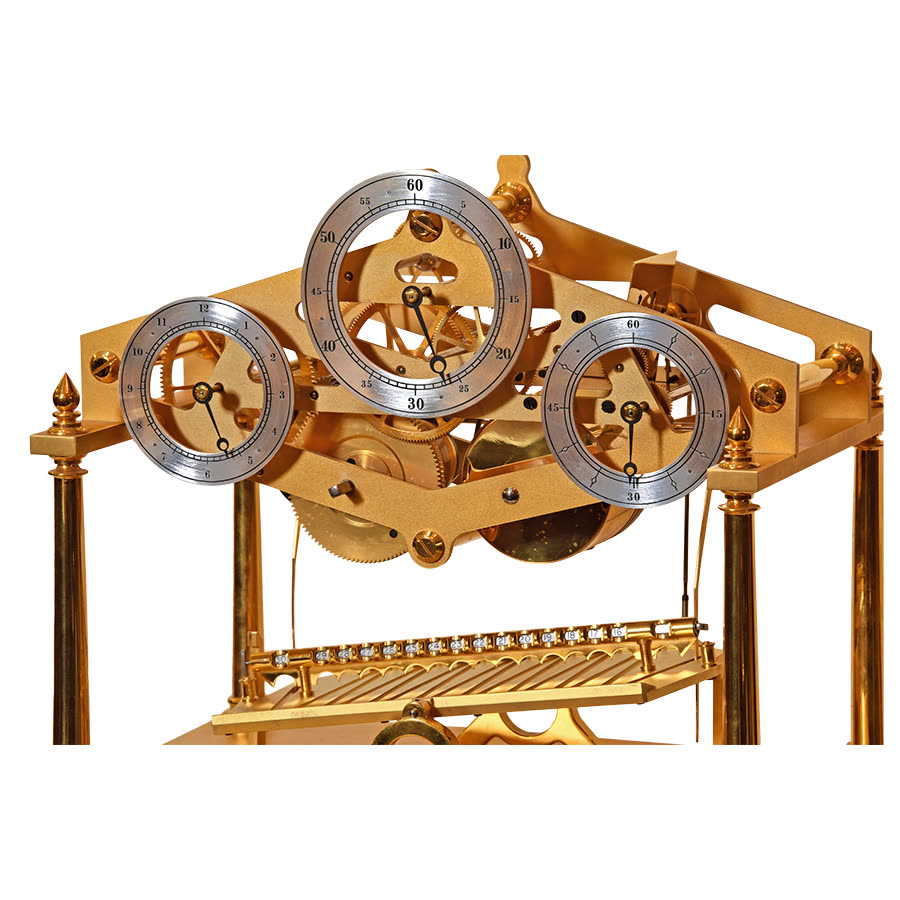
According to the seller, this Congreve rolling ball clock was crafted by Andrew Fell for Dent of London circa 1973 as number 141 in a limited edition of 150. Originating from Sir William Congreve's 1808 invention, the mechanism employs an inclined grooved platform traversed by a metal ball in 15-second cycles rather than a conventional pendulum regulator. Reaching the end of the zig-zag track trips an escapement that reverses the tilt and advances the seconds. The clock is powered by an 8-day fusee-driven timepiece movement set within an open brass architectural case with four classical columns, three silvered pediment dials, and a revolving seconds cylinder.

Front view of the Congreve rolling ball clock showing the three silvered dials, movement frame, tilting track, and marbled plinth
Front view of the Congreve rolling ball clock showing the three silvered dials, movement frame, tilting track, and marbled plinth — Renaissance Antiques. Rights pending — permission not yet requested. Original source

Catalogue identity

Source
www.renaissanceantiques.com
Category
Clock · Rolling ball clock
Maker / attribution
Andrew Fell for Dent of London
Reference
Not recorded
Catalogue / lot identifier
JMOR 1026 P
Source-reported date
Circa 1973
Country
United Kingdom
Source-reported serial
141 of 150

Source-reported attribution and specifications are not independent authentication. A listing does not establish present ownership, current display, availability or permission to reproduce.

Object description

Identity and Edition

According to the seller listing, this rolling ball clock was crafted circa 1973 by Andrew Fell for Dent of London as number 141 in a limited edition of 150. A small triangular plaque marked 'DENT' is affixed to the front of the stepped brass plinth, reflecting the retailer or commissioning attribution.

The underlying mechanism reflects the rolling ball clock design invented by Sir William Congreve in 1808. Andrew Fell's workshop mark and the specific edition number are not visible in the provided frontal image, resting solely on the dealer's catalog description.

Evidence for this section
  • “Andrew Fell crafted this astounding clock for the famed Dent of London.”
  • “This clock is #141 in a limited edition of 150.”
  • “A small triangular plaque marked 'DENT' is affixed to the front of the stepped brass plinth.”
  • “Based on the design of famed English inventor Sir William Congreve in 1808, the rolling ball clock is a unique concept in executing a clock without a pendulum.”

Case Architecture and Dial Arrangement

The seller lists the clock dimensions as 17.5 inches high, 19 inches wide, and 14.5 inches deep. The skeletonized brass architectural case features four columns supporting a pediment top frame, mounted on a wood tier over a dark green marbled stone base resting on turned metal feet.

Three silvered chapter rings are mounted along the pediment frame; the seller states they display hours, minutes, and seconds from left to right. In addition, a revolving cylinder mounted above the tilting platform turns to display seconds in 15-second intervals.

Evidence for this section
  • “17.5″ High x 19″ Wide x 14.5″ Deep”
  • “This horological work of art resides in a skeletonized brass architectural case with four tapered columns supporting the pediment top frame.”
  • “The clock structure is mounted on a wood tier over a dark green marbled stone base resting on turned metal feet.”
  • “Three silvered chapter rings are mounted along a pediment-shaped upper brass frame supported by four slender classical columns.”
  • “Three silvered dials indicate the time across the top of the case pediment. The dials display hours, minutes, and seconds from left to right.”
  • “A revolving cylinder displays the seconds above the platform, turning to show the next 15-second interval after each platform tilt.”

Escapement and Movement Function

In place of a conventional pendulum regulator, a zig-zag inclined brass track sits mounted on a central pivot above the brass base plate. A small metal ball rolls across the track in 15-second intervals; reaching the end trips an escapement that advances the seconds indication and tilts the platform in the reverse direction.

The listing notes that the clock runs on an 8-day fusee-driven timepiece movement. Details of the fusee assembly and train gearing are only partially visible from the frontal angle.

Evidence for this section
  • “A zig-zag inclined brass track sits mounted on a central pivot above the brass base plate.”
  • “On the platform, a small metal ball zig-zags across a track, counting out the seconds in 15-second intervals.”
  • “When the metal ball reaches the end of the platform, it trips an escapement prompting the seconds dial to advance and the platform to tilt in the opposite direction.”
  • “The clock runs on an 8-day fusee-driven timepiece movement.”

Open research questions

  • Where on the movement plates or frame are the Andrew Fell maker's mark and '#141 of 150' edition stamping located?
  • Was this clock issued originally with a glass vitrine cover, and does it survive?
  • What fusee line material (wire, chain, or gut) is fitted to the movement?

Source evidence

Recorded claims and source quotations for Dent of London Congreve Rolling Ball Clock by Andrew Fell
FieldSource-reported valueSource quotation
Maker attributionAndrew Fell for Dent of London“Andrew Fell crafted this astounding clock for the famed Dent of London.”
Movement type8-day fusee-driven timepiece movement“The clock runs on an 8-day fusee-driven timepiece movement.”
Limited edition number#141 of 150“This clock is #141 in a limited edition of 150.”
DateCirca 1973“Circa 1973”
Dimensions17.5″ High x 19″ Wide x 14.5″ Deep“17.5″ High x 19″ Wide x 14.5″ Deep”
Dial arrangementThree silvered dials indicating hours, minutes, and seconds“Three silvered dials indicate the time across the top of the case pediment. The dials display hours, minutes, and seconds from left to right.”
Original design basisSir William Congreve (1808)“Based on the design of famed English inventor Sir William Congreve in 1808, the rolling ball clock is a unique concept in executing a clock without a pendulum.”
Auxiliary seconds cylinderRevolving cylinder displaying 15-second intervals“A revolving cylinder displays the seconds above the platform, turning to show the next 15-second interval after each platform tilt.”

Visible details

  • Three silvered chapter rings are mounted along a pediment-shaped upper brass frame supported by four slender classical columns.
  • A zig-zag inclined brass track sits mounted on a central pivot above the brass base plate.
  • The clock structure is mounted on a wood tier over a dark green marbled stone base resting on turned metal feet.
  • A small triangular plaque marked 'DENT' is affixed to the front of the stepped brass plinth.

Research qualifications

  • Protective glass cover or dome is not depicted in the listing photograph.
  • Rear movement plate, limited edition engraving, and fusee gearing details are only partially visible from the frontal angle.

Photograph identity and source facts were screened before import; rights clearance remains pending.

Consulted source

English Congreve Rolling Ball Clock - Renaissance Antiques

Reviewed 2026-10-21 · Record 48f636b892

Terms in this record

Glossary explanations for terms named in this object’s record.