
Skip to content
The Encyclopedia of Horology

Clock · Rolling ball clock

A 20th Century Congreve rolling ball clock

Partially verified

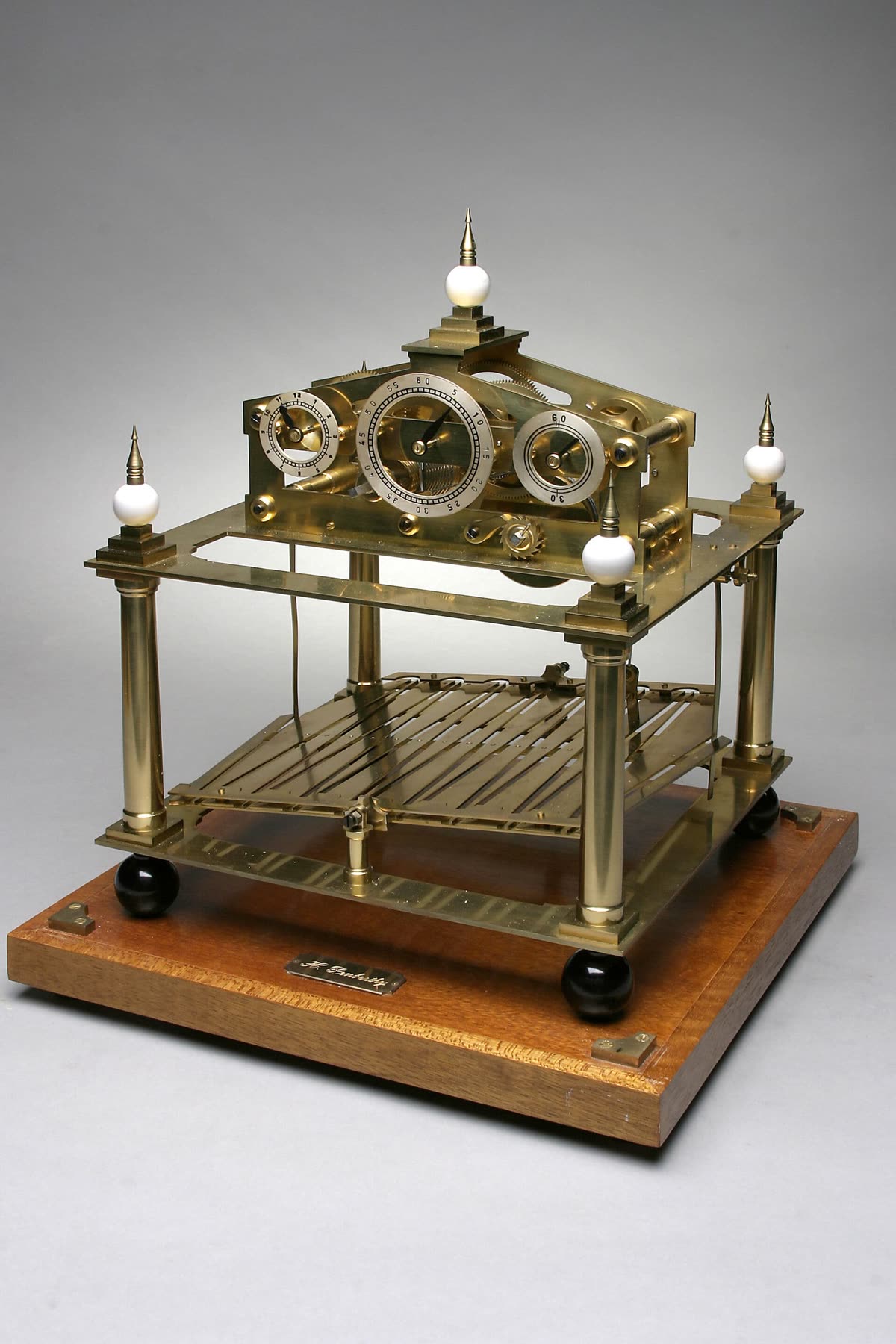
This lot features a 20th-century Congreve rolling ball clock offered at auction by Bonhams. Invented in 1808 by Sir William Congreve, the mechanism employs an inclined grooved table over which a rolling ball travels, alternating tilt to regulate time. The movement features three silvered dials for time divisions, supported on a brass framework with four columns above a tilting zig-zag track. The structure rests on four spherical feet upon a polished wooden plinth. Bonhams notes that this lot included John Wilding's book, 'How to make a Congreve Clock'.

Three-quarter view of the brass Congreve rolling ball clock mechanism mounted on a wooden plinth
Three-quarter view of the brass Congreve rolling ball clock mechanism mounted on a wooden plinth — Bonhams. Rights pending — permission not yet requested. Original source

Catalogue identity

Source
www.bonhams.com
Category
Clock · Rolling ball clock
Maker / attribution
Not established
Reference
Not recorded
Catalogue / lot identifier
555
Source-reported date
20th Century
Country
Not established

Source-reported attribution and specifications are not independent authentication. A listing does not establish present ownership, current display, availability or permission to reproduce.

Object description

Identity and Classification

Bonhams catalogued Lot 555 as "A 20th Century Congreve rolling ball clock,". The auction footnote remarks that Sir William Congreve invented the rolling ball clock in 1808.

The catalogue entry records that "This lot includes John Wilding's book How to make a Congreve Clock." No specific clockmaker or workshop name is documented in the auction text.

Evidence for this section
  • “A 20th Century Congreve rolling ball clock,”
  • “in 1808 he invented the rolling ball clock.”
  • “This lot includes John Wilding's book How to make a Congreve Clock.”

Frame and Base Construction

Visual observations record a "Brass four-column frame supporting an upper movement and a lower tilting grooved zig-zag track". The corner pillars and movement crest are adorned with finials featuring white spherical elements.

The brass frame rests on four dark spherical feet positioned on a rectangular wooden plinth. Additionally, a small engraved brass plaque is visible affixed to the top surface of the front plinth.

Evidence for this section
  • “Brass four-column frame supporting an upper movement and a lower tilting grooved zig-zag track”
  • “Corner pillars and movement crest adorned with finials featuring white spherical elements”
  • “Brass frame rests on four dark spherical feet set atop a rectangular wooden plinth”
  • “Small engraved brass plaque affixed to the top surface of the front plinth”

Dials and Movement Arrangement

The upper movement is fitted with three silvered dials indicating hours, minutes, and seconds or auxiliary increments. These dials are arranged side-by-side across the front of the upper movement framework.

Below the upper movement sits the tilting grooved zig-zag track characteristic of the Congreve rolling ball design, supported within the four-column frame.

Evidence for this section
  • “Upper movement fitted with three silvered dials indicating hours, minutes, and seconds or auxiliary increments”
  • “Brass four-column frame supporting an upper movement and a lower tilting grooved zig-zag track”

Auction Context and Condition Boundaries

The clock was offered at Bonhams' Chester sale of Clocks & Barometers on 7 October 2004, carrying a presale estimate of £1,000 - £2,000.

No maker attribution, dimensions, or plaque transcription are provided in the source description. Furthermore, while the clock is shown open, no protective case or glass dome is mentioned in the catalogue text or shown in the photograph.

Evidence for this section
  • “Lot 555”
  • “Clocks & Barometers 7 October 2004, 11:00 BST Chester”
  • “£1,000 - £2,000”

Open research questions

  • What text or maker mark is inscribed on the small brass plaque affixed to the wooden plinth?
  • Was this clock constructed by an individual maker following John Wilding's instructional book, or manufactured commercially?
  • Was a glass vitrine or cover originally provided with the clock to enclose the open movement and track?

Source evidence

Recorded claims and source quotations for A 20th Century Congreve rolling ball clock
FieldSource-reported valueSource quotation
Lot Number555“Lot 555”
TitleA 20th Century Congreve rolling ball clock“A 20th Century Congreve rolling ball clock,”
Accompanying BookJohn Wilding's book How to make a Congreve Clock“This lot includes John Wilding's book How to make a Congreve Clock.”
Sale Date and Location7 October 2004, Chester“7 October 2004, 11:00 BST Chester”
Auction Estimate£1,000 - £2,000“£1,000 - £2,000”
Invention Date Noted1808“in 1808 he invented the rolling ball clock.”

Visible details

  • Brass four-column frame supporting an upper movement and a lower tilting grooved zig-zag track
  • Upper movement fitted with three silvered dials indicating hours, minutes, and seconds or auxiliary increments
  • Corner pillars and movement crest adorned with finials featuring white spherical elements
  • Brass frame rests on four dark spherical feet set atop a rectangular wooden plinth
  • Small engraved brass plaque affixed to the top surface of the front plinth

Research qualifications

  • No specific maker is stated in the auction listing text, despite an engraved plaque visible on the base plinth
  • Protective case or dome is not present in the photograph

Photograph identity and source facts were screened before import; rights clearance remains pending.

Consulted source

Bonhams : A 20th Century Congreve rolling ball clock,

Reviewed 2026-10-21 · Record e9860931c9

Terms in this record

Glossary explanations for terms named in this object’s record.