
Skip to content
The Encyclopedia of Horology

Pocket watch · Open-faced tourbillon split-seconds chronograph minute repeating pocket watch

Charles Frodsham Minute Repeating Split-Seconds Chronograph Tourbillon Pocket Watch

Partially verified

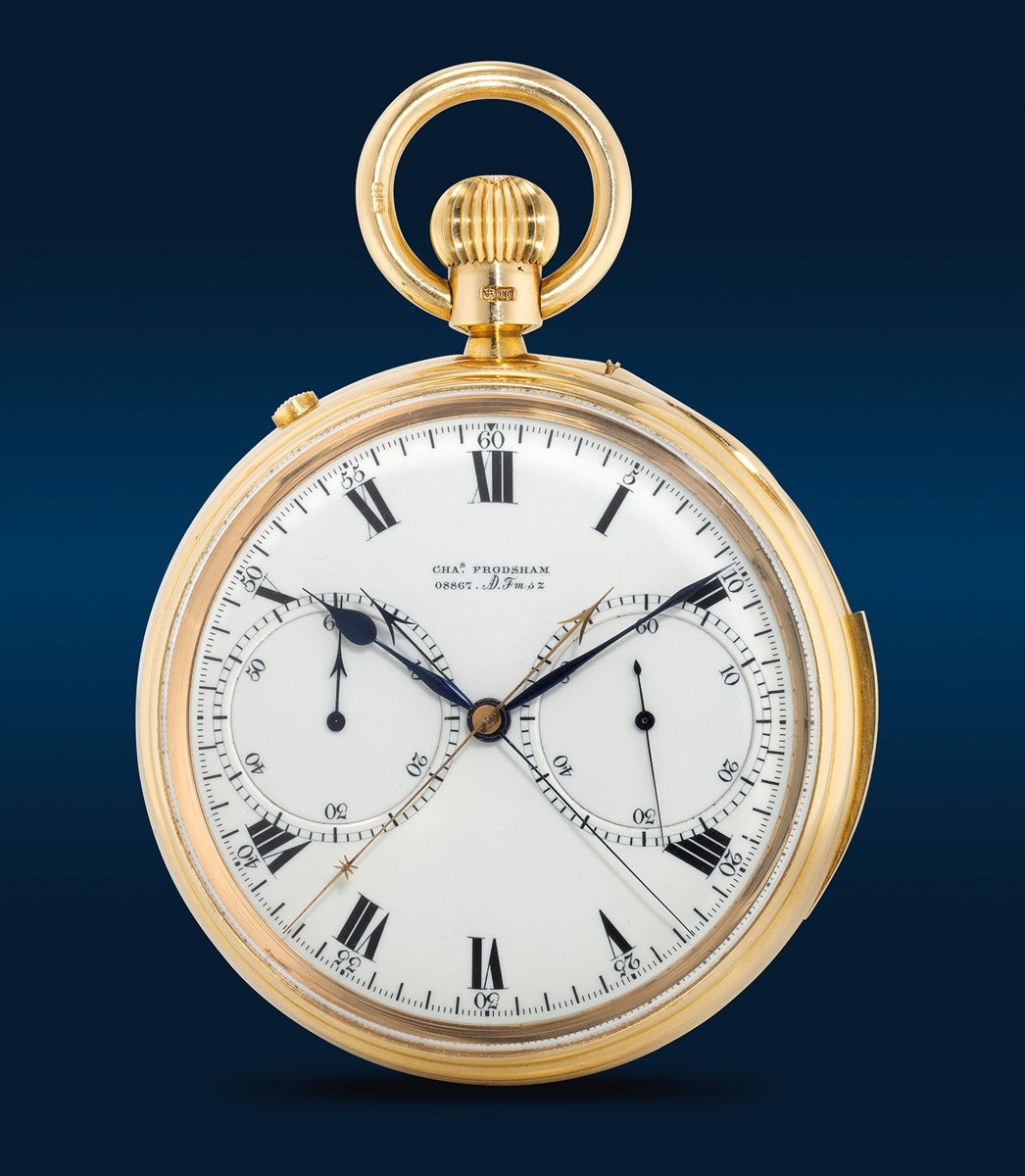
This 18K yellow gold open-faced keyless pocket watch by Charles Frodsham dates to circa 1901 and bears case and movement number 08'867. Sized at 63mm in diameter, the timepiece is powered by a manual gilt three-quarter plate 23-ligne calibre featuring a one-minute tourbillon, minute repeater, and split-seconds chronograph with a 60-minute register. The white enamel dial is inscribed with the maker's signature and the traditional coded letters 'AD.Fmsz'. Casework bears London hallmarks for 1901 along with the maker's mark 'HMF' for Harrison Mill Frodsham. In 1902, the watch achieved a Class A certificate at the Kew Observatory trial.

Dial and front view of the Charles Frodsham yellow gold tourbillon pocket watch
Dial and front view of the Charles Frodsham yellow gold tourbillon pocket watch — Phillips. Rights pending — permission not yet requested. Original source

Catalogue identity

Source
www.phillips.com
Category
Pocket watch · Open-faced tourbillon split-seconds chronograph minute repeating pocket watch
Maker / attribution
Charles Frodsham
Reference
Not recorded
Catalogue / lot identifier
891
Source-reported date
Circa 1901
Country
United Kingdom
Source-reported serial
08'867

Source-reported attribution and specifications are not independent authentication. A listing does not establish present ownership, current display, availability or permission to reproduce.

Object description

Dial and Case Construction

The timepiece is an open-faced keyless pocket watch measuring 63mm in diameter, constructed in an 18K yellow gold case. Visible frontal elements show a white enamel dial with black Roman numerals and an outer minute and chronograph track. Dual subsidiary dials are situated horizontally at the 9 and 3 o'clock positions.

Operating elements visible on the perimeter include a yellow gold bow and fluted winding crown positioned at 12 o'clock, a repeater slide along the case flank, and a split-seconds chronograph pusher located on the upper left rim. According to the auction catalogue, the inner caseback is stamped with London Assay Office hallmarks, including the Leopard's head, the crown for 18-carat gold, the date letter "f" for 1901, and the casemaker's mark "HMF" for Harrison Mill Frodsham.

Evidence for this section
  • “Dimensions 63mm diameter”
  • “Material 18K yellow gold”
  • “White enamel dial with Roman numerals and outer minute/chronograph track”
  • “Dual subsidiary dials positioned horizontally at 9 and 3 o'clock”
  • “Yellow gold bow and fluted winding crown at the 12 o'clock position”
  • “Repeater slide on the case flank and split-seconds pusher on the upper left rim”
  • “The inner caseback bears hallmarks including the Leopard's head, representing London's Assay Office, the crown symbolizing 18-carat gold, the letter "f" serving as a date stamp corresponding to the year 1901, and "HMF" denoting Harrison Mill Frodsham as the casemaker”

Reported Movement and Complications

The interior mechanism is not visible in the cataloguing photograph, but source documentation describes it as a jewelled, manual-wind 23-ligne gilt three-quarter plate calibre. The complication set encompasses a one-minute tourbillon, minute repeater, and a split-seconds chronograph with a 60-minute counter.

The movement is recorded under serial number 08'867, matching the case number. The catalogue notes that the movement is signed and engraved with the historical address "115 New Bond Street, Late of 84 Strand", alongside the firm's characteristic cryptogram "AD Fmsz" representing the year 1850.

Evidence for this section
  • “Calibre Manual, cal. 23’’’ gilt three-quarter plate, jewelled”
  • “minute repeating split-seconds chronograph open-faced keyless pocket watch with one-minute tourbillon, 60-minute register”
  • “Movement No 08'867”
  • “Case No 08'867”
  • “the three-quarter plate movement of the watch features interesting engravings such as the business premises of Charles Frodsham at "115 New Bond Street, Late of 84 Strand"”
  • “Many Frodsham watches particularly feature the coded letters "AD Fmsz" on the dials and movements. This cryptogram corresponds to 1850”

Observatory Trial History and Documentation

In 1902, the pocket watch underwent precision timing trials at the Kew Observatory in Richmond, Surrey. Tested across multiple positions and temperatures, the timepiece attained a Class A certificate with a score of 78.4 marks.

This evaluation placed the watch 8th out of 13 entries in the observatory's "Complicated watches" category. The auction essay further notes that only 12 Charles Frodsham tourbillon pocket watches of this type have resurfaced on the market.

Evidence for this section
  • “In 1902, the present watch underwent a time trial at the Kew Observatory (now known as The King's Observatory) in Richmond, Surrey. It was subjected to different temperatures and positions and achieved the highest A certificate with 78.4 marks”
  • “ranking 8th out of 13 watches in the "Complicated watches" category”
  • “currently, only 12 of these watches have re-emerged in the market”

Open research questions

  • What escapement construction is used within the reported one-minute tourbillon carriage?
  • Can direct examination of the inner caseback confirm the reported London date stamp 'f' for 1901 and maker's mark 'HMF'?
  • Do original Kew Observatory records specify the individual daily rate variations achieved during the 1902 trial?

Source evidence

Recorded claims and source quotations for Charles Frodsham Minute Repeating Split-Seconds Chronograph Tourbillon Pocket Watch
FieldSource-reported valueSource quotation
Movement Number08'867“Movement No 08'867”
Case Number08'867“Case No 08'867”
Case Material18K yellow gold“Material 18K yellow gold”
Diameter63mm“Dimensions 63mm diameter”
Casemaker MarkHMF (Harrison Mill Frodsham)“stamped with casemaker's mark “HMF” for Harrison Mill Frodsham”
Kew Observatory TrialHighest A certificate with 78.4 marks in 1902“In 1902, the present watch underwent a time trial at the Kew Observatory (now known as The King's Observatory) in Richmond, Surrey. It was subjected to different temperatures and positions and achieved the highest A certificate with 78.4 marks”
Kew Trial Ranking8th out of 13 watches in Complicated watches category“ranking 8th out of 13 watches in the "Complicated watches" category”
Movement Inscription115 New Bond Street, Late of 84 Strand“the three-quarter plate movement of the watch features interesting engravings such as the business premises of Charles Frodsham at "115 New Bond Street, Late of 84 Strand"”
Cryptogram InscriptionAD Fmsz“Many Frodsham watches particularly feature the coded letters "AD Fmsz" on the dials and movements. This cryptogram corresponds to 1850”

Visible details

  • White enamel dial with Roman numerals and outer minute/chronograph track
  • Dual subsidiary dials positioned horizontally at 9 and 3 o'clock
  • Yellow gold bow and fluted winding crown at the 12 o'clock position
  • Repeater slide on the case flank and split-seconds pusher on the upper left rim

Research qualifications

  • The movement and cuvette interior are not visible in the provided photograph.

Photograph identity and source facts were screened before import; rights clearance remains pending.

Consulted source

Charles Frodsham The Hong Kong Watch Auction: XVIII

Reviewed 2026-10-21 · Record 8c7a9beca5

Terms in this record

Glossary explanations for terms named in this object’s record.