
Skip to content
The Encyclopedia of Horology

Clock · Cartel clock

Cartel clock

Partially verified

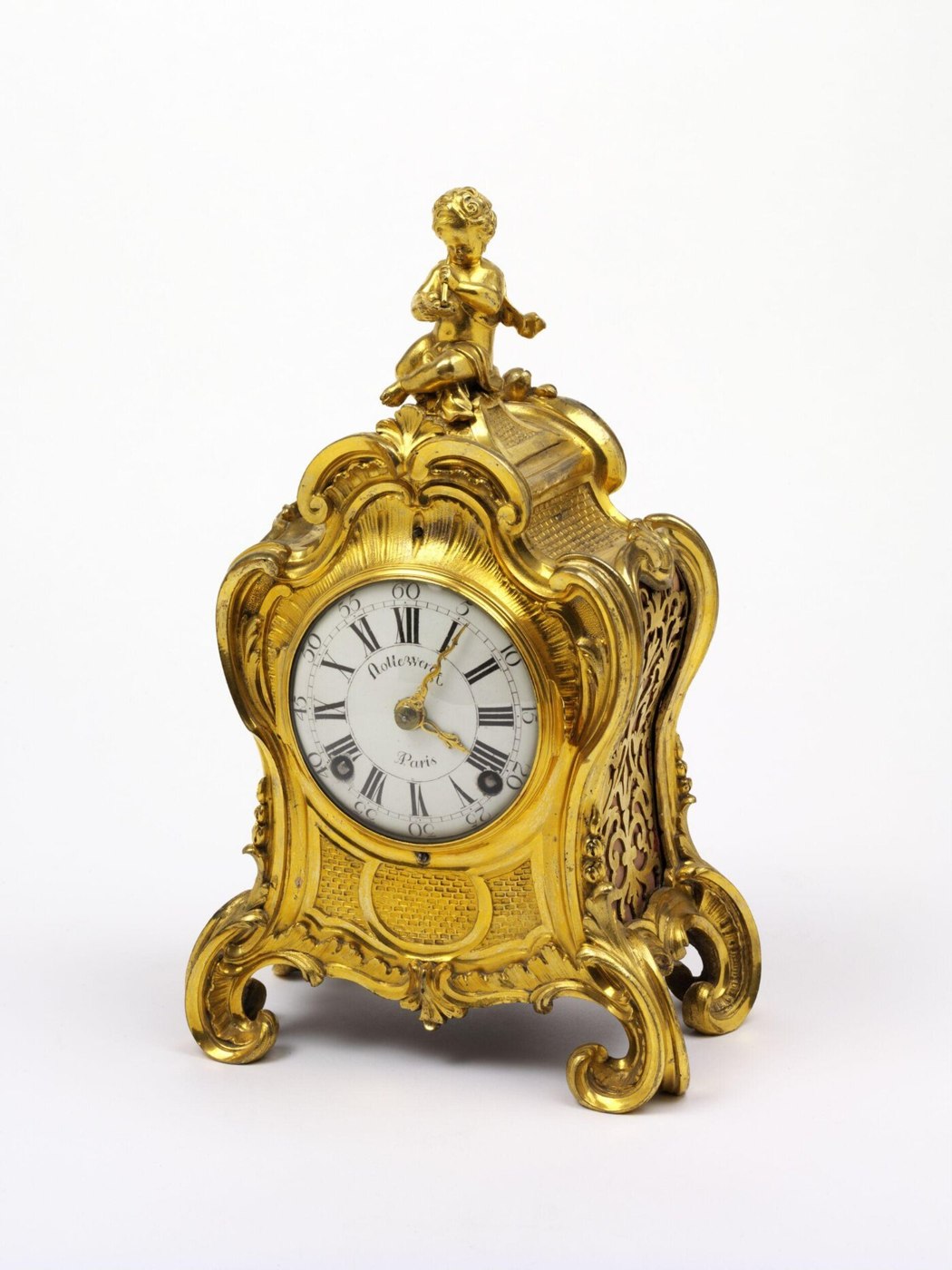
This cartel clock, dated circa 1745-1750, features an ormolu case surmounted by a finial in the form of a Cupid figure armed with a bow and arrows. The white enamel dial measures 8.9 cm in diameter and is signed 'Stollewerck a Paris', with the movement itself inscribed 'MStollewerck'. The movement includes a going train with a fusee of nine turns, a verge escapement, and a pendulum measuring 13.6 cm. It features a locking-plate striking mechanism and an external count-wheel. While the movement and dial are contemporary to the piece, the back plate has been modified to fit the case, and the side fret panels are later replacements. The clock was formerly part of the collection of John Jones and was bequeathed to the South Kensington Museum in 1882. It originally featured an ormolu wall bracket, which is now absent, and was once lined with red silk.

A 1745-1750 cartel clock by Michel Stollewerck, featuring an ormolu Cupid finial and an enamel dial.
A 1745-1750 cartel clock by Michel Stollewerck, featuring an ormolu Cupid finial and an enamel dial. — Victoria and Albert Museum. Rights pending — permission not yet requested. Original source

Catalogue identity

Source
collections.vam.ac.uk
Category
Clock · Cartel clock
Maker / attribution
Michel Stollewerck
Reference
Not recorded
Catalogue / lot identifier
997-1882
Source-reported date
1745-1750
Source-reported place
France

Source-reported attribution and specifications are not independent authentication. A listing does not establish present ownership, current display, availability or permission to reproduce.

Object description

Case and Dial Construction

The clock is housed in an ormolu case, which originally included a matching wall bracket. The white enamel dial features a conventional layout with Roman numerals and is pierced for winding, with the maker's signature located in the center.

The surface retains original 18th-century chasing in the ormolu. However, the clock has undergone modifications over time. The fretwork panels on the sides are considered to be later replacements, and the glass plate at the rear is a subsequent addition, as the back of such clocks was traditionally constructed entirely of metal.

Evidence for this section
  • “Ormolu case retaining its original 18th century surface chasing.”
  • “The side fret panels are later replacements.”
  • “The glass plate in the back is a later replacement as the back would originally have been entirely of metal.”
  • “The dial plate has a greenish tinge to the edge characteristic of 18th century enamelling.”

Movement and Mechanism

The movement is identified by the inscription 'MStollewerck'. It is configured with a going train and a barrel located at the bottom center. The power transmission utilizes a fusee with nine turns to the right. The timekeeping is regulated by a verge escapement featuring a 35-tooth crown wheel, with the crutch attached to the verge.

The pendulum, measuring 13.6 cm in length, is suspended by a wound-up cord and terminates in a lenticular bob with a diameter of 4.1 cm. For the striking functions, the clock employs a locking-plate mechanism situated to the left. It also incorporates an external count-wheel numbered from 1 to 12, which facilitates a single strike at the half-hours.

Evidence for this section
  • “The movement is inscribed 'MStollewerck'”
  • “Going train with barrel at the bottom centre of the movement, the fusee of 9 turns to the right.”
  • “Verge escapement, with crown wheel of 35T”
  • “The locking-plate striking mechanism to left”

Provenance and Acquisition

The clock was part of the personal collection of John Jones, a tailor and businessman based in London. It was stored within his house at 95 Piccadilly, where it appeared in an engraved view of the dining room. Jones bequeathed the clock and a large variety of other decorative art objects to the South Kensington Museum in his will dated 1879.

The items were transferred to the museum following Jones's death in 1882. This clock remains one of sixteen timepieces from the original Jones bequest held by the institution.

Evidence for this section
  • “The clock features in an engraved view of John Jones's Dining Room at 95 Piccadilly, London.”
  • “In his will of 4 December 1879 and in a codicil of 22 January 1880, Jones bequeathed the objects to the South Kensington Museum”
  • “it is one of sixteen clocks he bequeathed to this museum.”

Open research questions

  • What specific type of metal was originally used for the solid back plate before it was replaced with glass?
  • Are there any surviving archival records from the Michel Stollewerck workshop that confirm the production date of this specific case model?

Source evidence

Recorded claims and source quotations for Cartel clock
FieldSource-reported valueSource quotation
MakerMichel Stollewerck“Maker: Michel Stollewerck (clockmaker)”
Date1745-1750“Date: 1745-1750”
Dimensions30.5 cm x 20 cm x 11 cm“Height: 30.5 cm; Width: 20 cm; Depth: 11 cm”
Accession number997-1882“Accession number: 997-1882”
Movement signatureMStollewerck“The movement is inscribed 'MStollewerck'”
EscapementVerge“Verge escapement, with crown wheel of 35T”
ProvenanceJohn Jones collection“This clock was among a large collection of furniture, porcelain, metalwork, paintings and books owned by the tailor and businessman John Jones”

Visible details

  • Cupid figure finial at the top of the case
  • Pierced hour hand and plain minute hand
  • Open fretwork side panels
  • Roman numerals on the enamel dial

Research qualifications

  • Originality of the side fret panels is questioned
  • Exact status of original mounting bracket is unknown

Photograph identity and source facts were screened before import; rights clearance remains pending.

Consulted source

Cartel Clock

Reviewed 2026-10-26 · Record 88aaead425

Terms in this record

Glossary explanations for terms named in this object’s record.