
Skip to content
The Encyclopedia of Horology

Clock · Longcase clock

Burr Walnut 8-Day Longcase Clock by Joseph Windmills

Partially verified

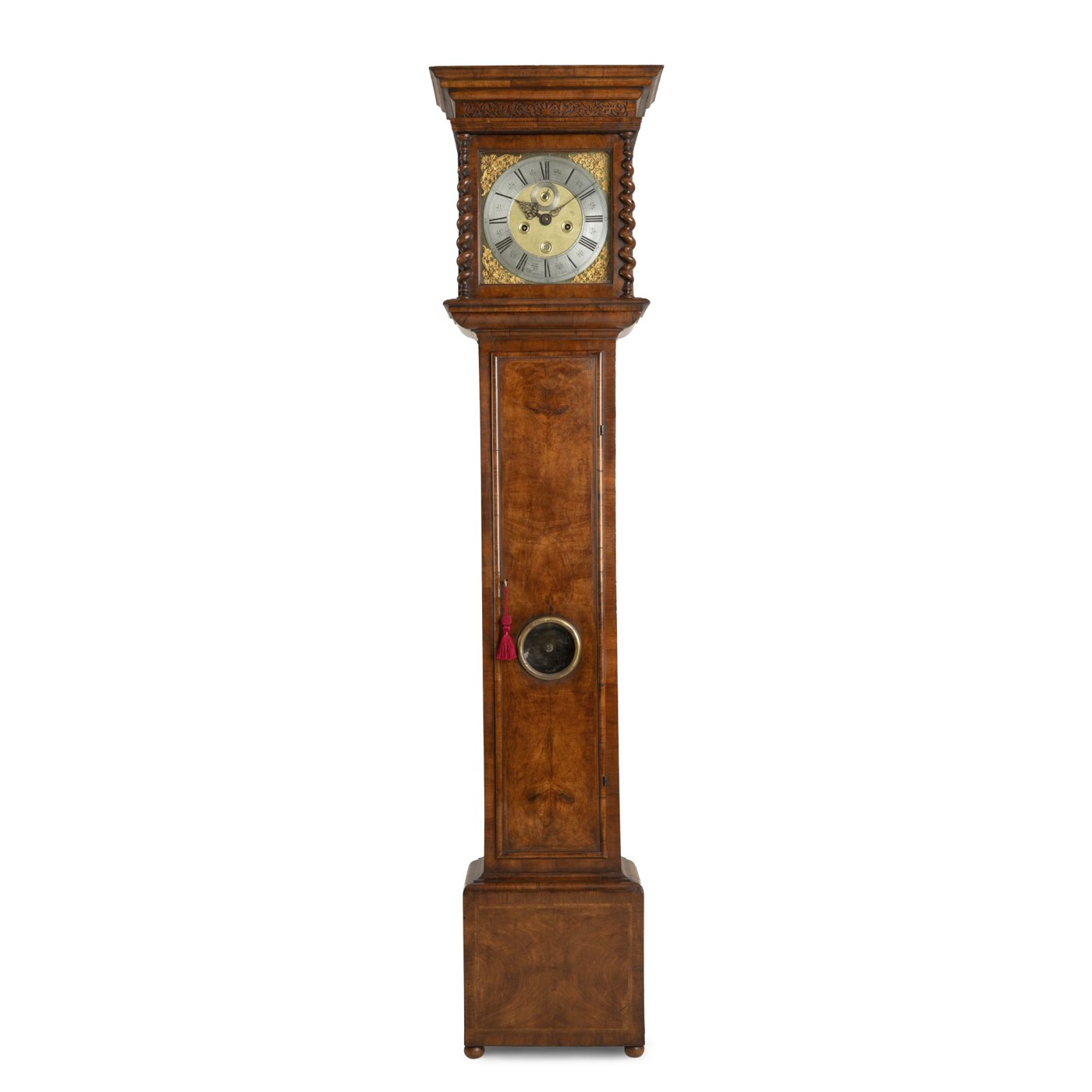
This 8-day longcase clock is attributed to the maker Joseph Windmills of London, dated circa 1695. The movement is weight-driven with an anchor escapement, six latched knopped pillars, and an inside count-wheel striking system. It is secured to the case via a bracket on the backboard. The dial is a 10 ¾-inch square brass plate with winged cherub head spandrels, a silvered chapter ring, a matted center, a subsidiary seconds dial, and a date aperture. The oak case features figured burr walnut veneers, with the trunk door containing a gilt brass lenticle. The hood is topped with a cross-grain walnut cornice moulding and a sound fret, flanked by barley-twist columns with wooden capitals and bases. The sides of the trunk are panelled with book-matched and crossbanded veneers. The piece is approximately 206 cm tall.

Front view of the 8-day burr walnut longcase clock showing the hood, dial, and trunk door.
Front view of the 8-day burr walnut longcase clock showing the hood, dial, and trunk door. — Dorset Antique Clocks. Rights pending — permission not yet requested. Original source

Catalogue identity

Source
www.dorsetantiqueclocks.co.uk
Category
Clock · Longcase clock
Maker / attribution
Joseph Windmills
Reference
Not recorded
Catalogue / lot identifier
Source URL identifies the listing
Source-reported date
circa 1695
Source-reported place
England

Source-reported attribution and specifications are not independent authentication. A listing does not establish present ownership, current display, availability or permission to reproduce.

Object description

Movement and Dial Details

The clock is powered by an eight-day duration weight-driven movement. It incorporates six latched knopped pillars and utilizes an anchor escapement. The striking mechanism is an inside count-wheel system, which sounds the hours on a bell. The movement is fixed to the case using a specific bracket mounted on the backboard.

The 10 ¾-inch square brass dial displays a matted center with a subsidiary seconds hand and a ringed date aperture. The chapter ring features silvered Roman and Arabic numerals, with the signature “J Windmills – London” positioned on either side of the VI numeral. The corners of the dial are embellished with winged cherub head spandrels, bordered by foliate engraving.

Evidence for this section
  • “The movement of 8-day duration is united by six latched knopped pillars, is weight driven with anchor escapement to a pendulum suspended from a hipped back cock, inside count-wheel striking system which strikes the hours to a bell.”
  • “The 10 ¾ square brass dial with single line border interspersed by foliate engraving, enclosing the elaborate winged cherub head spandrels, silvered Roman and Arabic chapter ring signed on either side of VI – ‘J Windmills – London’.”

Case Construction

The clock is housed in an oak case finished with figured burr walnut veneers. The trunk door is fitted with a gilt brass lenticle, allowing a view of the pendulum. The trunk sides are constructed with book-matched veneers and full crossbanding.

The hood features a walnut-veneered structure with a cross-grain cornice and a delicate sound fret. It is flanked by barley-twist columns that include wooden capitals and bases, contrasting with the overall walnut veneering of the carcass.

Evidence for this section
  • “The oak case is veneered with fine-quality figured burr walnut veneers and the trunk door has a gilt brass lenticle.”
  • “The walnut veneered hood is flanked by walnut barley-twist columns with wooden capitals and bases, and there is a delicate sound fret below the cross-grain walnut cornice moulding.”

Maker History

Joseph Windmills was an active clockmaker during the late 17th and early 18th centuries. He achieved freedom of the Clockmakers Company in July 1671 and established himself in St Martin le Grand before relocating to Mark Lane End, Tower Street, in 1687.

Throughout his career, Windmills held significant positions within the Clockmakers Company, serving as Warden in 1699 and as Master in 1702, succeeding Thomas Tompion. He is recognized for his association with prominent contemporaries like Tompion during this era.

Evidence for this section
  • “Joseph Windmills is recorded as “a great clockmaker” who was free of the Clockmakers Company in July 1671.”
  • “In 1702 he succeeded Tompion as Master of the Clockmakers Company.”

Open research questions

  • Is the movement original to this specific burr walnut case?
  • Can the provenance be traced beyond the general 'Private collection - U.K.'?

Source evidence

Recorded claims and source quotations for Burr Walnut 8-Day Longcase Clock by Joseph Windmills
FieldSource-reported valueSource quotation
MakerJoseph Windmills“JOSEPH WINDMILLS – LONDON”
Datecirca 1695“CIRCA. 1695”
Movement duration8-day“The movement of 8-day duration”
Dial size10 3/4 inch square“The 10 ¾ square brass dial”
EscapementAnchor escapement“anchor escapement”
Striking systemInside count-wheel“inside count-wheel striking system”
Height206 cm“Height: 81″ or 206 cm”
Case constructionOak veneered in burr walnut“The oak case is veneered with fine-quality figured burr walnut veneers”

Visible details

  • Barley-twist columns on the hood
  • Gilt brass lenticle in the trunk door
  • Winged cherub head spandrels on the dial
  • Sound fret below the cornice moulding

Research qualifications

  • Movement internal components not visible in photographs
  • Historical provenance limited to unspecified private collection

Photograph identity and source facts were screened before import; rights clearance remains pending.

Consulted source

A FINE BURR WALNUT 8-DAY LONGCASE CLOCK – JOSEPH WINDMILLS – LONDON

Reviewed 2026-11-02 · Record a6a033aeb1

Terms in this record

Glossary explanations for terms named in this object’s record.