
Skip to content
The Encyclopedia of Horology

Tool · Arabic-inscribed astrolabe, Iran

Brass Astrolabe by Muḥammad Ṣaffār

Partially verified

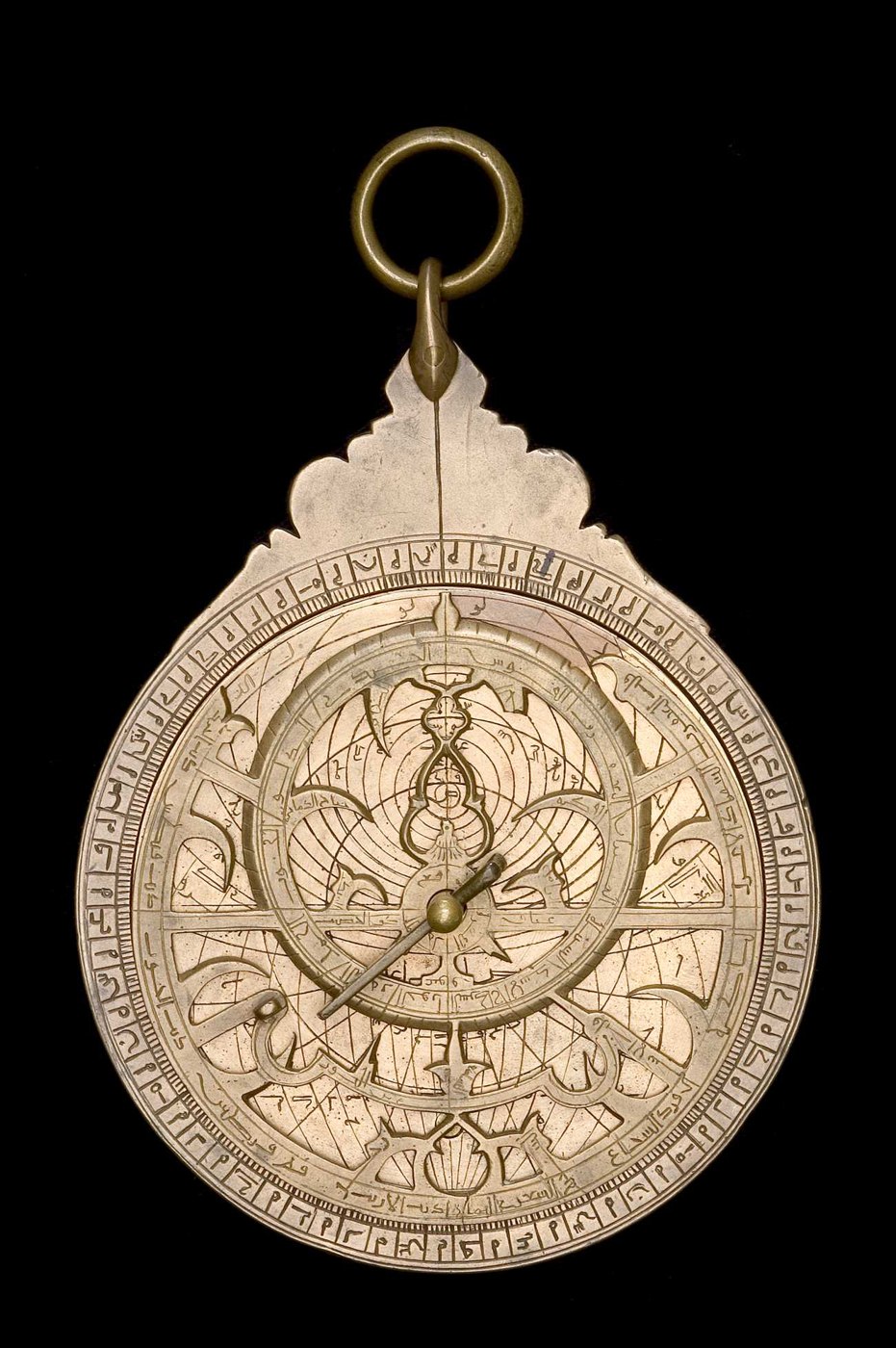
It features a one-piece mater and limb construction with a degree scale on the limb, a simple engraved throne, and an omega-type shackle. The instrument is equipped with a rete of the indicator-line type, featuring a small bird-shaped star pointer for Vega. The alidade is of an unusual design, constructed from two intersecting rules: one is slightly curved with a single sighting vane, while the other is straight with two sighting vanes. The assembly is secured by a pin and horse, though the auction house notes the pin is excessively long, indicating a potential later replacement. The back displays a maker's signature and a shadow square inscribed with scales for finger and foot shadows. The astrolabe was presented to the History of Science Museum by J. A. Billmeir in 1957.

Front view of the brass astrolabe showing the rete, pin, and degree-scaled limb.
Front view of the brass astrolabe showing the rete, pin, and degree-scaled limb. — History of Science Museum, University of Oxford. Rights pending — permission not yet requested. Original source

Catalogue identity

Source
www.mhs.ox.ac.uk
Category
Tool · Arabic-inscribed astrolabe, Iran
Maker / attribution
Muḥammad Ṣaffār
Reference
Not recorded
Catalogue / lot identifier
51182
Source-reported date
1505/06 (A.H. 911)
Source-reported place
Persia

Source-reported attribution and specifications are not independent authentication. A listing does not establish present ownership, current display, availability or permission to reproduce.

Object description

Construction and Design

The astrolabe is constructed primarily of brass and utilizes a one-piece mater and limb. The limb features a circular, concentric degree scale marked from 0 to 360 degrees, incremented every 5 degrees. The throne is of a simple, engraved style with an integrated base, supporting a simple, squared cross-section ring and an omega-type shackle.

The rete is of the simple, indicator-line type and includes a single rotation knob positioned in the lower-left portion. A notable decorative feature on the rete is the star pointer for Vega, which is fashioned as a small bird. The instrument lacks hook-pointer star markings, relying instead on the established geometric layout of the rete.

Evidence for this section
  • “The mater and limb are of one-piece construction.”
  • “The throne is of the simple, engraved type made of brass attached with integrated base”
  • “The rete is of the indicator-line (simple) type.”
  • “the star pointer for vega is a small bird”

Alidade and Assembly

The sighting mechanism is distinctive, featuring a double-ended alidade constructed from two intersecting rules. One rule is slightly curved and equipped with a single sighting vane, while the second is straight and fitted with two sighting vanes. This configuration deviates from standard single-rule alidade designs found on many instruments.

The assembly of the rete and alidade is maintained by a pin and horse. The current pin is noted as being of excessive length, which suggests it is a later replacement rather than an original component. There is a possibility that the horse is also a replacement, as a thicker version would be required to compensate for the slack present in the pin assembly.

Evidence for this section
  • “The alidade is quite unusual by being constructed out of two intersecting rules.”
  • “The rete is attached using a pin & horse. The pin is far too long, suggesting that this is a later replacement.”
  • “It is also possible that the horse is a replacement, for a thicker horse would take up the slack in the pin.”

Inscriptions and Provenance

The back of the instrument carries a maker’s signature and a shadow square. The Arabic inscription identifies the maker as Shams ad-Dīn Muḥammad Ṣaffār and provides the date A.H. 911 (1505/06). The shadow square contains labels for the 'shadow of the fingers' and the 'shadow of the feet', with text positioned upside down within the square.

Formerly part of the Chadenat Collection in La Ferté-Bernard, the astrolabe was subsequently acquired by the museum. It was presented to the collection by J. A. Billmeir in 1957 and is held under the accession number 1957-84/158.

Evidence for this section
  • “The back is inscribed: with a maker's signature”
  • “Of this astrolabe the servant in need of God the forgiving, Shams ad-Dīn Muḥammad Ṣaffār in the year nine hundred and eleven.”
  • “Formerly in the Chadenat Collection, La Fert魂ernard.”
  • “Presented by J. A. Billmeir in 1957”

Open research questions

  • What is the specific geometric purpose of the two-rule intersecting alidade design?
  • Are there similar instruments by Muḥammad Ṣaffār that feature the same unusual bird-shaped star pointer for Vega?

Source evidence

Recorded claims and source quotations for Brass Astrolabe by Muḥammad Ṣaffār
FieldSource-reported valueSource quotation
MakerMuḥammad Ṣaffār“Maker Muḥammad Ṣaffār”
Date1505/06 (A.H. 911)“Date 1505/06 (A.H. 911)”
Place of originPersia“Place Persia”
MaterialBrass“Material Brass”
Accession number51182“Inventory no. 51182”
AcquisitionPresented by J. A. Billmeir in 1957“Presented by J. A. Billmeir in 1957”
SignatureShams ad-Dīn Muḥammad Ṣaffār“Shams ad-Dīn Muḥammad Ṣaffār”
Alidade constructionDouble-ended, two intersecting rules“The alidade is quite unusual by being constructed out of two intersecting rules.”

Visible details

  • Small bird-shaped star pointer on the rete
  • Unusual alidade made of two intersecting rules
  • Shadow square on the back includes upside-down text
  • Simple omega-shaped shackle

Research qualifications

  • The pin appears to be a later replacement due to its length
  • The horse may also be a replacement

Photograph identity and source facts were screened before import; rights clearance remains pending.

Consulted source

Astrolabe, inventory 51182 (Persia, 1505/06 (A.H. 911))

Reviewed 2026-10-26 · Record 136087baae

Terms in this record

Glossary explanations for terms named in this object’s record.