
Skip to content
The Encyclopedia of Horology

Tool · Arabic-inscribed astrolabe, Iran

Astrolabe by 'Abd al-'Alī

Partially verified

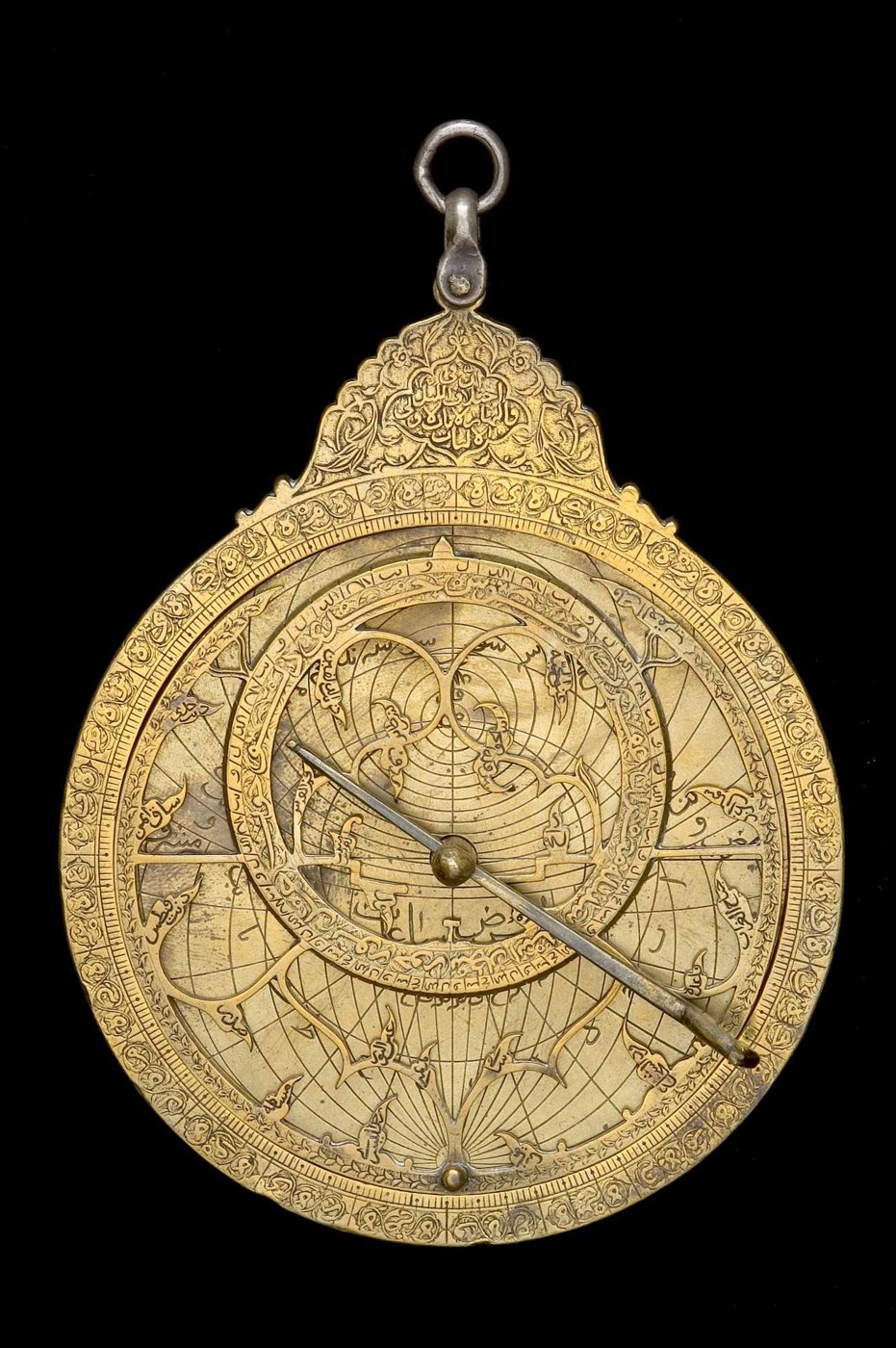
This brass astrolabe (inventory 36247) is an early 18th-century Persian instrument presented to the University of Oxford by J. A. Billmeir in 1957. Signed by the maker 'Abd al-'Alī, the instrument features an engraved Indo-Persian style throne with an integrated base and a circular, round cross-section ring with an omega-type shackle. The front mater is embossed with a Qur'anic verse. The back contains 16 distinct astronomical scales, including those for altitude, azimuth of Qibla, sine/cosine, and shadow squares. The instrument includes four plates with latitudes between 22° and 39°. The rete is a replacement lacking the central section, necessitating a custom-made, elongated pin and horse for attachment. The alidade is also a replacement. The instrument retains a gazetteer in the womb listing coordinates for 27 cities.

Front view of the astrolabe showing the rete, replacement horse, and engraved throne.
Front view of the astrolabe showing the rete, replacement horse, and engraved throne. — History of Science Museum, University of Oxford. Rights pending — permission not yet requested. Original source

Catalogue identity

Source
www.mhs.ox.ac.uk
Category
Tool · Arabic-inscribed astrolabe, Iran
Maker / attribution
'Abd al-'Alī
Reference
Not recorded
Catalogue / lot identifier
36247
Source-reported date
early 18th century
Source-reported place
Persia
Source-reported serial
36247

Source-reported attribution and specifications are not independent authentication. A listing does not establish present ownership, current display, availability or permission to reproduce.

Object description

Construction and Design

The astrolabe is constructed of brass and features an engraved Indo-Persian style throne attached via an integrated base. The instrument's ring is a simple round cross-section piece, held by an omega-shaped shackle. The front of the throne is embossed with a Qur'anic verse, while the back displays a foliate decorative pattern. The mater and limb are integrated as a single-piece construction, with the tympan tab located at the base, 180 degrees from the throne.

The instrument includes four plates providing coverage for latitudes ranging from 22° to 39°. The interior of the womb serves as a geographical gazetteer, providing coordinates including longitude, latitude, and specific orientation data for 27 cities, ranging from Iṣfahan to Qandahar.

Evidence for this section
  • “The throne is of the indo-persian, engraved type made of brass”
  • “The front is embossed with a quotation from the Qur'an.”
  • “The mater and limb are of one-piece construction.”
  • “The womb contains a gazetteer with coordinates for 27 cities”

Astronomical Scales and Functions

The reverse side of the astrolabe is highly complex, featuring 16 separate scales used for astronomical calculations. These include circular, concentric scales for altitude and cotangent readings, as well as specific arcs for declination, the azimuth of the Qibla, and the altitude of the noon sun.

Additionally, the back includes inner box and circular scales for zodiacal signs, lunar mansions, faces, triplicities, and shadow squares. The shadow squares are calibrated in both feet and fingers to assist in height and distance calculations. The maker's signature, reading 'Abd al-'Alī, is inscribed directly onto the back of the instrument.

Evidence for this section
  • “The back contains 16 scales of the following types:”
  • “The back is inscribed: with a maker's signature marked as عبد العلي صنعه (‘Abd al-‘Ali made this).”
  • “Shadow square 0 - 7, Feet”

Modifications and Replacements

Several components of the astrolabe are identified as later replacements. Consequently, it cannot pivot at the center and is held by a specialized, elongated pin and horse assembly.

The alidade is also identified as a double-ended replacement. These parts are considered contemporary with one another, though they post-date the original manufacturing of the instrument.

Evidence for this section
  • “The rete is a replacement.”
  • “This replacement rete has an unusual design in that it lacks central strapwork”
  • “The horse (inventory no. 85861) is longer than usual so that it can hold the rete”
  • “The rule is not original. This is a replacement.”

Open research questions

  • What is the estimated date of the replacement rete and alidade?
  • Are the coordinates listed in the gazetteer consistent with 18th-century cartographic records?

Source evidence

Recorded claims and source quotations for Astrolabe by 'Abd al-'Alī
FieldSource-reported valueSource quotation
Inventory number36247“Inventory no. 36247”
Maker'Abd al-'Alī“Maker ’Abd al-’Alī”
MaterialBrass“Material Brass”
Dateearly 18th century“Date early 18th century”
PlacePersia“Place Persia”
Signature'Abd al-'Ali“عبد العلي صنعه (‘Abd al-‘Ali made this)”

Visible details

  • Engraved Qur'anic verse on the throne
  • Replacement rete lacking central strapwork
  • Custom-made elongated horse (inventory 85861)
  • Gazetteer within the womb containing 27 city coordinates

Research qualifications

  • The rete is stated to be a replacement
  • The alidade is reported as a non-original replacement
  • The pin and horse are presumably contemporary with the replacement rete

Photograph identity and source facts were screened before import; rights clearance remains pending.

Consulted source

Astrolabe, inventory 36247 (Persia, early 18th century)

Reviewed 2026-10-26 · Record 8c8b076db2

Terms in this record

Glossary explanations for terms named in this object’s record.