
Skip to content
The Encyclopedia of Horology

Tool · Arabic-inscribed astrolabe, Iran

Astrolabe by Muḥammad Mahdī

Partially verified

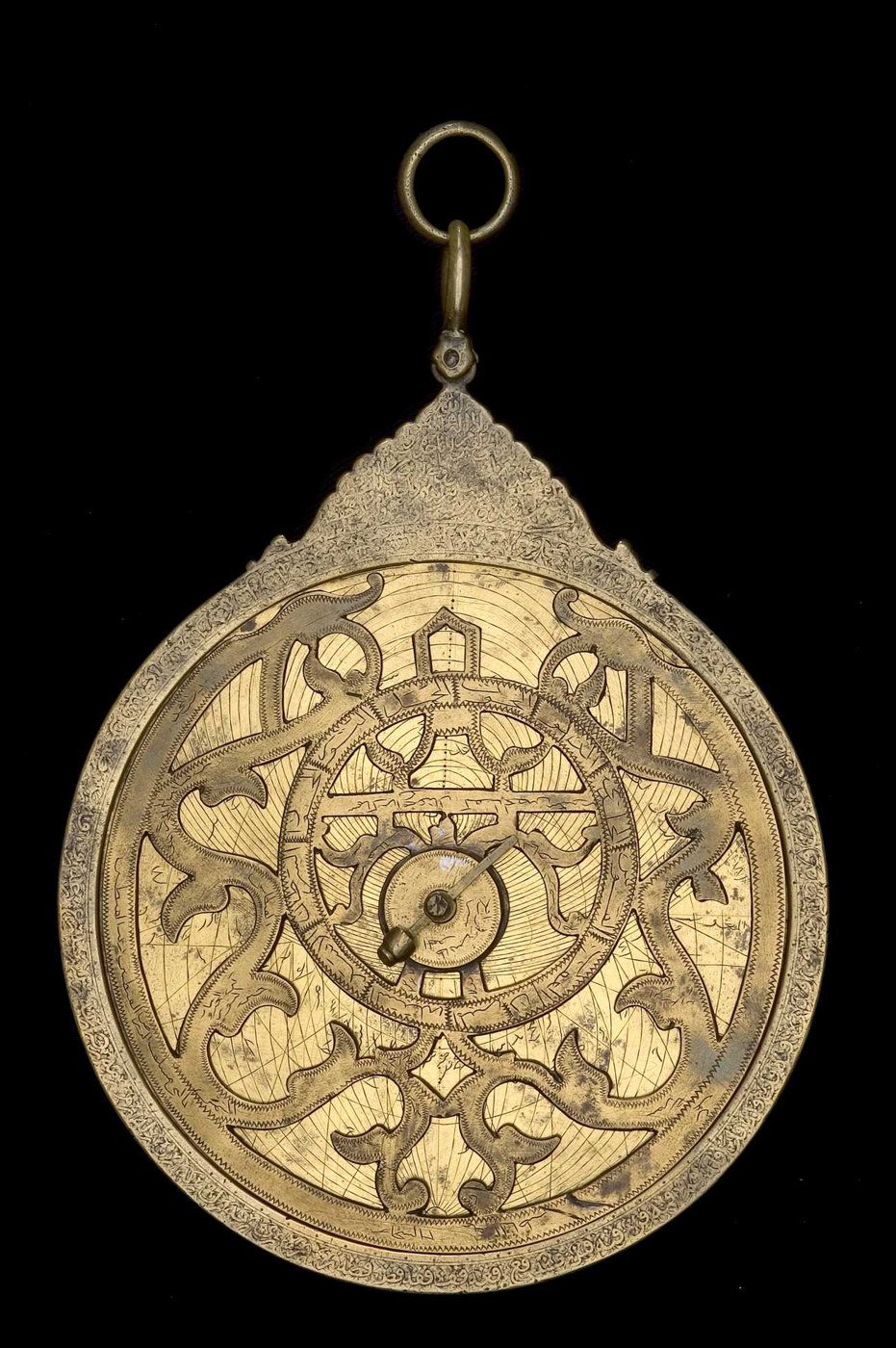
This brass astrolabe (inventory number 50122) is attributed to the maker Muḥammad Mahdī and dated to approximately 1650. It features an engraved, Indo-Persian style throne attached to an integrated base, accompanied by an omega-shaped shackle and a simple, round cross-section ring. The mater and limb are constructed from a single piece of brass, with a stationary plate tab at the instrument's base. The device includes a foliate, replacement rete featuring zodiac signs, as well as a non-original, double-ended alidade described as plain in appearance. The back is inscribed with a maker's signature identifying Muḥammad Mahdī al-Yazdī al-Khādim within a cartouche, and includes a devotional inscription at the bottom edge. Acquired in 1944, the instrument was formerly part of the collection of R. S. Clay. The piece shows replacement components including the rete and the rule.

Front view of the astrolabe showing the rete, throne, and degree scale.
Front view of the astrolabe showing the rete, throne, and degree scale. — History of Science Museum, University of Oxford. Rights pending — permission not yet requested. Original source

Catalogue identity

Source
www.mhs.ox.ac.uk
Category
Tool · Arabic-inscribed astrolabe, Iran
Maker / attribution
Muḥammad Mahdī
Reference
Not recorded
Catalogue / lot identifier
1944-1/579
Source-reported date
ca. 1650
Source-reported place
Persia
Source-reported serial
50122

Source-reported attribution and specifications are not independent authentication. A listing does not establish present ownership, current display, availability or permission to reproduce.

Object description

Structure and Throne

The astrolabe is constructed primarily from brass, featuring a mater and limb fabricated as a single-piece unit. A tab located at the base of the instrument serves to keep the internal plates stationary. The throne is fashioned in an engraved, Indo-Persian style and is attached to the body via an integrated base.

Supporting components include an omega-shaped shackle and a suspension ring characterized by a simple, round cross-section. The limb is marked with a circular, concentric degree scale ranging from 0 to 360 degrees, with intervals marked every 5 degrees.

Evidence for this section
  • “The mater and limb are of one-piece construction.”
  • “The throne is of the indo-persian, engraved type made of brass attached with integrated base made of brass”
  • “Shackle of the omega type (i.e. Ω-shaped shackle).”

Signature and Inscriptions

The reverse of the instrument features two distinct inscriptions. One is a formal maker's signature located within a cartouche, which identifies the creator as Muḥammad Mahdī al-Yazdī al-Khādim. A second inscription, positioned at the bottom edge of the back, conveys the sentiment that the purpose of the engraving is to ensure it remains after the maker.

The front of the instrument also bears an inscription, though the catalogue records that the content along the limb has become illegible. Religious text, identified as a Qur'anic verse, is present on the instrument.

Evidence for this section
  • “The back is inscribed: with a maker's signature marked as صنعه محمد مهدي اليزدي الخادم (...)”
  • “The aim of the engraving is that it should remain after me.”
  • “[The iscription along the limb has become illegible]”

Replacement Components

The instrument includes several parts noted as not being original to the primary manufacture. Specifically, the rete, which is of a foliate, plain type, is catalogued as a replacement and features a thick, soldered spacer at its center. This rete displays the zodiac signs in their standard order.

The rule and the double-ended alidade are also noted as replacements. The alidade is described as remarkably plain, rigid, and featuring single pinholes, distinguishing it from the primary metalwork of the instrument's main body.

Evidence for this section
  • “The rete is a replacement.”
  • “The rule is not original.”
  • “The alidade is remarkably plain.”

Open research questions

  • What is the specific composition of the brass alloy used for the mater versus the replacement rete?
  • Are there archival records identifying the specific London dealers from whom R. S. Clay acquired this instrument?

Source evidence

Recorded claims and source quotations for Astrolabe by Muḥammad Mahdī
FieldSource-reported valueSource quotation
MakerMuḥammad Mahdī“Maker Muḥammad Mahdī”
MaterialBrass“Material Brass”
Dateca. 1650“Date ca. 1650”
SignatureMuḥammad Mahdī al-Yazdī al-Khādim“صنعه محمد مهدي اليزدي الخادم (...) (Made by Muḥammad Mahdī al-Yazdī al-Khādim (= the servant) (…)).”
Inventory Number50122“Inventory no. 50122”
AcquisitionPurchased from R. S. Clay in 1944“Purchased from R. S. Clay in 1944”
Throne TypeIndo-Persian, engraved“The throne is of the indo-persian, engraved type”

Visible details

  • Foliate, replacement rete present
  • Plain, double-ended replacement alidade
  • Engraved Indo-Persian style throne
  • Omega-shaped shackle

Research qualifications

  • Rete and rule are identified as replacements by the cataloguer
  • Specific limb inscription is reported as illegible

Photograph identity and source facts were screened before import; rights clearance remains pending.

Consulted source

Astrolabe, inventory 50122 (Persia, ca. 1650)

Reviewed 2026-10-26 · Record 14c0e6de41

Terms in this record

Glossary explanations for terms named in this object’s record.