
Skip to content
The Encyclopedia of Horology

Tool · Arabic-inscribed astrolabe, Iran

Brass Astrolabe by Muḥammad Mahdī

Partially verified

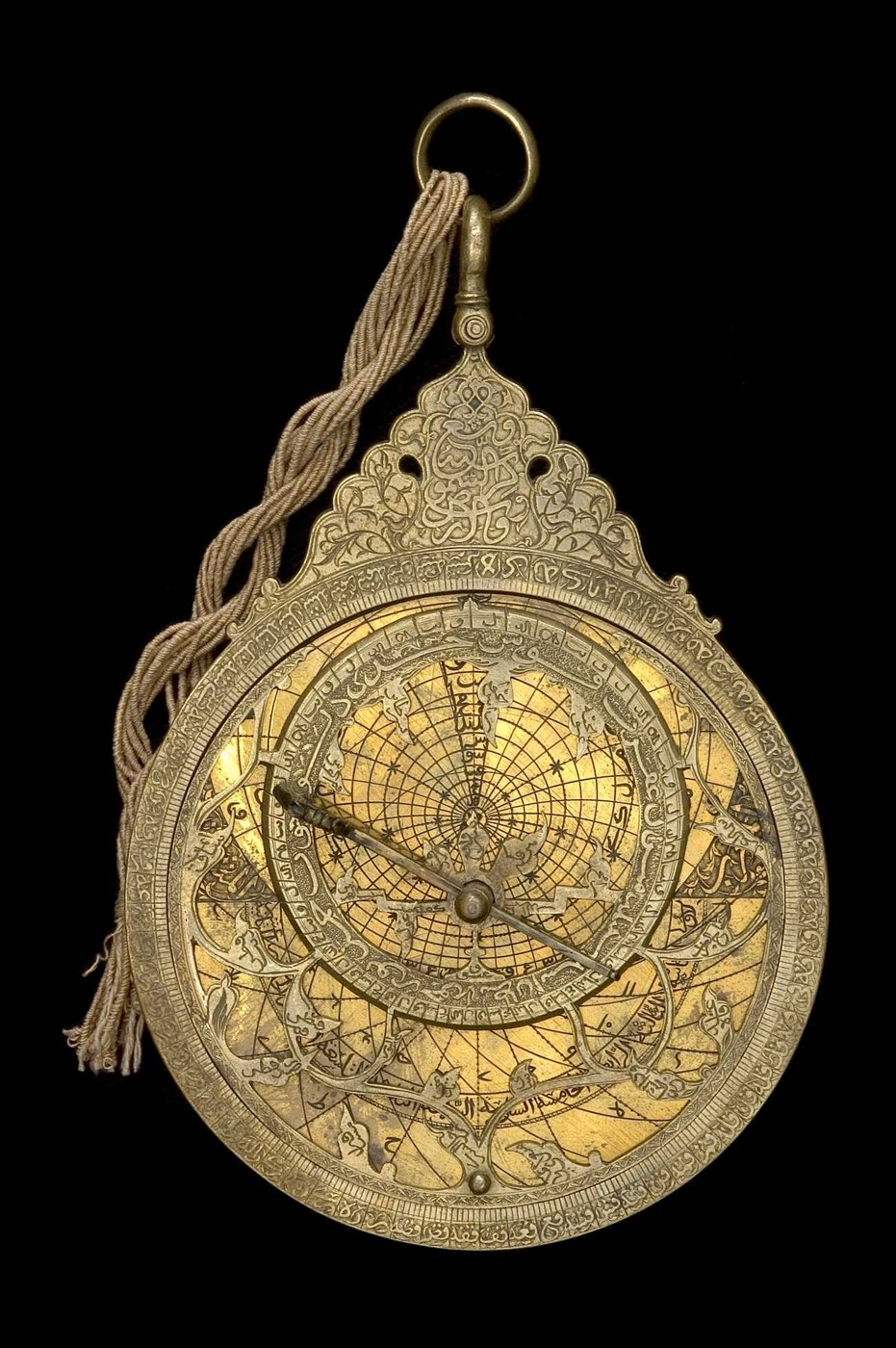
This brass astrolabe (inventory number 45581) is attributed to the maker Muḥammad Mahdī and dates to approximately 1660. The instrument features an Indo-Persian pierced-style throne with an integrated base, a simple round ring, and an omega-type shackle. The mater and limb are constructed as one piece, with the limb featuring a 0-360 degree scale marked at five-degree intervals and an inscription listing the twelve Shiite Imams. The reverse is decorated with an embossed foliate pattern and includes an altitude scale, a shadow square, and a cartouche with an inscription regarding the purpose of the engraving. The rete is of the foliate single-knob type, and the instrument is supplied with five plates covering latitudes between 22 and 45 degrees. It is held in the collection of the History of Science Museum, Oxford, having been presented by J. A. Billmeir in 1957.

Front view of the brass astrolabe (inventory 45581) showing the rete, limb, and throne.
Front view of the brass astrolabe (inventory 45581) showing the rete, limb, and throne. — History of Science Museum, University of Oxford. Rights pending — permission not yet requested. Original source

Catalogue identity

Source
www.mhs.ox.ac.uk
Category
Tool · Arabic-inscribed astrolabe, Iran
Maker / attribution
Muḥammad Mahdī
Reference
Not recorded
Catalogue / lot identifier
45581
Source-reported date
ca. 1660
Source-reported place
Persia

Source-reported attribution and specifications are not independent authentication. A listing does not establish present ownership, current display, availability or permission to reproduce.

Object description

Construction and Design

The astrolabe is crafted primarily from brass, featuring a pierced, Indo-Persian style throne. This component is fitted with an integrated base and supports a simple ring with a round cross-section, which connects to an omega-shaped shackle. The main body consists of the mater and limb constructed as a single unit.

The limb is marked with a degree scale spanning 0 to 360 degrees, partitioned into five-degree increments. The instrument's rete is of the foliate single-knob design, while the accompanying five plates provide latitude coverage ranging from 22 to 45 degrees.

Evidence for this section
  • “The throne is of the indo-persian, pierced type made of brass attached with integrated base”
  • “The mater and limb are of one-piece construction”
  • “The rete is of the foliate (single knob) type.”
  • “The horse is unusually long.”

Inscriptions and Signatures

The instrument is highly inscribed. The limb carries a detailed inscription around its edge that lists the twelve Shiite Imams, beginning with Muḥammad and concluding with the hidden Imam, Muḥammad al-Mahdī.

On the back of the instrument, a cartouche positioned beneath the shadow square contains the phrase regarding the aim of the engraving. The maker's signature, "Embellished by Muḥammad Mahdī al-Yazdī," is found along the bottom edge of the back.

Evidence for this section
  • “The limb is inscribed: with a miscellaneous marked as اللهم صلى على محمد المصطفى”
  • “The back is inscribed: with a miscellaneous marked as غرض نقشيست كه تا باز ماند”
  • “with a maker's signature marked as نمقه محمد مهدي اليزدي (Embellished by Muḥammad Mahdī al-Yazdī)”

Components and Provenance

The astrolabe includes an alidade, which has been identified as a later replacement. This is based on the absence of both decorative elements and standard astronomical scales, which contrast with the finish on the original components.

The astrolabe was acquired by the History of Science Museum in 1957 as a gift from J. A. Billmeir, who had previously acquired the object during the period 1955-1957. Prior to Billmeir's ownership, the instrument was held in the collection of Henri Michel in Brussels.

Evidence for this section
  • “The rule is not original. The lack of decorative elements on the rule as well as the absence of scales suggest that this is a later replacement.”
  • “Presented by J. A. Billmeir in 1957”
  • “It was previously in the collection of Henri Michel, of Brussels.”

Open research questions

  • What specific stylistic markers identify the throne as 'Indo-Persian' compared to purely Persian or Indian designs?
  • Can the specific identity of the 'rule' replacement be traced to a particular period of maintenance or restoration?

Source evidence

Recorded claims and source quotations for Brass Astrolabe by Muḥammad Mahdī
FieldSource-reported valueSource quotation
MakerMuḥammad Mahdī“Maker Muḥammad Mahdī”
Inventory Number45581“Inventory no. 45581”
Dateca. 1660“Date ca. 1660”
MaterialBrass“Material Brass”
ProvenancePresented by J. A. Billmeir in 1957“Presented by J. A. Billmeir in 1957”
InscriptionList of twelve Shiite Imams on limb“Note: This is a list of the twelve Shiite Imams”
SignatureEmbellished by Muḥammad Mahdī al-Yazdī“نمقه محمد مهدي اليزدي (Embellished by Muḥammad Mahdī al-Yazdī)”
AlidadeDouble-ended and not original“The rule is not original.”

Visible details

  • Throne is pierced Indo-Persian type with integrated base
  • Rete is of foliate single-knob type
  • Rule appears to be a later replacement lacking decorative elements
  • Omega-shaped shackle attached to a simple round ring

Research qualifications

  • Rule is identified as a likely later replacement
  • The 'families' inscription on the limb is marked with a question mark in the source documentation

Photograph identity and source facts were screened before import; rights clearance remains pending.

Consulted source

Astrolabe, inventory 45581 (Persia, ca. 1660)

Reviewed 2026-10-26 · Record 2ae758744c

Terms in this record

Glossary explanations for terms named in this object’s record.